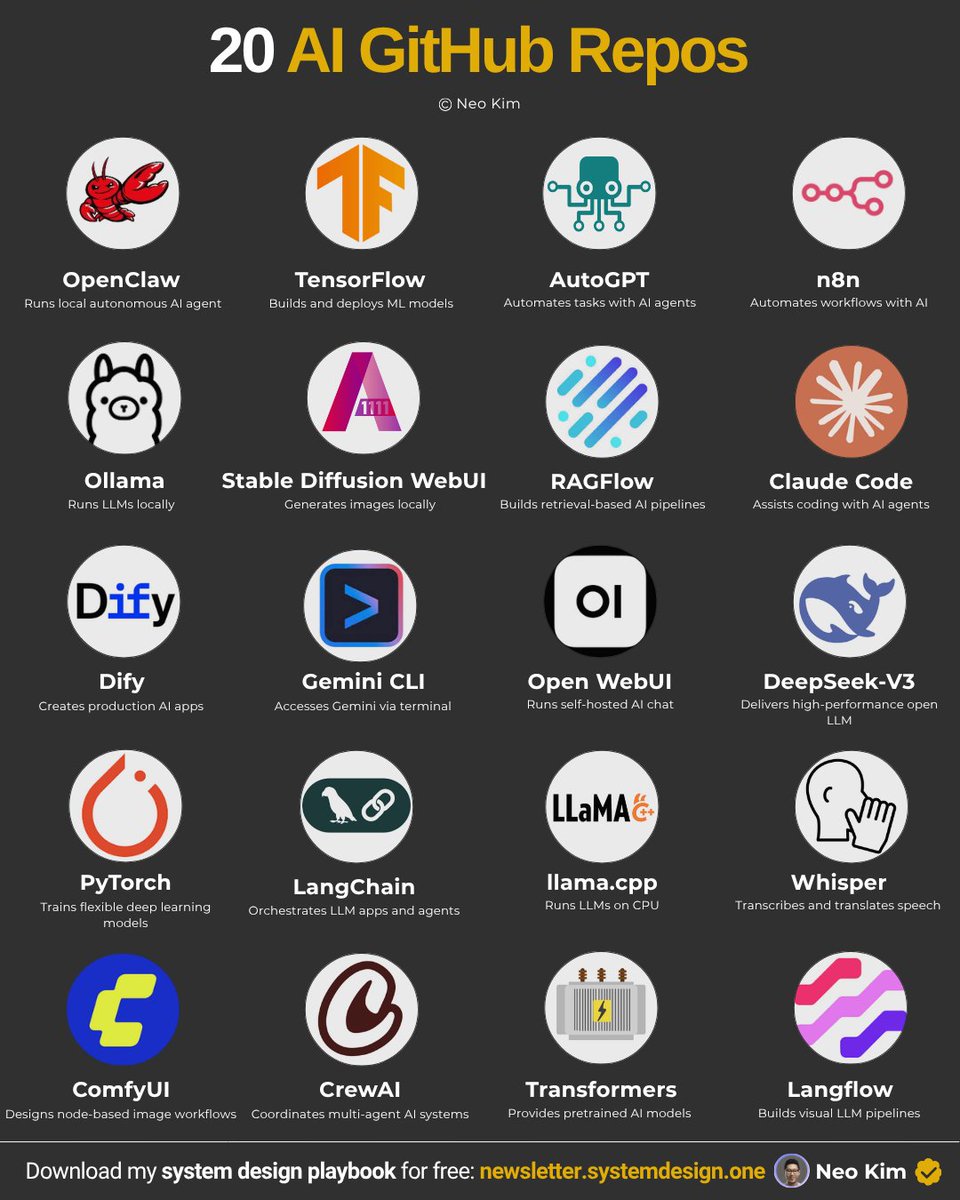
20 useful AI GitHub repos every software engineer should bookmark (you'll thank me later):
1 OpenClaw
↳ Runs a personal AI agent locally that can browse, plan & take actions on your device.
2 TensorFlow
↳ Provides a production-ready framework to build, train & deploy ML models at scale.
3 AutoGPT
↳ Automates multi-step tasks by chaining LLM reasoning into autonomous agents.
4 n8n
↳ Automates workflows with a visual builder that integrates APIs, data & AI tools.
5 Ollama
↳ Runs open LLMs locally with simple commands & optimized performance.
6 Stable Diffusion WebUI
↳ Generates images locally with a powerful UI for Stable Diffusion models.
7 Hugging Face Transformers
↳ Offers thousands of pretrained models for NLP, vision & multimodal AI tasks.
8 Dify
↳ Creates production-ready AI apps with built-in orchestration, prompts & APIs.
9 Langflow
↳ Builds & tests LLM pipelines visually using a drag & drop interface.
10 LangChain
↳ Orchestrates LLM workflows, tools, memory & agents in applications.
11 Open WebUI
↳ Delivers a self-hosted ChatGPT-style interface with local & API model support.
12 DeepSeek-V3
↳ Provides a high-performance open-weight LLM optimized for reasoning & coding.
13 PyTorch
↳ Builds & trains deep learning models with flexible, research-friendly APIs.
14 Gemini CLI
↳ Interacts with Google’s Gemini models directly from command line.
15 llama cpp
↳ Runs LLaMA-style models efficiently on CPUs & local hardware.
16 Whisper
↳ Transcribes & translates speech with high accuracy using deep learning.
17 ComfyUI
↳ Designs advanced image generation workflows using node-based pipelines.
18 CrewAI
↳ Coordinates multiple AI agents to collaborate on complex tasks.
19 RAGFlow
↳ Implements retrieval-augmented generation pipelines for enterprise search & QA.
20 Claude Code
↳ Assists coding with deep repository understanding & agent-style workflows.
What else should make this list?
===
1 Save & RT to help others learn AI engineering.
2 Follow @systemdesignone + turn on notifications.
My brain broke when I read this paper.
A tiny 7 Million parameter model just beat DeepSeek-R1, Gemini 2.5 pro, and o3-mini at reasoning on both ARG-AGI 1 and ARC-AGI 2.
It's called Tiny Recursive Model (TRM) from Samsung.
How can a model 10,000x smaller be smarter?
Here's how it works:
1. Draft an Initial Answer: Unlike an LLM that writes word-by-word, TRM first generates a quick, complete "draft" of the solution. Think of this as its first rough guess.
2. Create a "Scratchpad": It then creates a separate space for its internal thoughts, a latent reasoning "scratchpad." This is where the real magic happens.
3. Intensely Self-Critique: The model enters an intense inner loop. It compares its draft answer to the original problem and refines its reasoning on the scratchpad over and over (6 times in a row), asking itself, "Does my logic hold up? Where are the errors?"
4. Revise the Answer: After this focused "thinking," it uses the improved logic from its scratchpad to create a brand new, much better draft of the final answer.
5. Repeat until Confident: The entire process, draft, think, revise, is repeated up to 16 times. Each cycle pushes the model closer to a correct, logically sound solution.
Why this matters:
Business Leaders: This is what algorithmic advantage looks like. While competitors are paying massive inference costs for brute-force scale, a smarter, more efficient model can deliver superior performance for a tiny fraction of the cost.
Researchers: This is a major validation for neuro-symbolic ideas. The model's ability to recursively "think" before "acting" demonstrates that architecture, not just scale, can be a primary driver of reasoning ability.
Practitioners: SOTA reasoning is no longer gated behind billion-dollar GPU clusters. This paper provides a highly efficient, parameter-light blueprint for building specialized reasoners that can run anywhere.
This isn't just scaling down; it's a completely different, more deliberate way of solving problems.
🚀 We just launched a service that turns any GitHub repo into an easy-to-understand tutorial.
🤔 Got a complex codebase you want to get your head around? It's dumb simple to use:
1. Paste the GitHub link.
2. Our AI figures out the important stuff and builds a tutorial.
3. In ~5 minutes , you get a clear, step-by-step guide.
🛠️ This is built on our open-source project that already has 8K+ GitHub stars. You might have seen my YouTube videos on its development or the podcast with Angel Poon – which together hit 100K+ views! All that enthusiasm made us realize we needed to make this even easier for everyone.
💡 So, we built this service. ZERO setup. Just paste a link and it works.
👇 Link to try it is in the comments. Let me know how it goes!
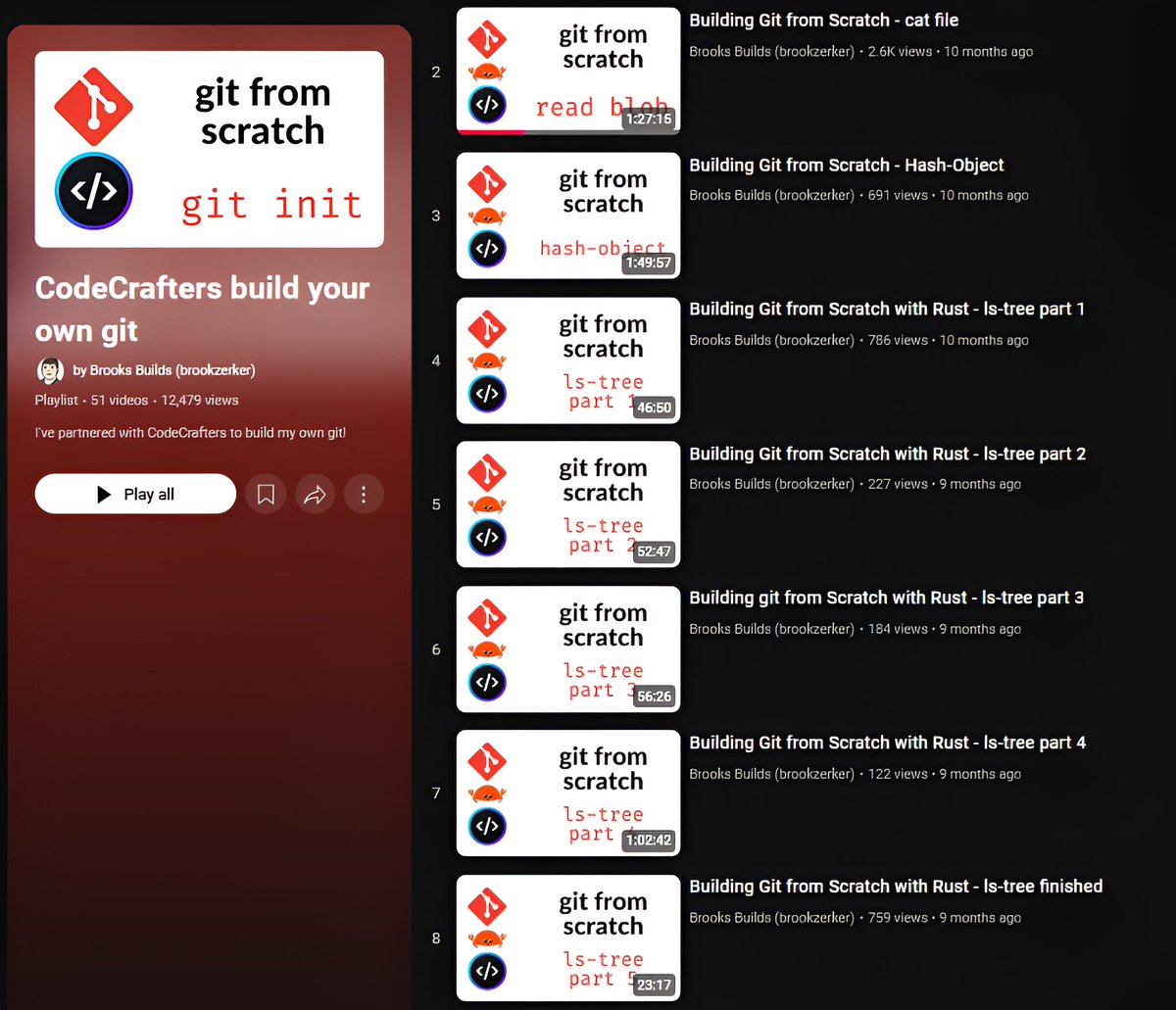
Build Your Own "Git" In C From Scratch
-really great playlist, use this to get most out of this.
-it's great if someone wants to understand how really "Git" works behind the scenes.
-it would give you solid foundation for "Low level system programming".
-don't watch completely, it's quite long, just do what you need.
-learn as you require concepts that you need.
🔘 AI Course: Self-Driving Cars
This course covers the most dominant paradigms of self-driving cars: modular pipeline-based approaches as well as deep-learning based end-to-end driving techniques.
🔗https://t.co/VZuUNQfcDO
👉 DeepLearn Implementation
This repository contains implementation of some popular research papers on Natural Language Processing, Computer Vision, ML, and Deep Learning.
🔗https://t.co/xA3qkuYuPa
LLMOps, a new course with @GoogleCloud is available now.
Learn Large Language Model Operations (LLMOps) best practices as you design and automate the steps to tune an LLM for a specific task and deploy it as a callable API.
Learn more and enroll now: https://t.co/An0gqMvDRr
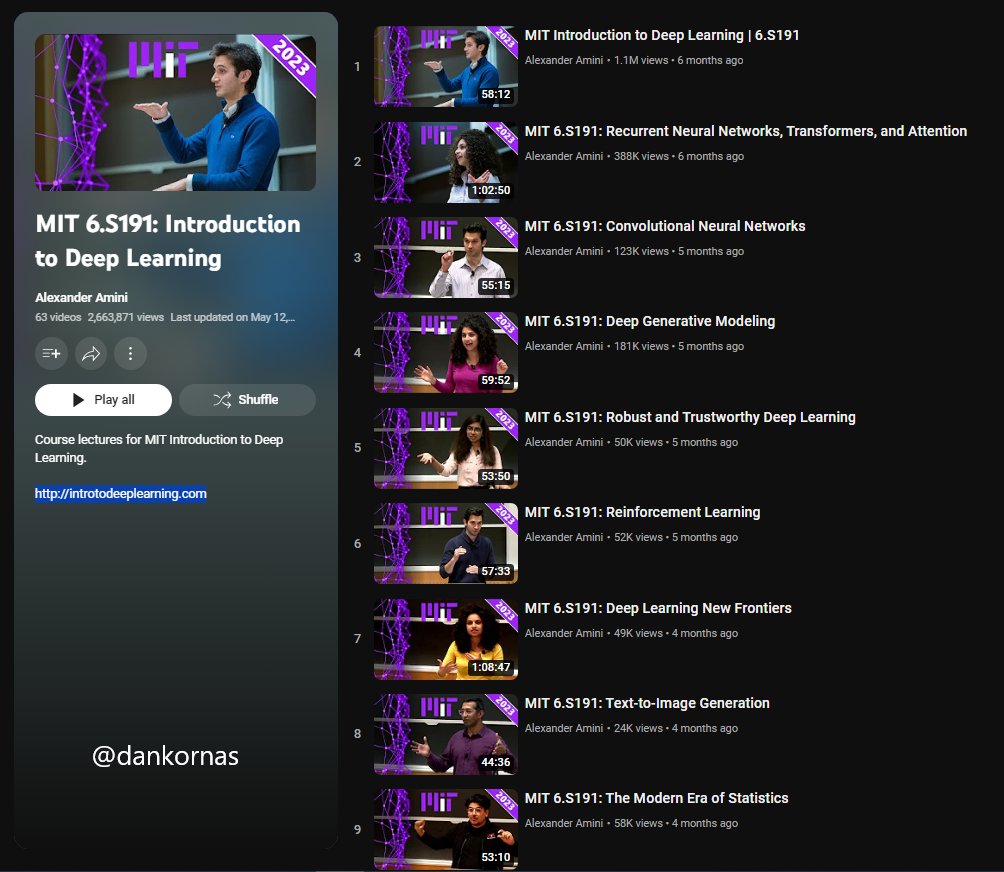
👉 Introduction to Deep Learning by @MIT
An efficient and high-intensity bootcamp designed to teach you the fundamentals of deep learning as quickly as possible.
🔗https://t.co/AkA6bVAOME
👉 From Zero to AI Research Scientist Full Resources Guide
This guide is for anybody with basic programming knowledge interested in becoming a Research Scientist in Deep Learning and NLP.
🔗 https://t.co/cseX6xDaVG