If you allow AI to do all of your tasks, you are giving up your agency. Period. There is NO WAY for you to check their work. None. Especially if you're not a top-notch coder.
The end product will be a culmination of data training and work, yes, but will it be your work? Will it be what you intended? Will there be injected 'ideas'?
I used to think that as long as it was MY IDEA, then it any prompt I would give to an agent would yield an end product that would be my work, from my idea.
I don't think that anymore.
@brownstoneinst@jeffreytucker
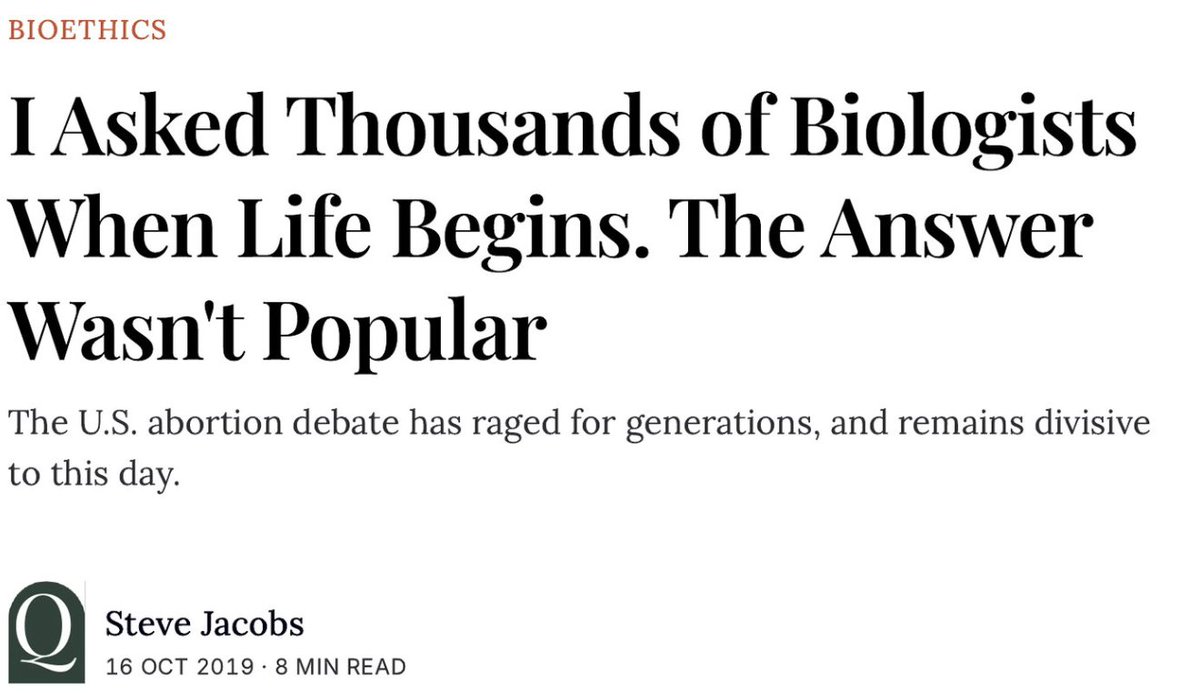
A University of Chicago researcher surveyed 5,577 mainly pro-choice biologists, asking one question: when does life begin? 96% said at fertilization.
Then they found out the survey was about abortion.
They'd accidentally given the pro-life answer.
Here's what happened next:
🧵THREAD: There can be no just future without confronting the crimes of the past.
Remember when they cancelled cancer screenings while performing ridiculous dance routines?
Those responsible still walk free, while many of us who spoke out continue to pay the price.
Here are 20 reminders of what they did to us during COVID.
Please share. Never forget. Demand justice. ⬇️
If, after everything we've seen for the last six years, you're still falling for the official government narrative out of Iowa today — just delete your account. You're not going to make it. Government lies about everything because you are the feedstock they exploit for profit.
How long do you think you can systematically degrade and tax the pipeline that gives you good quality physicians and not expect these things from happening?
We’ve got great baseball players.
So you’ll be entertained while in the hospital bed.
As a teacher, I think several things are happening here. Here are a few:
1. Too many schools still don't teach phonics, even though the cognitive science of early reading has been settled for almost 30 years. Schools and teachers are still using inquiry-learning methods like "balanced literacy" that allow for more student choice, instead of a structured, systematic phonics program led by a teacher. In fairness to them, many teachers' colleges discourage phonics teaching for ideological reasons: they don't like the idea of teachers as a "sage on the stage" preferring instead a "guide on the side," even when research indicates the kids would benefit from being taught by such a sage.
2. Even once kids have learned to decode words, we aren't getting them to read very much content anymore. Knowledge-rich textbooks are basically gone in most schools now, as are challenging, high-lexile level novels. They've been replaced with online research tools, short text excerpts, and video lessons that emphasize a kind of proto-critical thinking or social-emotional learning approach without providing enough context for students to really engage thoughtfully with the material. This means kids lack the background knowledge and vocabulary they need to help them comprehend new texts, and it reduces their overall capacity to reason.
Plus, many schools have given up on assigning regular reading homework. This worsens the general cultural problem of replacing of the habit of reading for pleasure with the habit of watching short videos on phones.
3. While there's always a place for special education, we've tend to over-accommodate student learning needs instead of actually addressing causes them--which we often could, if only we'd introduce more discipline and structure into our classes and schools. For example, a student with ADHD who is having trouble learning how to read may be allowed to listen to questions read aloud to him on standardized tests, but we won't do what it takes to provide him with a quiet, orderly classroom that would better enable him to focus so he could learn to read in the first place.
4. Student absenteeism is way up since COVID, including for long visits to see family overseas during the school year. While you can understand that it's expensive to travel with family during school holidays, missing six weeks of Grade One is disastrous for most kids' basic phonics learning, especially if they are learning English as a Second Language, and they almost always struggle to catch up. But there's a real reluctance to push parents on it because schools don't want to appear insensitive.
I could go on--and likely will!--but suffice it to say we have real problems, some of which are cultural and hard to resolve, but others which are completely in schools' control and that we should be prioritizing fixing ASAP.
Perhaps one of the most unlikely developments of the last ten years has been the rise in demand for autism diagnoses. So much so that many are prepared to wait for years or pay thousands of pounds. It has become a diagnosis of desire.
This is not something (as far as I know) that has happened in psychiatry before. No one goes on a waiting list of several years for a diagnosis of schizophrenia or bipolar, knowing that they will be discharged directly after assessment. We do not have private clinics set up just to diagnose OCD, PTSD or social anxiety, for which people pay themselves.
Yet for autism, we do. There’s no treatment, so it’s the diagnosis itself which is desirable. The more demand rises, the more clinics are opened up, and yet the waiting lists continue to rise.
Much of what we call autism in 2026 is a cultural phenomenon disguised as a neurodevelopmental disorder. When there’s a huge social shift like this, we have to start asking why.
Friends, human rights do not come from government or a higher class, and they do not well up from below. They come from God.
If they didn’t, they would be alienable: by society, by government, by elites, or by whoever happens to hold power.
Watch how this played out in the totalitarian societies of the last century, which were explicitly hostile to religion: Nazi Germany, Soviet Russia, Communist China. Bastions of human rights? On the contrary.
Take God out of the equation, and our rights evanesce.
We knew how to teach children more effectively decades ago. Yet the evidence was buried, and generations of students were denied the education they deserved. The consequences reach far beyond the classroom.
At the start of COVID the first strange sign that something wasn't adding up was finding no patients.
Thirty years of emergency medicine across multiple hospitals I had never gone to work and done nothing.
Then I had 14-hour night shifts with an empty waiting room.
Meanwhile, CBC news were calling doctors heroes, describing overloaded hospitals and people dying.
The difference was too obvious to ignore.
People think that physicians grow on trees. There is a huge amount of delayed gratification and impulse control that needs to be exercised for a physician to go through the process that it takes to become a physician.
By the time you are 25 to 30 years of age. Your colleagues that decided to do something else are usually middle managers with good packages and have good offices.
You on the other hand are at the bottom of the totem pole as a resident working long hours, being paid barely above minimum wage and having laws written to limit your work to 80 hours a week for patient’s safety (not yours).
Nobody does that unless there is something at the end.
By the time you are 32 years of age, you’re just getting out into practice by this point your friends have already had kids and some of them are making far more than you are while you have close to $200k to $300k maybe even half $1 million of debt. That will be even more now because of HR1 that limited government backed loans making it more difficult to pay back.
CMS just cut Physician reimbursement.
Now people are waking up to the fact that we don’t have enough physicians to staff all of the intensive care units in the United States.
Yes, telemedicine is a way to bridge that. Don’t blame that. Blame the irresponsibility that got us here in the first place.
Pro tip: The government's lead detection equipment will always read 0.0 ppm when the equipment is intentionally mis-calibrated or the air intake is clogged.
If you believe the government is reporting the truth about the lead bomb explosion, you're officially a retard. In the former Soviet Union, following the Chernobyl disaster, USSR government officials simply turned off the sensors. So did Japanese officials following the Fukushima disaster in 2011. While this lead azide detonation isn't believed to involve nuclear materials and it's not anywhere near the danger of a nuclear reactor meltdown, if you think the U.S. government wouldn't simply TURN OFF THE SENSORS, then you are absurdly gullible and you need to recalibrate your understanding of government deception and malfeasance.
Your great-grandmother likely hosted dozens of people in a house half the size of yours. No caterer. No group text to coordinate who's bringing what. She just cooked for three days and opened the door.
Now you've got 3,000 square feet, a double oven, and you're "not sure we can host this year."
You can host. You don't want to. Because hosting means you'll be welcoming your loud-mouth uncle, that one family member who always seems a bit arrogant and pompous, and maybe even your mom who'll make comments about the way you're raising your kids. It means mess and tension and real people in your space being real.
Good. Let them come.
A patriarch opens his doors. He doesn't curate a guest list from his own bloodline. He sets the Christ-centered tone of the house, he reads Scripture before the meal, he seats the 15 year-old nephew next to the 45 year-old uncle and the 75 year-old grandfather makes them talk. That's the job.
The American family doesn't need fewer people at the table. It needs a man at the head of it who isn't afraid of his own relatives.
Make the American extended family great again. Bring them home and lead as a patriarch.
Will it be easy? No.
Is it a worthy goal? Yes.
Deus Vult ⚔️