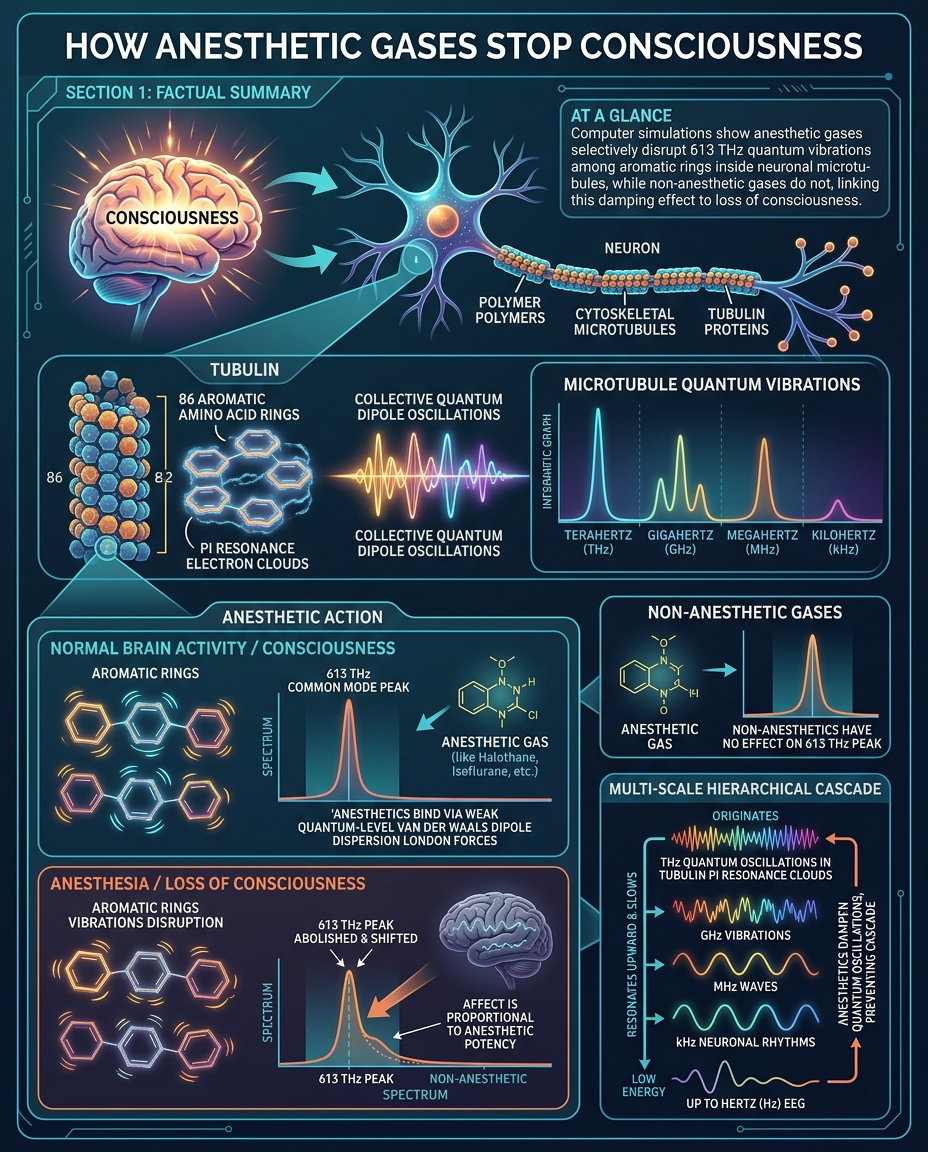
The standard advice on consciousness assumes it starts with hertz waves. But a 613 terahertz quantum cascade inside your microtubules is the real starting point.
Think of this as a high-speed master clock buried within the protein tubulin. Inside the electron clouds of these proteins, 86 aromatic rings vibrate in a collective quantum dance at exactly 613 terahertz.
This incredibly fast vibration serves as the fundamental note for the rest of your biology. It does not stay isolated at that microscopic scale; instead, it resonates upward through the entire structural architecture of the neuron.
As the energy moves from the quantum level to the physical structure of the cell, the frequency slows down. It steps through a hierarchy, moving from terahertz to gigahertz, then megahertz, and eventually into the hertz waves seen on a standard brain scan.
Anesthetic gases disrupt this process by binding to these electron clouds with weak quantum-level forces. This interaction dampens the 613 terahertz peak, shifting the vibration and effectively silencing the master clock.
It is like placing a steady finger on a vibrating violin string. By muting that initial high-frequency oscillation, the anesthetics prevent the resonance from ever reaching the slower frequencies necessary for awareness.
This perspective shifts the focus away from simple electrical firing. It suggests that consciousness is the end result of a precise, multi-scale synchronization that begins with the movement of subatomic dipoles.
The physics of the mind runs much deeper than we thought.
https://t.co/yY0EFRCQ64
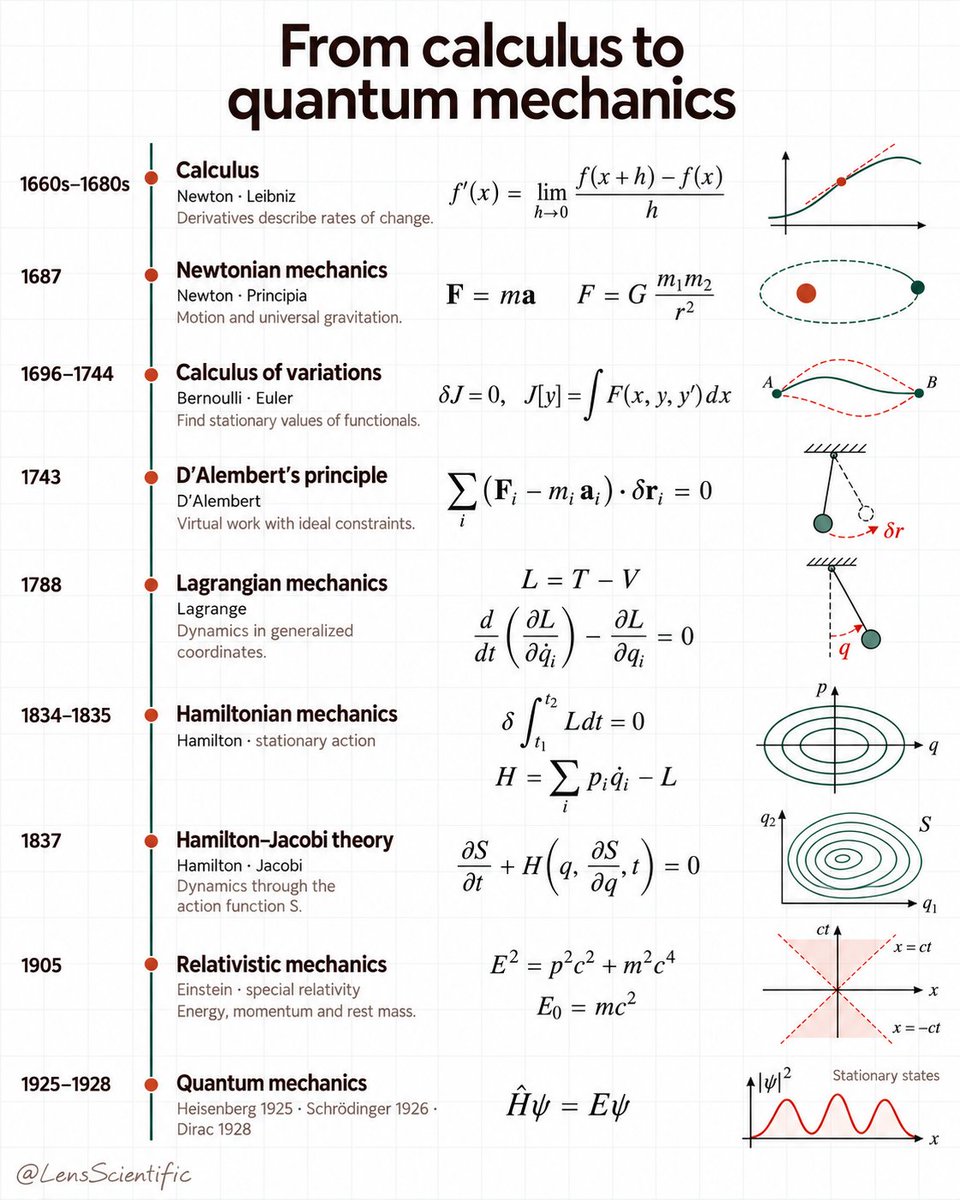
A Brief History of Mechanics
Calculus gave physicists a language for change. Newton used it to connect falling objects and planetary orbits through the same laws of motion and gravity. Lagrange and Hamilton recast mechanics using energy and action, making complex systems easier to describe.
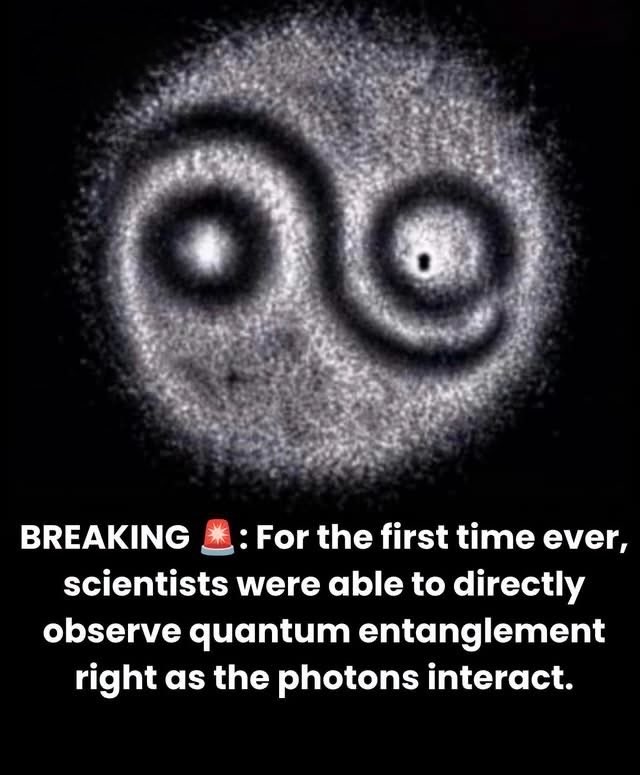
🚨 SCIENTISTS JUST CAPTURED AN IMAGE OF A QUANTUM MYSTERY
For decades, scientists have known that two particles can become entangled, meaning their quantum states can remain connected even when the particles are separated. But there has always been a fascinating question: can we actually see what this strange connection looks like?
Now, physicists have created images that reveal the interference pattern produced by entangled photons.
The image does not show two photons physically connected by some invisible thread. Instead, it shows the pattern of probabilities created by their quantum behavior. Bright and dark regions appear as different probability amplitudes combine, strengthen each other, or cancel each other out.
It is similar to what happens when waves overlap. In some places they add together and become stronger. In others, they cancel out. But here, the pattern comes from quantum probabilities rather than ordinary water or sound waves.
What makes the experiment so interesting is that scientists are getting a more direct view of the correlations within an entangled quantum state. Normally, researchers have to perform many measurements and use the results to reconstruct what is happening.
This kind of imaging could make complicated quantum states easier to study and control. In the future, techniques like this could be useful in areas such as quantum computing, quantum communication and highly precise measurements.
And there is something genuinely strange about the picture.
It isn’t a photograph of an invisible connection between two particles. It is a picture of what their quantum possibilities look like when they interfere.
At the smallest scales, nature does not behave like the familiar objects we see around us. Particles can exist in quantum states where probabilities interfere, outcomes become correlated, and patterns emerge that have no simple everyday equivalent.
For something we cannot see with our eyes, the fact that its behavior can now be turned into an image is remarkable.
Source: Scientific Reports / Physical Review Letters
EVERYONE USES GOOGLE MAPS.
But almost nobody uses it right. Most people type an address, hit "Directions," and call it a day.
Meanwhile Maps is sitting on features that can save you time, gas, arguments, and the occasional scare.
Here are 8 features you need to know:🧵
Nobody trolls better than Trump. 😂🤣
TRUMP: So an Israeli plumber, never flew a plane, strong guy, lift him up, throw him back. They knew they were going to die shortly bc of the G-forces, but they were able to hold him bc he was going crazy.
And this plumber, never having flown a plane, had the sense to lift the stick.
And when I asked why he did that, he said he watches that show, Air Disasters. You know the show? It's that crazy show.
He said he watches it a lot and he learned from watching that show sort of how to fly. I mean, you tell me. This is the craziest thing.
Now, this is the story that I heard. I don't know "if it's true", but that's the story that I got from Bibi (Netanyahu).
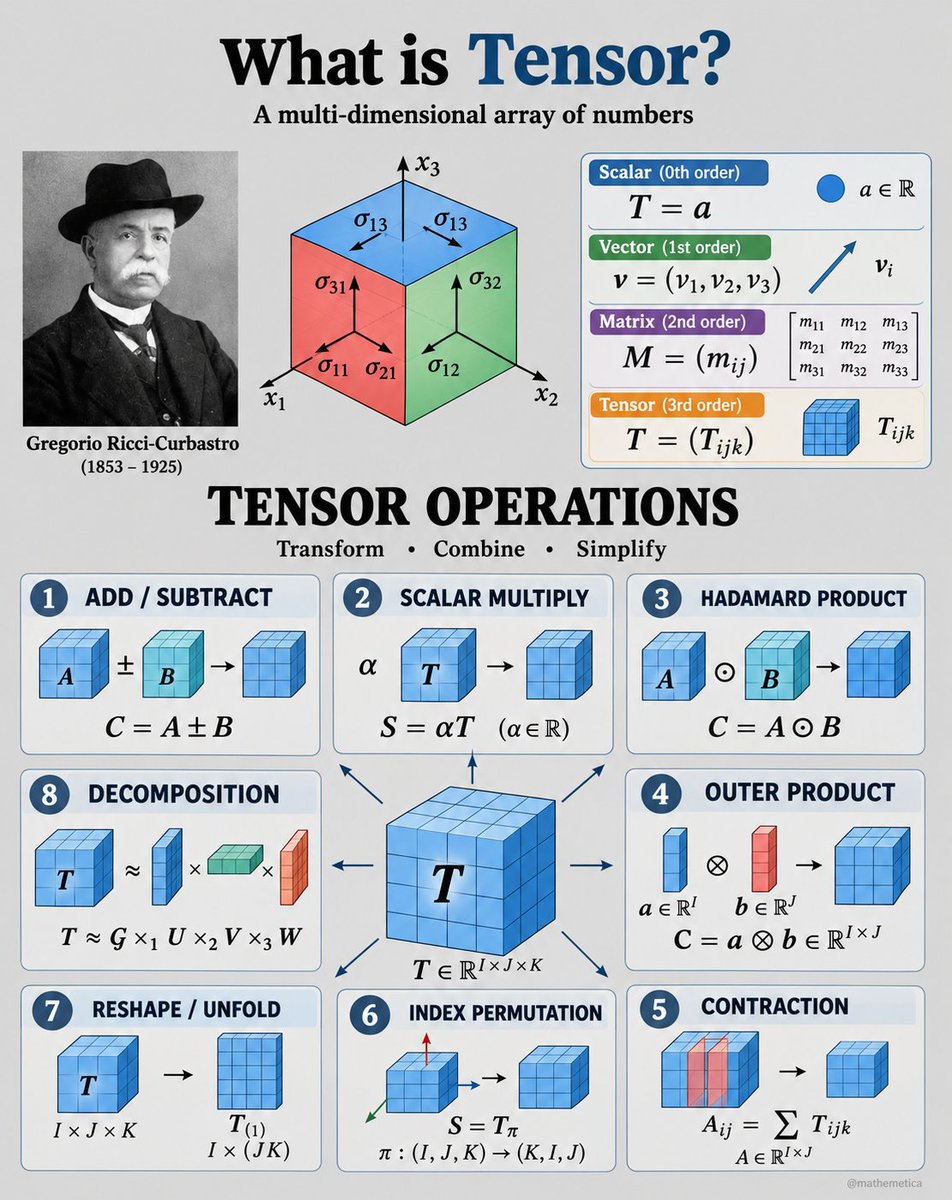
Nine components, σ₁₁ through σ₃₃, already decide how a solid will stretch, shear, or twist when forces meet its faces.
That array is a tensor of order two: rotate the axes and its entries mix according to a fixed rule, so the predicted force is unchanged.
Gregorio Ricci-Curbastro, with Tullio Levi-Civita, made this transformation law the starting point of the absolute differential calculus in their 1900 memoir. A scalar is the order-zero case, a vector the order-one case; one further index yields an order-three array T_ijk.
THE MIT PROFESSOR WHOSE CALCULUS STUDENTS SAY NO ONE HAS EVER MADE THEM FEEL MORE CAPABLE INTRODUCES LINE INTEGRALS BY PROVING THAT SOMETIMES THE GEOMETRIC INSIGHT SOLVES IN THREE LINES WHAT THE CALCULATION TAKES HALF A BLACKBOARD TO FINISH
This is Denis Auroux, MIT, 18.02 Multivariable Calculus, Fall 2007. His students consistently rank him among the most beloved teachers in the mathematics department. He opens with one claim - vector fields and line integrals are completely different from double integrals and it actually helps to forget everything from last week.
He starts with vector fields. At every point in the plane you have a vector. Wind maps are vector fields. Gravitational fields are vector fields. The field xi plus yj points radially outward from the origin and grows with distance. The field minus yi plus xj rotates everything counterclockwise at unit angular velocity. A particle of fluid in that field traces a perfect circle and returns to its starting point in exactly two pi units of time.
Then work. When a force pushes a particle along a trajectory the work done is the force dotted with the displacement. For a straight line and constant force this is simple multiplication. For a curved trajectory where the force changes at every point you cut the path into infinitely many tiny pieces, dot the force with each tiny displacement, and sum. That sum is the line integral.
Then computation. Parameterize the curve with a single variable. Express x and y in terms of that variable. Replace dx and dy with their derivatives times dt. The two-dimensional integral collapses into a single ordinary integral you already know how to solve.
Then the geometric shortcut. The line integral equals the integral of the tangential component of the force along the curve. If the force is always perpendicular to the curve the work is zero with no calculation needed. The field xi plus yj on a circle of radius a gives zero immediately because the radial force is always perpendicular to the circular path. The field minus yi plus xj on the same circle gives two pi a squared immediately because the force always points exactly along the path with magnitude a.
Watch the moment he computes the same integral two ways side by side. The geometric method takes three lines. The parametric method takes half a blackboard. Same answer. The insight about perpendicularity or parallelism does in seconds what algebra does in minutes.
A mechanical engineering student I know rewatched this lecture before a problem set on conservative force fields. Said it was the first time the dot product felt like it was measuring something physical rather than producing a number.
In three-dimensional space the determinant of a matrix whose columns are three vectors equals the signed volume of the parallelepiped those vectors span; changing the middle column so the base parallelogram doubles in area while height stays fixed therefore yields a volume of two cubic units.
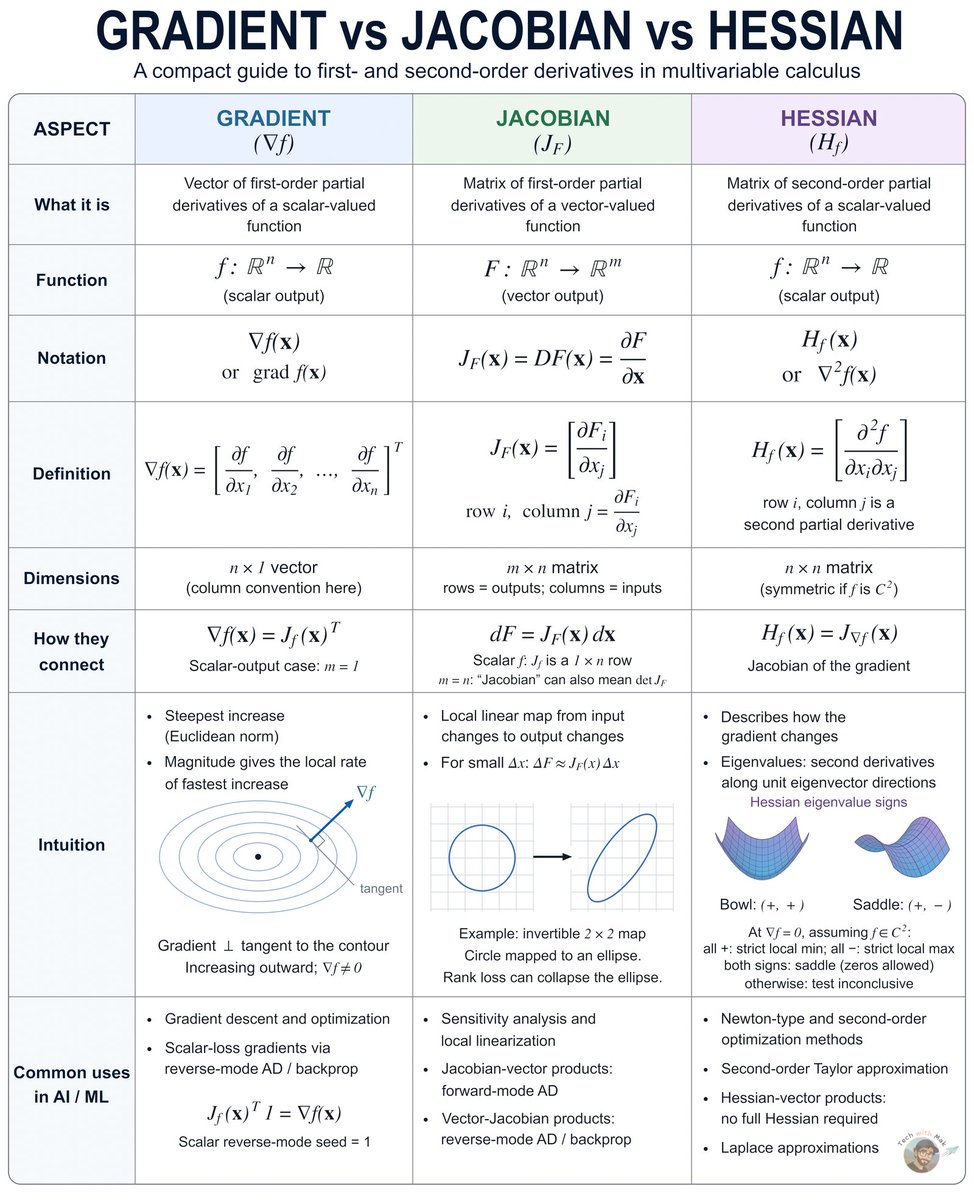
This math sits underneath nearly every AI model being trained right now.
Gradient. Jacobian. Hessian.
Three words that look intimidating at first. But they are really just three ways of measuring change.
(Throughout, assume the functions are smooth enough to differentiate.)
𝟭./ 𝗚𝗿𝗮𝗱𝗶𝗲𝗻𝘁 ∇f
Takes a scalar function:
f : ℝⁿ → ℝ
Returns a vector of n first-order partial derivatives (written as a column here).
It answers:
"Which direction makes f increase fastest?"
That is why gradients are central to optimization.
Gradient descent steps in the opposite direction, because the gradient points uphill.
Backpropagation is how we compute gradients efficiently during training.
𝟮./ 𝗝𝗮𝗰𝗼𝗯𝗶𝗮𝗻 J_F
Takes a vector-valued function:
F : ℝⁿ → ℝᵐ
Returns an m × n matrix of first-order partial derivatives.
It answers:
"How does each output change with each input?"
The Jacobian is the local linear map of F:
ΔF ≈ J_F(x) Δx for small Δx
It shows up in:
→ sensitivity analysis and local linearization
→ change of variables (through its determinant, when m = n)
→ automatic differentiation:
• forward-mode AD computes Jacobian-vector products
• reverse-mode AD (backprop) computes vector-Jacobian products
When m = 1, the Jacobian is just the gradient written as a row.
𝟯./ 𝗛𝗲𝘀𝘀𝗶𝗮𝗻 H_f
Takes a scalar function:
f : ℝⁿ → ℝ
Returns an n × n matrix of second-order partial derivatives.
It answers:
"How does the gradient itself change?"
That is why the Hessian captures the local curvature of f.
When the second partial derivatives are continuous, the Hessian is symmetric.
At a critical point (where ∇f = 0):
→ positive definite Hessian → strict local minimum
→ negative definite Hessian → strict local maximum
→ indefinite Hessian → saddle point
→ semidefinite Hessian → inconclusive
It powers Newton-type and other second-order optimization methods, and uncertainty approximations such as the Laplace approximation.
𝗧𝗵𝗲 𝗰𝗹𝗲𝗮𝗻 𝗺𝗲𝗻𝘁𝗮𝗹 𝗺𝗼𝗱𝗲𝗹
Gradient = first derivatives of one output
→ tells you direction
Jacobian = first derivatives of many outputs
→ tells you sensitivity
Hessian = second derivatives of one output
→ tells you curvature
And they connect:
∇f = (J_f)ᵀ for scalar f (row vs. column convention)
H_f = the Jacobian of ∇f
Same idea:
measure change.
Different object:
direction, sensitivity, curvature.
Once this clicks, optimization stops looking like a pile of formulas.
It starts looking like a map of the problem.
THE BOOK OF ENOCH - The Entire Story
The Book of Enoch is one of the most controversial texts ever left out of the Bible. Written more than two thousand years ago, and said to have been composed by the ancient scribe Enoch, the only man in the Book of Genesis who never died, it tells of a world before the flood, when two hundred rebellious angels abandoned heaven to take human wives, when their monstrous offspring, the giants known as the Nephilim, ravaged the earth, and when a single man was carried to the ends of creation and shown things no other prophet had ever seen.
Rejected by the early Christian church in the fifth century and lost to the western world for over a thousand years, the Book of Enoch was recovered by chance in the eighteenth century in the mountains of Ethiopia, where it had been preserved by the Ethiopian church since the fourth century. Its authenticity was finally confirmed in 1947 with the discovery of the Dead Sea Scrolls, where eleven separate manuscripts of the book were found among the ruins, the oldest of them written two centuries before the birth of Christ. In this video, we tell the entire story of the Book of Enoch from beginning to end.
The fall of the Watchers. The rise of the Nephilim. The great flood that was sent to wipe them from the earth. The journeys of Enoch to the ends of the world, to the mountain of the dead, and to the throne of God himself. And the extraordinary history of how a book left out of the Bible was lost, rediscovered, and finally returned to the world.
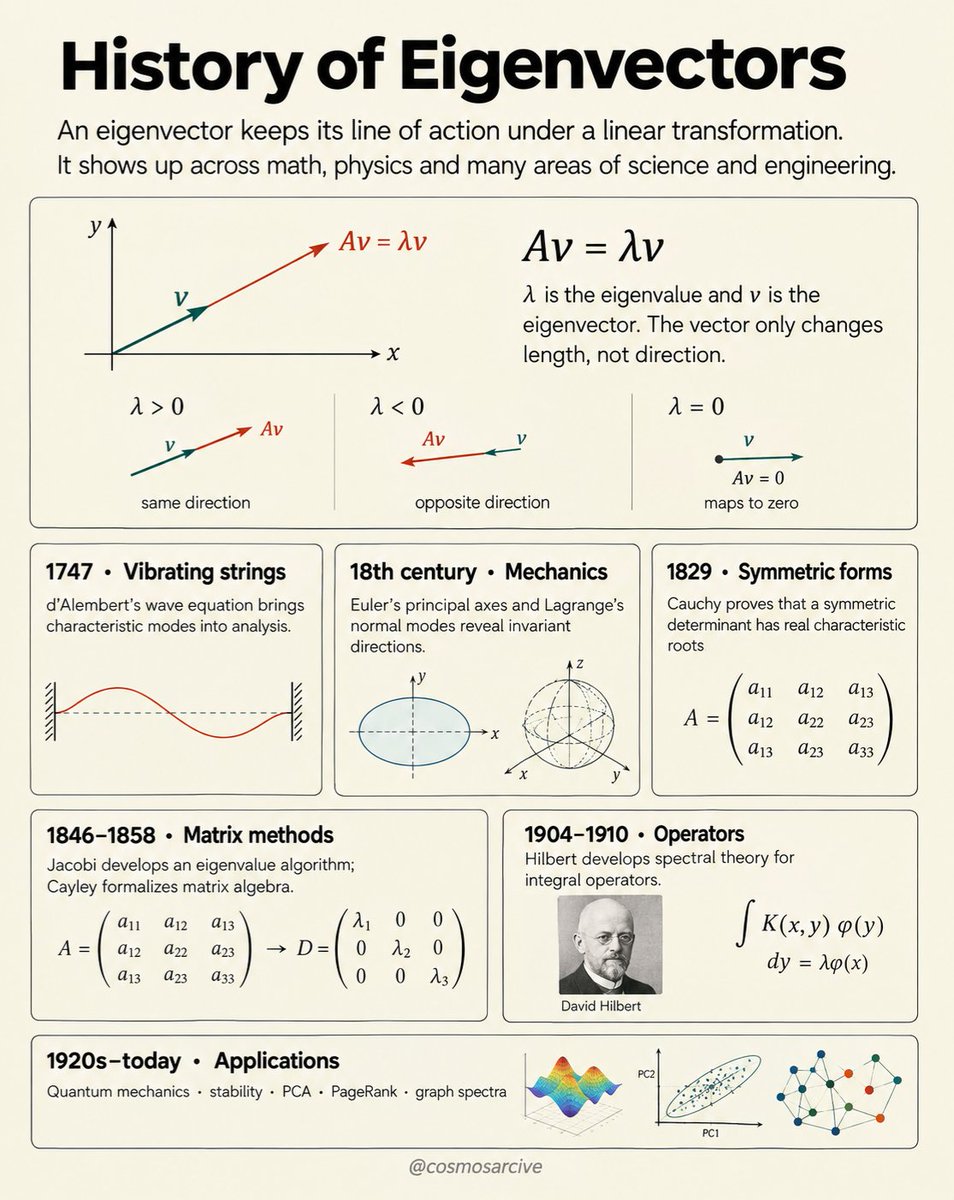
Eigenvectors are the directions a transformation cannot truly turn.
For a matrix A, they satisfy Av = λv: the vector may stretch, shrink, or flip, but it stays on the same line. The idea grew from 18th century problems in vibrating strings and mechanics, before Cauchy formalized the mathematics in 1829 and Hilbert developed spectral theory in the early 1900s.
Today, the same idea sits behind quantum mechanics, PCA, stability analysis, PageRank and graph spectra.
What began as a question about invariant directions became one of the most useful ideas in applied mathematics.
🚨 حدث تاريخي ينهي 30 عاماً من تاريخ الكمبيوتر الشخصي: NVIDIA تُجهز رسمياً على معمارية الحاسب التقليدية بضربة واحدة! 💻💥🧠
منذ 30 سنة وأجهزة الـ PC هي نفس المعاناة: معالج Intel أو AMD، كرت شاشة منفصل، ودعوات متواصلة ألا ينفجر الجهاز أو يتوقف عن العمل!
الليلة.. جينسن هوانغ وضع حدّاً لهذا العصر للأبد بإطلاق شريحة RTX Spark! ⚡️
🔥 الأرقام والمواصفات التي تزلزل الأسواق:
• ثورة المعمارية: لأول مرة من إنفيديا.. CPU و GPU وذاكرة رام (RAM) معاً على قطعة سيليكون واحدة بمعمارية ARM ودقة 3 نانومتر!
• قوة مرعبة: 1 Petaflop من قوة معالجة الذكاء الاصطناعي المحلي.. كل هذا داخل لاب توب بنحافة 14 ملليمتر فقط!
• أداء ألعاب مجنون: تشغيل ألعاب AAA على المسرح بسرعة +100 FPS وبدقة 1440p بدون كابل كهرباء وبدون أي حرارة أو هبوط بالأداء (No Throttling)!
💡 الرقم الذي يغير وجه التكنولوجيا للأبد:
تشغيل نماذج ذكاء اصطناعي ضخمة بحجم 120B Parameter محلياً بالكامل!
بدون إنترنت.. بدون سيرفرات سحابية.. بدون اشتراكات شهرية! الـ AI Agent الخاص بك يعيش داخل جهازك ويعمل 24 ساعة تحت سيطرتك المطلقة وحدك! 🔐
الـ PC لم يعد مجرد شاشة ولوحة مفاتيح.. أهلاً بكم في عصر محطات الذكاء الاصطناعي الشخصية! 🚀
احفظ المنشور وشاركه مع كل المهتمين بالتقنية والألعاب! 🧵👇
Bhagat Singh’s fellow comrade Shiv Verma recalled what Bhagat Singh told him during their final meeting. Bhagat Singh was martyred at the age of 23.
This video was recorded in 1986, when the then CPIM leader Shiv Verma was 81 years old.
#BhagatSingh#ShivVerma