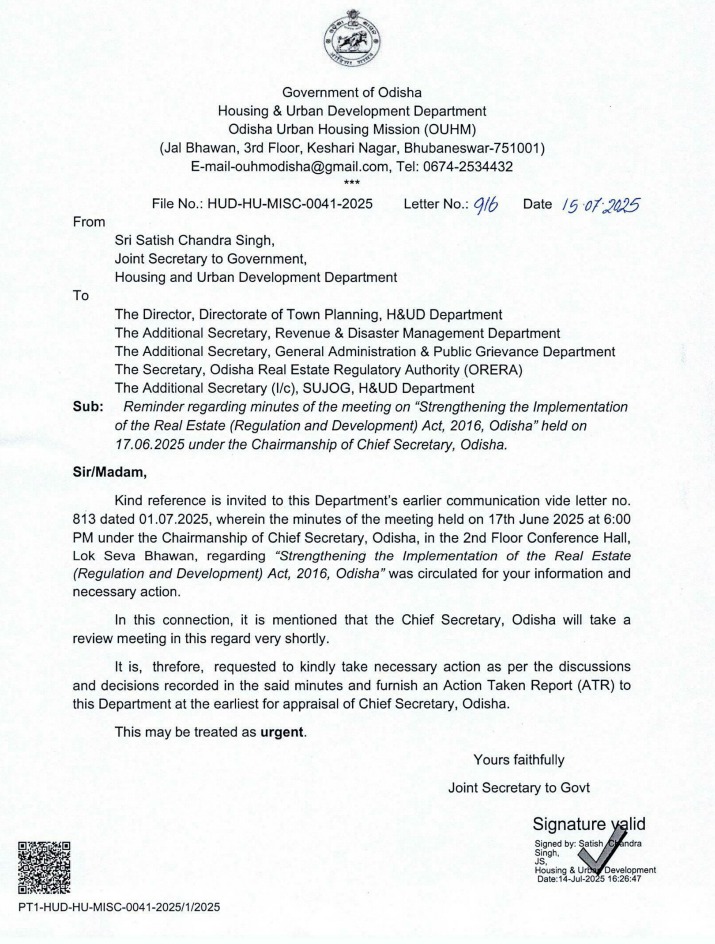
UNAUTHORISED CONSTRUCTIONS comes up for hearing in the Supreme Court today, 15 September 2026 at 2 pm (link below)
For #Odisha, @bmcbbsr and @SecyChief have both been added as parties.
BMC first placed a list of 153 properties before the Court (16 May). It later revised that figure to 4,739 properties (1 August).
@ChanchalRanaIAS should look at what this litigation is already producing elsewhere:
GURUGRAM: demolition of unauthorised floors, rooms in the stilt, and ramps from house to road
DELHI: demolition of illegal houses in several areas
LUCKNOW: removal of unauthorised constructions
BHOPAL: the State’s attempt to set up a committee was stayed
PATNA: a list of about 27,000 properties submitted
MEERUT: thousands of illegal extensions demolished, including schools and hospitals
BHUBANESWAR: BMC was added as a party on 25 March — nearly six months ago. Even now, the authority has no credible plan to protect or guide its citizens.
Hiding the record on plan approvals, occupancy certificates, fire safety certificates, deviations and commercial use of residential properties will not help the public. That record will return to haunt the administration, as it is doing now. Instead of evading responsibility, the government should produce a proper regularisation-and-enforcement plan. Recycling holding-tax data will not camouflage years of inefficiency, corruption and an apathetic official attitude.
Today in Court:
Watch the hearing live at 2 pm (court no. 7) https://t.co/v3veuNjVwv
@ChanchalRanaIAS@ushapadhee1996@_anugarg
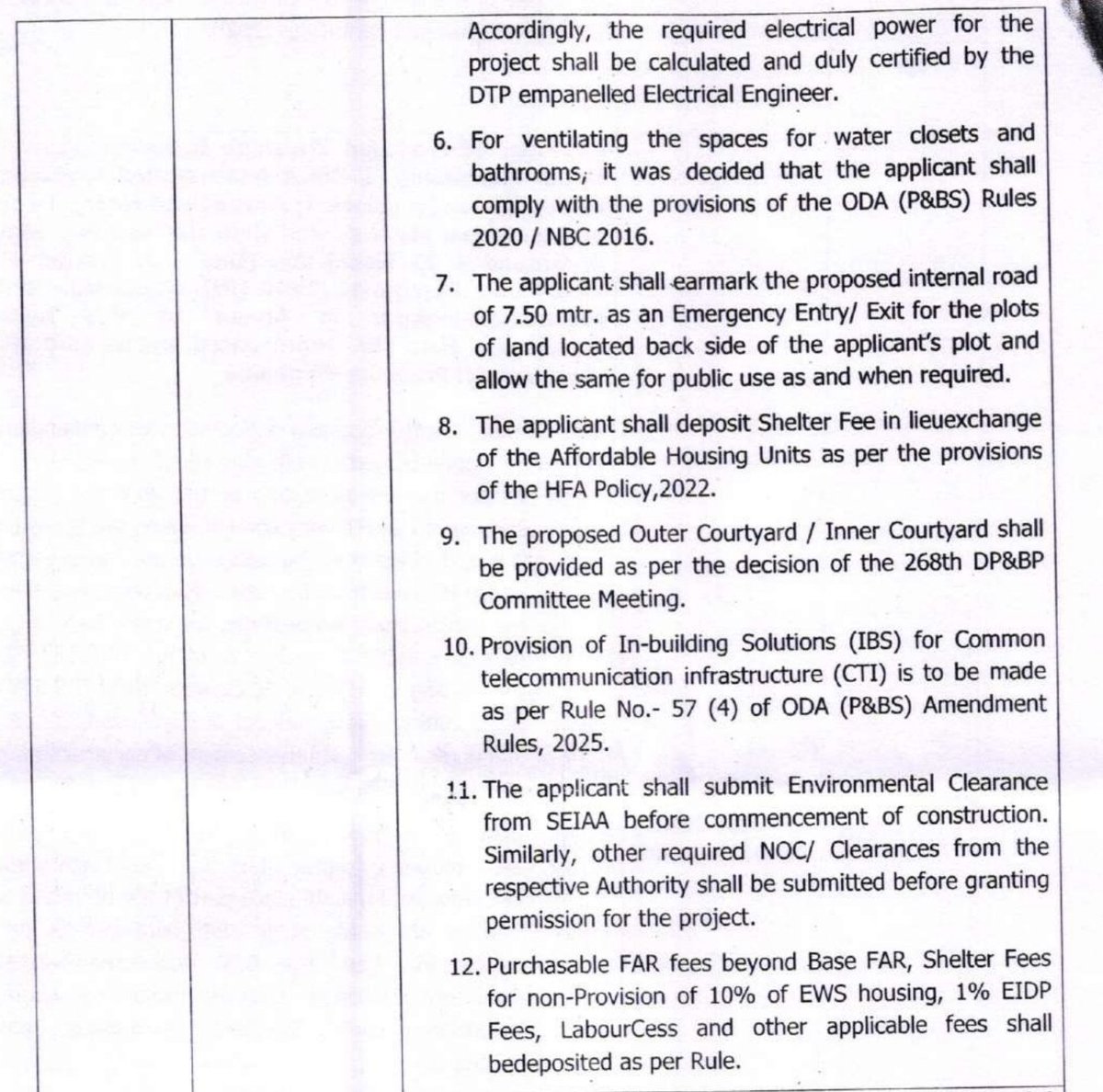
Yes, the project is located exactly opposite of AIIMS, Bhubaneswar. (today's photograph of the site is attached)
1️⃣ Can someone start construction before plan approval❓
Under Section 15 of the Orissa Development Authorities Act, 1982, no development (including construction) is permitted without prior permission from the Authority (BDA in this case).
2️⃣Is the conditional recommendations by the DP&BP meeting be considered as plan approval❓(DP & BP documents attached)
Definitely "NO"
3️⃣ Can construction begin before Environmental Clearance (EC) from SEIAA❓
Paragraph 2 of the EIA Notification, 2006 mandates prior Environmental Clearance before any construction work or land preparation (except mere securing of the site).
The Supreme Court in Vanashakti v. Union of India (2026 INSC 761) has reaffirmed that the prior-EC regime is mandatory. Construction begun without EC is void at inception; post-facto regularisation is not available under the current law.
4️⃣ What is the correct method/process to dig / abstract groundwater❓
A project proponent must obtain a No Objection Certificate (NOC) from the Central Ground Water Authority (CGWA) / State Ground Water Authority before constructing any abstraction structure (borewell/tubewell) or commencing extraction.
Application is online through the CGWA portal, supported by hydro-geological data, impact assessment (where required), and compliance with the Guidelines dated 24.09.2020 (as amended). Digging or pumping without this NOC is illegal under the Environment (Protection) Act, 1986.
NOTE: without a plan approval being displayed at the project site as mandated under law as well as by the Supreme Court in the Barjatya judgement, the builder is at default. If the builder @AvinashGroup has obtained such NOC for ground water, (4-5 wells have been dug in the project site), it should come clean.
5️⃣ Is groundwater allowed to be used for construction work❓
Only after obtaining a specific CGWA NOC for construction / dewatering purposes.
In over-exploited or critical areas the permission is further restricted and usually granted only if treated sewage water is unavailable within 10 km. Using groundwater for construction without this prior NOC is a clear violation.
These are not technicalities — they are statutory preconditions.
When a project starts earthwork, foundations or pumping groundwater before these clearances are in hand, both the builder and the approving authorities become answerable.
@BDA_BBSR@bmcbbsr@CPCB_OFFICIAL@SEIAAOdisha@CGWB_CHQ@GWDOdisha@HUDDeptOdisha@ChanchalRanaIAS@ushapadhee1996 will the record be examined and action taken if any contravention of legal provisions or court directions are found❓
#Bhubaneswar #RealEstate #HomebuyersRights #ODA #EIA #Groundwater
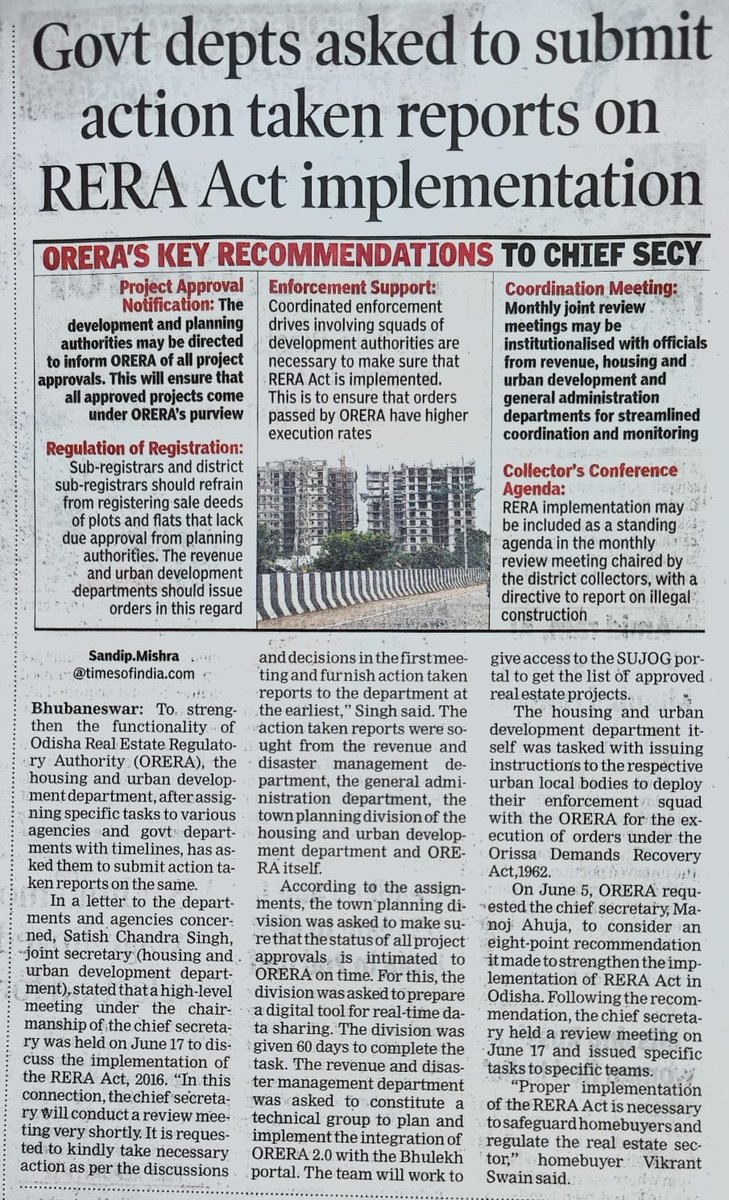
The newspapers today on the APARTMENT REGISTRATION in #Odisha
Remember:
✅The Authority to approach is the respective Competent Authority in your area. (Not the Sub-registrar)
Know your Authority: https://t.co/gwnmtp5b8M
✅The role of Sub-registrar comes only after the sale deed is endorsed by the concerned Competent Authority. A sub-registrar will act only when an endorsed sale deed form is presented before it. The registering officers scope is limited to,
(i)Check the endorsement of the Competent Authority,
(ii)Collect the Registration fee (for common area registration it is fixed at ₹20k and for Apartment it is 2%),
(iii)Collect Stamp duty (for common areas it is fixed at ₹50k and for Apartment it is 5% on the value of the Apartment)
NOTE: Sale deeds will be in the prescribed format, Form-G: Sale deed of the Common Areas i.e. Entire land of the project and amenities AND Form-F: Sale deed of the individual Apartment.
IMPORTANT: After the registration, the Sub-registrar must send a copy of the sale deed to the Competent Authority
✅ Registration for both sale and resale is allowed only if one has the mandatory documents.
Know the procedure of registration: https://t.co/zIvRFvo3EX
🙏 Requesting @arvindpadhee to consider a training program for all the Sub-collectors as well as Registering officers.
@sureshkpujari@dr_kcmahapatra@ushapadhee1996@ChanchalRanaIAS@IgrOdisha@OdishaRera
Homebuyer Can't Be Compelled To Accept Possession Without Occupancy Certificate Obtained By Builder : Supreme ... https://t.co/3tUF0gpDEC
CIVIL APPEAL NO. 5289 OF 2022
Parsvnath Developers Ltd. vs Mohit Khirbat
By: Justice B.V. NAGARATHNA and Justice R. MAHADEVAN
1️⃣On terms in the agreement cannot override the statute if such terms are one sided:
Paragraph 18: Accordingly, it must be held that the NCDRC acted well within the ambit of its statutory authority in awarding compensation, notwithstanding the restrictive stipulation contained in Clause 10(c) of the Agreement. The power of the consumer fora to grant just and reasonable compensation for deficiency in service is traceable to the statute and cannot be curtailed by contractual terms which operate to the detriment of the consumer. The award therefore represents a legitimate and permissible exercise of statutory jurisdiction.
2️⃣After resale, the new buyer is entitled for compensation admissible under the law:
Paragraph 18.1: Further, as held in Laureate Buildwell Private Limited v. Charanjeet Singh, a subsequent purchaser is entitled to seek the same relief as the original allottee and cannot be denied compensation merely on the ground that he or she stepped into the shoes of the original allottee at a later stage. The right to claim compensation for deficiency in service travels with the allotment, unless expressly barred.
3️⃣Calculation of Compensation
Paragraph 19: As regards the determination of compensation in cases of delayed or failed delivery of possession, reference may be made to the decision in Bangalore Development Authority v. Syndicate Bank, wherein, this Court after surveying a catena of decisions, crystallised the governing principles relating to grant or refusal of relief to an allottee aggrieved by delayed or non-delivery of possession. It was held that where possession is not delivered within the stipulated or reasonable time without justifiable cause, the allottee is entitled to refund with reasonable interest and in appropriate cases, additional compensation depending upon the facts. Compensation is not uniform and must be moulded in light of the nature of delay, conduct of the authority, and extent of harassment suffered.
4️⃣Possession without Occupancy Certificate (OC):
Paragraph 26: In view of these authoritative pronouncements, possession without an Occupancy Certificate cannot be forced upon the respondents. Obtaining such certificate is a statutory pre-condition integral to lawful delivery of possession.
@OdishaRera
the order⬇️
https://t.co/D0oSQF2m9E
Essential Registrations That Every Apartment Buyer Must Insist On.
(1) Registration of the Deed of Declaration: This foundational document outlines the project's structure, rights, and obligations, ensuring legal clarity on percentage ownership over the land for all owners.
(2) Registration of the "Association of Allottees": Forms the official body representing buyers, empowering them to own the Common Areas and manage common affairs.
(3) Conveyance of Common Areas: As mandated by Section 17 of the Real Estate (Regulation and Development) Act, 2016, this transfers undivided proportionate title in shared spaces to the association, preventing promoter exploitation.
When governments fail to enforce or facilitate these, it's clear they're prioritising the interests of promoters over the rights and welfare of lakhs of home buyers.
Buyers, demand these, your future security depends on it!
Unauthorised Constructions......
C U L P R I T S:
1) Builders: Sell and vanish
2) Authorities: Apathetic Attitude (at times corruption)
3) Agents: they broker the deal
4) Registering officers: allows registration without ensuring approvals
5) Buyers: it's their money after all.
Registration of Apartments sale deeds in #odishahostsgels2025
The state of Odisha will be coming up with an ordinance in the next cabinet meeting effecting changes to the schedule I-A of the Indian Stamp Act, 1899.
Only after the said Ordinance the registration of Common Areas to the Association of Allottees will be possible.
Registration of individual Apartments from the builder to the Allottees will begin only after that.
In the meanwhile, calling upon every Home Buyer/registered Associations to ensure the following,
1) Registration of the "Association of Allottees" (the law allows the buyers to apply for registration of Association)
NOTE: Till now more than 500 Association of Allottees have been registered within Bhubaneswar
2) Occupancy Certificate from the plan approving Authority.
3) Builders must submit the "Declaration" to the Competent Authority under the Odisha Apartment (Ownership and Management) Act.
Till now more than 80 Declarations have been submitted and endorsed.
NOTE: (a)in case the builder does not submit the Declaration, the law allows the registered Association to submit (b) each buyer's share in the land (Common Areas) is to be mentioned in this document.
4) Registration of the Common Areas including the entire land as described in the plan approval is to be registered in the name of the registered Association (for this transfer, the Govt. came up with the required changes in the registration law, now the Ordinance to make changes in the Stamp Act is awaited).
5) Every sale deed in the prescribed format is to be signed by the parties➡️the signed document is submitted to the Competent Authority➡️the Competent Authority shall verify the details like Association, OC, Declaration, Common Areas registration➡️then endorses on the sale deed➡️such sale deeds after endorsement has to be submitted to the Sub-registrar for registration➡️the Sub-registrar is duty bound to register the sale deed within 15 days after ensuring payment of Registration fee and Stamp duty➡️the Sub-registrar will send a copy of the registered sale deed to the Competent authority for record keeping.
NOTE: for those projects whose all apartments were sold earlier, there is no need for another registration of Sale deed for the Common Areas. As the law (Section-7, 1982 Act and Section 15, 2023 Act) has "deemed" clauses. So those projects the question of any registration fee or stamp duty will not arise.
@ushapadhee1996@sureshkpujari@dr_kcmahapatra@ChanchalRanaIAS@SecyChief@IgrOdisha
Registration of all Apartments is now OPEN.
Finally the @rdmodisha has made changes in the table of "fees payable" under the Registration Act 1908.
The promoters will be able to transfer through a registered sale deed the Common Areas (the entire land of the project) to the registered "Association of Allottees" by paying a consolidated fee of Rs.20000/- as registration fee.
CONGRATIULATIONS to all Associations of Allottees.
Thank you @sureshkpujari
@ChanchalRanaIAS not only the plan approval, but also the "Fire Certificate" and "Occupancy Certificate" are mandatory. Your proposed survey of Commercial properties may include the status of all these three important documents.
Further, please consider departmental action against officials (in case of any violations) as per the Supreme Court's direction regarding Unauthorised Construction and Occupancy Certificate in CIVIL APPEAL NO. 14604 OF 2024. Which reads,
"Hence, necessary instructions should be issued by all the State/UT Governments in the form of Circular to all concerned with a warning that all directions must be scrupulously followed and failure to do so will be viewed seriously, with departmental action being initiated against the erring officials as per law."
🅰️
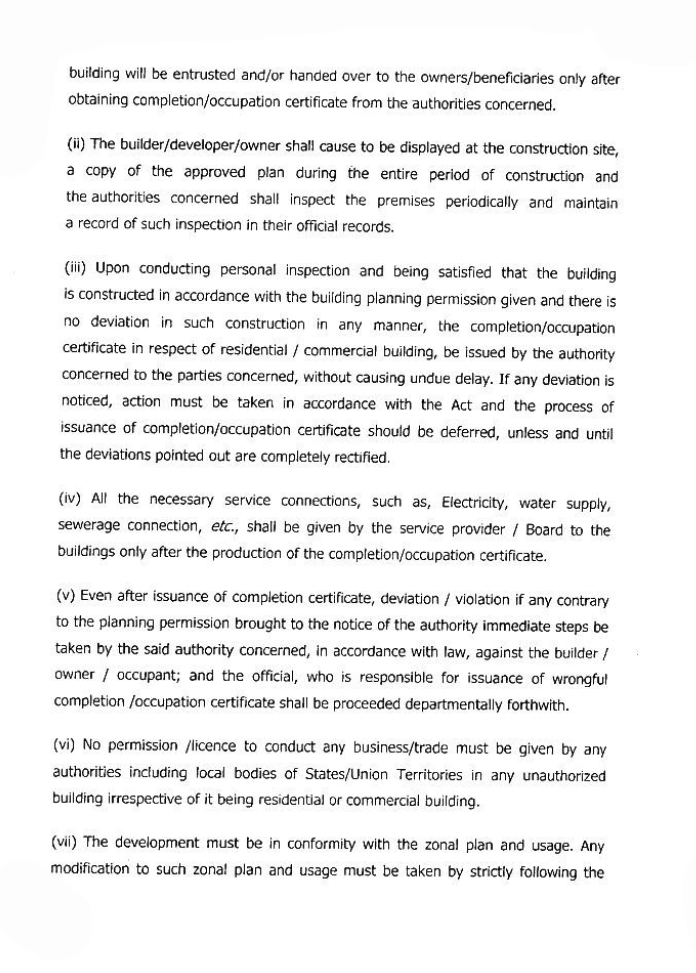
@HUDDeptOdisha Notification no. 20784 dt. 4.9.2025:
Sl. No.(vi): "No permission / licence to conduct any business/ trade must be given by any authorities including local bodies of States/Union Territories in any unauthorized building irrespective of it being residential or commercial building."
🅱️
The ODA Rules clearly says that those properties without Occupancy Certificate are considered "Unauthorised" ⬇️
ODA Rules, 2020:
Competent Authority may declare such building without Occupancy Certificate as unsafe for occupation and such construction shall be treated as unauthorised development.
@CMO_Odisha@SecyChief@dr_kcmahapatra@ushapadhee1996@BDA_BBSR@bmcbbsr
IS THE 2023 ODISHA APARTMENT OWNERSHIP ACT RETROSPECTIVE IN NATURE?
Real Estate laws are always buyer centric.
But, unscrupulous builders, apathetic attitude of the authorities, poor executions of law and a corrupt system ensures an effect which is just the opposite of the legal provisions.
Thus, the Real Estate transactions are implemented in a seller friendly method.
Consider the case of Odisha Apartment Ownership Act, 1982. During its existence of 40 years, till it was repealed in 2023, i.e.
☑️Formation of Association,
☑️Entire land must be transferred to the owners, ☑️Registration of "Declaration' detailing the project parameters,
☑️Calculation of percentage share to each owners,
☑️No change in percentage share without 100% owners agreeing to it,
☑️No registration of sale deeds without Occupancy Certificate
☑️ No registration without the endorsement of the Competent Authority.
But the Act was literally killed by the system (builders and Authority) as,
❌Not a single Association was registered,
❌Not a single Declaration was registered
❌The authority did not exercise its power u/s14 to ensure submission & registration of Declaration
❌Builders in most of the projects did not transfer the entire land
❌percentage share on land for each apartment owner is not mentioned anywhere so not known
❌Sub-registrars kept on registering apartments without Occupancy Certificate & Declaration and without ensuring transfer of the entire land.
Multiple cases in the Odisha High Court forced the government to bring an updated and simplified Odisha Apartment (Ownership and Management) Act 2023. While buyers saw some hope, builders were not very happy.
Now, the current establishment is trying its best to help the builders who cheated home buyers and with an intention to hide its own failure of four decades, has decided to bring changes to the 2023 law.
Requesting the @HUDDeptOdisha@SecyChief to safeguard the interest of the Home Buyers while using Section 35 of the Act and resolve the issues of OC and Unauthorised constructions through regularisation.
@ushapadhee1996@OdishaRera@IgrOdisha@dr_kcmahapatra
UNAUTHORISED CONSTRUCTIONS: Odisha Govt. comes up with Notification.
1) The notification is just a Copy & Paste of the Supreme Court's December 2024 order. @HUDDeptOdisha
2) In #Odisha the Completion Certificate is not issued by the Authority. Rather it is a notice by the Architect, on behalf of the builder, informing the Plan approving Authority about completion of the construction.
This point of law is being presented by the builders with wrong interpretation. The Notification should have used the word "Occupancy Certificate" only.
3) The notification is silent about the implementation or detailed direction/guidelines/SOP. @SecyChief
4) Looks like a half-hearted attempt to comply the Supreme Court's direction in the pending Contempt case.
5) By the way, why is the sl. no. "X" of the Apex Court's order missing in the Notification?
Any ways, congratulations @CMO_Odisha for being one of the first states (probably the first) in the country to have come up with this notification. We all know, the "wrong elements" within and out side the government system will try to sabotage the implementation of these guidelines.
WE WILL REMAIN ALERT.
@ushapadhee1996@ThirumalaNaik4@sureshkpujari@ChanchalRanaIAS@CredaiOdisha@dr_kcmahapatra
UNAUTHORISED CONSTRUCTIONS
The Supreme Court has turned the spotlight on unauthorised constructions, urging high courts and state governments to act decisively against the menace that has eroded urban planning, strained civic infrastructure and endangered public safety.
In recent months, important cases in the Supreme court related to Unauthorised constructions....the list covers NORTH-SOUTH-EAST & WEST🔰
Barjatya (Uttar Pradesh)
Kaniz Ahmed (Karnataka)
Wellingdon Heights(Maharastra)
M/s T.S. Construction (West Bengal
Bimalendu Pradhan (Odisha)
Things consistent in all these orders....."Zero tolerance towards Illegal/unauthorised construction" , "No compromise on Occupancy Certificate".
@dr_kcmahapatra@ushapadhee1996@ThirumalaNaik4@ChanchalRanaIAS
I am sure if all processes are complete and all documents are available, the Sub-registrar has no reason to deny registration.
Documents:
1) Registered "Association of Allottees"
(➡️I am sure, this is already done by the owners)
2) Occupancy Certificate issued by the plan approving Authority.
(➡️without a valid OC, the project is not complete as well as legally one can not reside there)
3) "Declaration" submitted to the Competent Authority by the builder
(➡️this document describes the available facilities and Amenities plus the ownership of the land. It also calculates the share an owner has on the land. The responsibility of submission of Declaration is of the builder)
4) The entire land registered in the name of the Association
(➡️no title remains with the builder: Supreme Court)
5) The sale deed is endorsed by the competent Authority.
(➡️the Sub-registrar has limited role as all checkibgs are to be done by the Competent Authority. The registering officer s duty bound to register uf the sale deed has the endorsement)
The Odisha Apartment (Ownership and Management) Act, 2023 is not good news for builders in general.
The earlier law was in 1982....never implemented by the Builder and the Government supported the builders by keeping silent.
For four decades, the Home Buyers were denied the rightful ownership over the common areas for which they had paid along with the apartments.
When the home buyers knocked the door of the High Court, the @OdishaRera the @HUDDeptOdisha@IgrOdisha as well as @credaibbsr and @CredaiOdisha stood together trying their best not to allow a new Apartment law in the state.
But, GOD has different plans.
Now, after the new Act has come into effect, the game of false narratives have been doing the rounds.
FOR ALL NEW PROJECTS:
Govt's clarity on stamp duty will expedite 96% sale deeds.
FOR ALL OLD PROJECTS:
(1) Regularisation of OC or clarity from the govt. regarding deemed OC for all old projects.
(2) As per the new Act,
(i)the entire land is deemed to have been registered in the name of the Association of Allottees.
(ii)there is no need to have any new registration for the land/common areas.
(iii)Association of Allottees need to submit the list of owners in Form-I to the Competent Authority.
So, no new registration, no payments.....the land is already deemed to be owned by the Association.
The only bottleneck is the Occupancy Certificate for the old project. Let's ask the @CMO_Odisha@SecyChief to regularise Occupancy Certificates so that these old projects will never be branded as "unauthorised/Illegal" 🙏
Odisha Apartment (Ownership and Management), 2023 and transfer of property rights under the applicable law
The following data highlights the efficiency of various stages, including the Registration of Association, Registration of Declaration, Endorsement for Common Areas, and Endorsement of Sale Deeds, while identifying critical bottlenecks affecting the registration of sale deeds. @SecyChief@OdishaRera@ushapadhee1996@dr_kcmahapatra@sureshkpujari@ThirumalaNaik4
1⃣Registration of Association of Allottees (AoA)
Total Applications: 536
Registrations Completed: 430
Disposal Rate: 80%
The registration of 430 Associations out of 536 applications reflects a commendable disposal rate of 80%, indicating effective processing by the competent authority i.e. Secretary @BDA_BBSR
2⃣Registration of Declaration (Form-D)
Total Applications: 80
Declarations Approved: 67
Disposal Rate: 84% (80/67)
The competent authority, Secretary, Bhubaneswar Development Authority (BDA), has achieved an impressive 84% disposal rate for 'Declaration' applications.
3⃣Endorsement for Common Areas (Form-G)
Total Submissions: 62
Endorsements Completed: 55
Disposal Rate: 89% (62/55)
Out of the 67 approved Declarations, 62 projects submitted Form-G for endorsement, with 55 (89%) successfully endorsed by the competent authority. This high disposal rate underscores the authority’s commitment to facilitating the transfer of land and common areas from builders to the AoA.
4⃣Endorsement of Sale Deeds
Total Registrations: 8
Registrations Completed: 8
Disposal Rate: 100% (8/8)
All submitted sale deeds have been successfully endorsed, reflecting seamless processing at this stage.
✅Analysis of Bottlenecks
Despite the robust performance of the competent authority in processing applications, significant challenges hinder the timely registration of sale deeds, primarily due to the following factors:
➡️Non-Submission of Declarations by Builders:
Out of 430 registered Associations, only 80 applications for Declaration (Form-D) were submitted, representing a significant drop-off. This low submission rate is attributed to: (i)Unavailability of Occupancy Certificates (OCs), and (ii) Builders are deliberately not submitting 'Declarations' due to reasons best known to them.
➡️Reluctance to Disclose Project Information:
Builders’ hesitancy to provide project-related details may stem from irregularities in project execution or concerns about losing land ownership to the AoA upon Declaration submission.
➡️Non-Registration of Form-G by Builders:
While 55 out of 62 Form-G submissions have been endorsed by the competent authority, no Form-G registrations have been completed by builders at the Sub-Registrar’s office. This critical failure stalls the transfer of common areas to the AoA, directly impacting the registration of thousands of sale deeds.
➡️Government’s Failure to Clarify Stamp Duty:
Builders attribute the non-registration of Form-G to the lack of clarity from the government regarding stamp duty applicable to the registration of common areas. This ambiguity has created a significant bottleneck, delaying the entire process of sale deed registration.
The fact is,
The regulatory framework governing the registration and transfer of property rights is functioning effectively, as evidenced by the high disposal rates at various stages (80% for AoA registration, 84% for Declarations, and 89% for Form-G endorsements).
However, the failure of builders to register Form-G, coupled with the government’s lack of clarity on stamp duty for common areas, remains the primary impediment to the timely registration of sale deeds.
Additionally, the low submission rate of Declarations, driven by the unavailability of Occupancy Certificates and builders’ reluctance to disclose project details, further exacerbates delays.
So what's next❓
➡️The government should urgently issue clear guidelines on stamp duty for the registration of common areas to facilitate Form-G registration.
➡️Regulatory authorities should enforce stricter compliance by builders to ensure timely submission of Declarations and OCs.
➡️Collaborative efforts between the government, competent authorities, AoA and builders are essential to streamline processes and expedite the registration of sale deeds, thereby safeguarding the interests of allottees.
UNAUTHORISED CONSTRUCTIONS (Guidelines) by the Supreme Court
DIRECTION TO THE CHIEF SECRETARIES
The Supreme Court issued specific directions to the Chief Secretaries of all states and union territories to ensure the effective implementation of the guidelines and issue circulars.
Odisha @SecyChief has failed to implement the Court's direction till now.
A. Background
From a dispute over unauthorized commercial constructions on a residential plot without obtaining necessary approvals, violating the terms of allotment and zoning regulations.
The High Court ordered the demolition and directed action against erring officials.
In the appeal, the Supreme Court, upholding the High Court’s demolition order. The Court emphasized a zero-tolerance stance on unauthorized constructions.
The apex Court also issued comprehensive guidelines to curb unauthorized constructions nationwide.
B. Guidelines for All States
To address the widespread issue of unauthorized constructions, the Supreme Court issued comprehensive guidelines for all states and union territories to follow.
1) Undertaking from Builders: Builders or applicants must provide an undertaking that possession of the building will be handed over to owners or beneficiaries only after obtaining a completion or occupation certificate (OC) from the competent authority.
2) Display of Approved Plans:
A copy of the approved building plan must be displayed at the construction site throughout the construction period.
3) Periodic Inspections: Authorities must conduct periodic inspections of construction sites and maintain official records of these inspections.
4) Issuance of Completion/Occupation Certificates:
OCs should be issued only after authorities are satisfied that the construction adheres to the approved plan without deviations. If deviations are found, issuance of the OC must be deferred until rectification is completed.
5) Essential Services Post-OC: Service providers (electricity, water, sewage) must provide connections only after the production of a valid OC, ensuring that unauthorized buildings do not gain access to utilities.
6) Action Against Post-OC Violations:
Any deviations or violations detected after the issuance of an OC must trigger swift corrective action, including demolition of the illegal portion and penalties for erring officials.
7) Prohibition on Business Licenses:
No trade or business licenses should be granted for operations in buildings constructed illegally or in violation of zoning regulations.
8) Conformity with Zonal Plans: Development must align with zonal plans and usage regulations, prioritizing public interest over individual convenience when modifying such plans.
9) Inter-Departmental Cooperation:
When authorities under the planning department or local body seek assistance from other departments to act against unauthorized constructions, immediate assistance must be provided. Failure to do so will result in strict action against erring officials.
10) Timely Disposal of Appeals: Applications, appeals, or revisions related to non-issuance of OCs, regularization requests, or rectification of deviations must be disposed of within 90 days.
11) Verification by Financial Institutions:
Banks and financial institutions must verify the OC before sanctioning loans against properties to prevent funding for illegal constructions.
12) Accountability of Officials: Officers who issue incorrect OCs or fail to act against unauthorized constructions must face departmental action to curb laxity and collusion
13) Limited Regularization Schemes:
Regularization schemes should be rare, exceptional, and limited to residential houses after a detailed survey, considering factors like land usage, environmental impact, and public interest. Such schemes must not compromise safety or urban planning
14) Contempt for Non-Compliance:
Any deviation from these guidelines may lead to contempt proceedings against responsible officials or authorities
@ushapadhee1996