The ultimate online preparation resource for applicants to ST4 Cardiology training, with over 450 questions questions covering all aspects of the interview.
An 87-year-old man presents with recurrent episodes of dizziness. His medical history includes hypertension and a subdural haematoma sustained after a fall three months ago. An ECG is performed. What abnormality does it demonstrate?
A 78-year-old man with a history of peripheral arterial disease and heavy smoking had acute chest pain 10 days ago and now presents with 60 minutes of new left-sided weakness. Based on the ECG shown, what are the key abnormalities and what is the most likely diagnosis?
Answer:
This is an inferior STEMI presenting atypically with dyspnoea in a diabetic patient, complicated by a junctional rhythm. The key step is urgent reperfusion with primary PCI, with supportive management of bradycardia and hypotension.
A 62-year-old man with a history of type 1 diabetes and CKD stage 3 is brought to the Emergency Department with sudden onset severe shortness of breath, light-headedness, and profuse sweating. He denies any chest pain. On arrival, he is hypotensive and bradycardic.
How would you interpret this ECG, and what would be your immediate management priority?
Subscribe to https://t.co/qex694rrpk; the ultimate question bank for ST4 Cardiology interview preparation
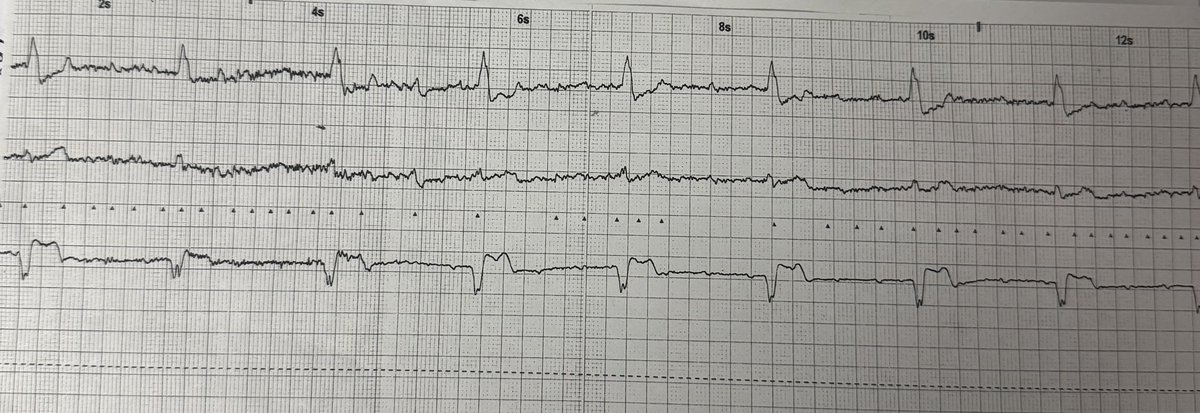
A 78-year-old woman presents with multiple collapses with brief loss of consciousness over 3 weeks.
She has a past medical history of HTN and RA.
What does her ECG show?
Subscribe now to https://t.co/qex694qTzM; the ultimate resource for Cardiology interview preparation.
Answer:
The ECG shows sinus rhythm with ST elevation in lead aVR along with global ST depression, suggesting left main stem or multivessel ischemia. The diagnosis is an acute myocardial infarction complicated by ischemic MR, likely due to papillary muscle dysfunction or rupture.
A 59-year-old man presents with acute, severe chest pain and shortness of breath for one hour. He appears distressed, tachypneic, and diaphoretic, with mild hypotension and a new harsh systolic murmur at the apex. Troponin T is elevated at 1216 ng/L.
Transthoracic echocardiogram (TTE) shows a left ventricular ejection fraction (LVEF) of ~40% with severe mitral regurgitation (MR) and wall motion abnormalities.
What is the diagnosis and the likely type of the patient’s MR given his clinical findings and ECG?
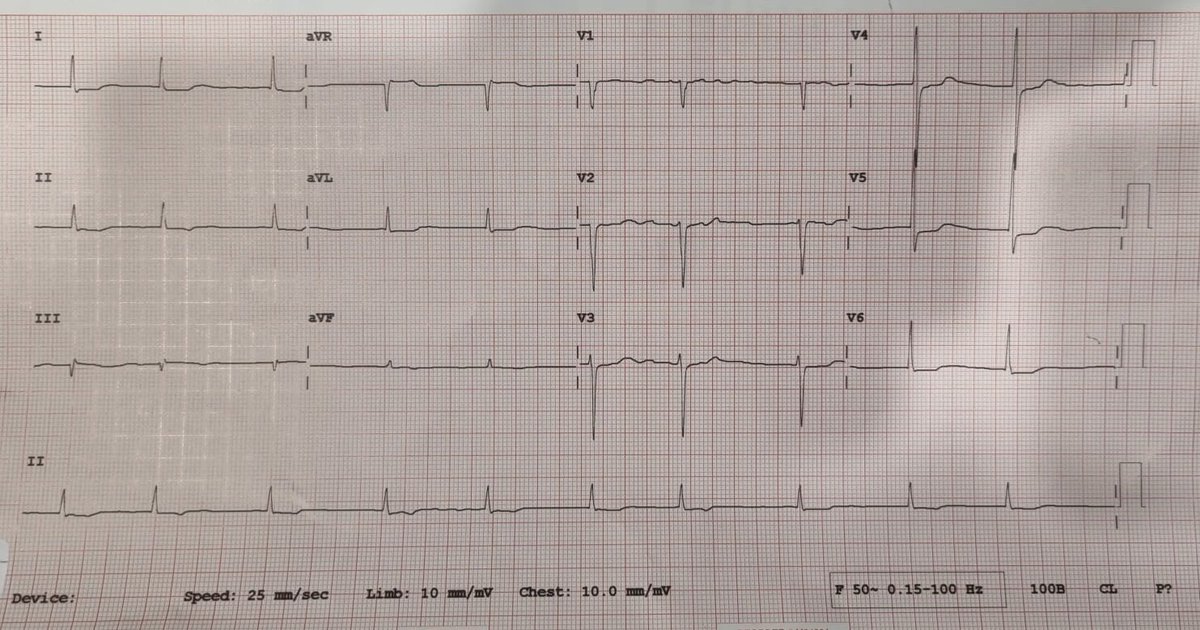
An 87-year-old man presents with recurrent episodes of dizziness, described as transient sensations of unsteadiness without loss of consciousness. He has a history of a subdural hematoma following a fall three months ago, which was managed conservatively.
He is on Amlodipine 5 mg PO OD and Candesartan 8 mg PO OD.
What does his ECG show?
Subscribe now to https://t.co/qex694qTzM; the ultimate resource for Cardiology interview preparation.
His past medical history is also significant for hypertension, which is controlled with medication. He denies chest pain, palpitations, focal neurological deficits, or recent head trauma. No history of syncope, visual disturbances, or significant orthostatic symptoms.
Answer:
The 12-lead- ECG shows sinus rhythm with a ventricular rate of ~ 82 bpm with frequent VEs. There is ST segment elevation in leads V1-V5 along with some reciprocal ST segment depression inferiorly.
The case represents an acute anterior STEMI.
A 54-year-old male with a history of hypertension and hyperlipidemia presents to the emergency department with acute onset of chest pain and palpitations that started while jogging this morning.
What does the ECG show?
Subscribe to https://t.co/qex694qTzM
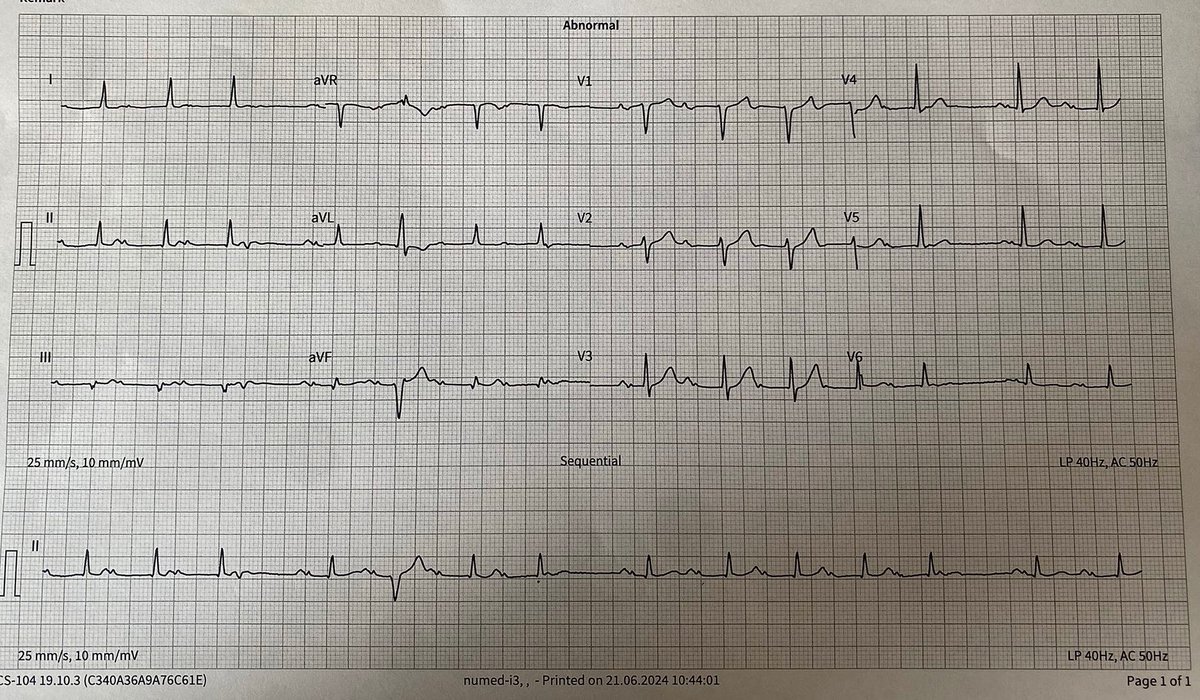
A 76-year-old man is found to have bradycardia during preoperative assessment for right hip replacement. He has no cardiac symptoms.
How would you manage the patient given his clinical history and ECG findings?
Subscribe now to https://t.co/qex694rrpk
The 12-lead ECG shows sinus rhythm with second-degree (Mobitz 1 - Wenckebach) AV block. There is aberrant ventricular conduction following a short-long-short interval, consistent with Ashman phenomenon.
Congratulations to all those who were successful in their Cardiology interview! 🎉
A 55-year-old man is found to have irregular pulse. What does his 12-lead ECG show?