A single tooth from the Popol Vuh Museum is attracting the attention of researchers studying ancient Maya remains.....
The specimen is a lower molar featuring a small green stone set into the centre of its occlusal (chewing) surface. The material has been identified as jadeite. While stone inlays are well attested in Maya contexts, they are almost exclusively found in anterior (front) teeth; placement within a molar appears to be previously undocumented.
The tooth comes from a collection of archaeological material gathered in Guatemala during the 20th century. It is not tied to a specific excavation, but its characteristics match known examples of Maya dental work. The crown shows a shaped cavity where the stone sits, held in place by a bonding substance.
Imaging was carried out using cone beam computed tomography. The scans show changes inside the tooth that occur in living tissue. The pulp chamber displays heavy calcification, a response that develops over time. This indicates the procedure took place while the individual was alive.
The internal structure is intact, with visible pulp horns and root canals. These features point to a young adult. There is no sign of advanced wear that would suggest old age.
The position of the inlay is notable. Molar teeth are not visible during speech or display. Known Maya dental modifications usually focus on visible areas and are linked to appearance or identity. This example does not fit that pattern.
One explanation is that the stone was placed for practical reasons. Tooth decay and infection were common in ancient populations, especially where diets relied heavily on maize. In other regions, there is evidence of drilling or filling teeth to manage pain or damage.
Cases from Europe and Asia show early attempts to treat dental problems, including the use of plant fibres, bitumen or wax. In the Americas, similar work has been recorded, though examples are few. Most involve drilling rather than filling.
The Maya had the technical skill to work teeth with precision. Decorative inlays show controlled shaping and placement without damaging the inner structure. This molar suggests that such skill may also have been applied in other contexts.
There is no direct proof that the stone addressed a cavity or injury. The tooth does not preserve clear evidence of decay at the site of the inlay. Other motives cannot be excluded, though the location makes a display function unlikely.
The find adds a rare example to the record of dental intervention in ancient Mesoamerica. It shows that work on teeth was not only limited to visible modification and aesthetic purpose.
#archaeohistories
@histories_arch Itz amazing it haz survived the centuries. They did a great job finding it in 1945,and itz a great picture colored makes it seem more recent than the age and ,circumstances it waz take in .
Martius or mensis Martius ("March") was the first month of the ancient Roman year until possibly as late as 153 BC. After that time, it was the third month, following Februarius (February) and preceding Aprilis (April). Martius was one of the few Roman months named for a deity, Mars, who was regarded as an ancestor of the Roman people through his sons Romulus and Remus.
March marked a return to the active life of farming, military campaigning, and sailing. It was densely packed with religious observances dating from the earliest period of Roman history. Because of its original position as the first month, a number of festivals originally associated with the new year occurred in March. In the Imperial period, March was also a time for public celebration of syncretic or international deities whose cultus was spread throughout the empire, including Isis and Cybele.
📷 : Panel thought to depict the Mamuralia from a mosaic of the months that places March first (from El Djem, Tunisia, first half of 3rd Century AD)
#archaeohistories
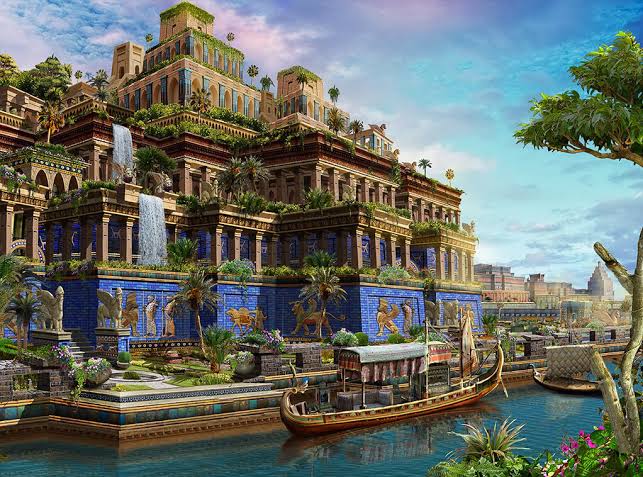
@archeohistories Imaging if they rebuilt a hanging garden weather it waz completely to the possibilities the original 1 would haft had would be amazing.
Hanging Gardens of Babylon are known to history as one of the Seven Wonders of the Ancient World, alongside other landmarks of bygone eras such as Lighthouse of Alexandria and Great Pyramids of Giza. The gardens were said to have been built in Babylon, capital of ancient city of Babylon in Mesopotamia by King Nebuchadnezzar II. Many of Seven Wonders of the Ancient World have been lost to time, with only remaining wonder being the pyramids. However, Hanging Gardens of Babylon in itself is unique compared to the other wonders in that historians still dispute whether or not Gardens truly existed or not.
King Nebuchadnezzar II had the Hanging Gardens constructed as a gift to his wife, Queen Amytis, who was from Media (present-day Iran). Queen Amytis was homesick, missing the mountains and plant life of her home. Hanging Gardens was to be a remedy for her homesickness. Using irrigation techniques, Hanging Gardens was a terraced garden, where the plants were placed alongside steps up a hill. Machu Picchu is an example of another ancient terrace garden. Within Babylonian culture at the time, it was common for wealthy individuals to foster their own private gardens as a show of wealth and as a status symbol.
Many people in cities and other crowded places have potted plants on their outdoor patios, but most of these people probably don't think anyone is about to marvel at the wonder of their 'hanging gardens.' Of course, those 'hanging gardens' were probably more sophisticated than potted plants on patios we see today.
Hanging Gardens of Babylon were one of the greatest engineering achievements of the ancient world. Although the exact location has never been uncovered, the Kingdom of Babylon, in which the Gardens were said to exist, was in the region around modern-day Iraq. Hanging Gardens have been described as the ideal representation of a horticultural landscape. Although actual Hanging Gardens have never been found, their creation is usually attributed to a Babylonian ruler known as King Nebuchadnezzar II, who ruled from 605-562 BC. According to some legends, he had the Hanging Gardens built for his wife, Queen Amytis, who missed the green valleys of her home in northern Iran.
Written accounts tell us that Hanging Gardens of Babylon were built into a complex of stairs, terraces, and buildings that required advanced irrigation to water the Gardens and advanced architecture to support the weight of the massive Gardens. According to the accounts, the walls were 22ft thick, with ten-foot wide hallways. Terraces were made with reeds and baked bricks underneath a layer of lead to create a foundation that would hold moisture. Mounds of soil were placed on top of this that were deep enough for the roots of trees. The oldest account of the Gardens comes from the Babylonian priest Berossus, around 290 BC. Later, after Alexander the Great expanded his empire to include most of the Mediterranean region, it became common for Greeks and others to travel across the empire and explore the cultures of Egypt, Persia and Babylon. At some point around 4th Century BC, Greeks developed a list of seven must-see sights for travelers that was made up of some of the most remarkable building projects in the ancient world. In essence, it was the world's first travel guide. This list became known as Seven Wonders of the World. There were several versions of this list, which didn't really become standardized until around 140 BC.
#archaeohistories
A shake-up of the dinosaur family tree! Rhabdodontids are not ornithopods. They are ceratopsians.
There were horned dinosaurs in Europe! As shown by a new fossil of Ajkaceratops from Hungary!
Check out our new study, led by Susie Maidment⤵️
@fasc1nate My great great great great grandma was named Willimina levenstinina hotenslayer dinglebender ruthteta Elizabeth Ann James. Shi was boran in 1851 in salt Lake, Utah shi died in bountiful utah at my grandma fays house in 1960 .
@Saskia802@fasc1nate It was closed for safety concerns. A submarine bomb in 1916 that was when world war 1 waz going on.caused it to be closed .also the way up to the torch has only a lader. so it would be difficult for disabled people to climb it
@Malisimo67@fasc1nate The broken chains around the ankles moast don't know about .represent all people breaking free from bondage . (Slavery) Nat just for African people. At points in history even white people was slaves to outher white people. In England and even back in the old Roman empire
@Malisimo67@fasc1nate So they cut holes in the flame of the torch and took the pieces home as souvenirs so it had to have glass instead of the gilt metal .to torch there now is a replacement of the original. And it replicates the way it waz supposed to be .the broken chaines around her ankles .