In response to a consistent rise in hate speech and harmful behaviour across the @X platform, we will be deleting this account on April 30, 2026.
Follow us on other platforms:
https://t.co/LBcENT51d8
https://t.co/dWBx2rLnGA
We have rebranded! STEM with Disabilities is now an incorporated non-profit called The Disabled CoLab. Follow us on Bluesky, Instagram, and at our website https://t.co/JSjsW4VgNe
“I feel comfortable in my skin. Being disabled...it has never been a negative thing for me. That might not be the case for everyone, and not everyone feels the same way about disclosing their disability.”
Read the full report of student quotes at https://t.co/RW6gh2RAfK
For @Laura_M_Otter, a legally blind biogeochemist, accessibility tools help her with computer and lab academic work, including the visual markers on microscopes including this #PiFM (as seen in these pictures)! #DisabledInSTEM#DisabledAndSTEM
Photo: Nic Vevers/ANU
“What does it look like to transition from the structured support of university to the working world? How can you be prepared so that, when you graduate, you are not without support?”
Read the full report of student quotes at https://t.co/RW6gh2RAfK
@Laura_M_Otter is an interdisciplinary researcher at the Research School of Earth Sciences at the Australian National University in Canberra, Australia @anuearthscience As a geologist and geochemist, she studies the biomineralization process of marine organisms.
Photo Nic Vevers
Meet Dr. Laura Otter (@Laura_M_Otter) a legally blind biogeochemist trying to make sense of marine calcification in changing environments. #DisabledInSTEM#DisabledAndSTEM#STEMWithDisabilities
https://t.co/KM1JBShNQ7
Photo: Nic Vevers/ANU
“Sure, intentional discrimination sucks, but I feel like indirect discrimination based on ignorance is probably the most frustrating thing..."
Read the full report of student quotes at https://t.co/RW6gh2R2qc
“If we are going to make change, then we need to share our experiences and our stories. We have to let others know.”
Read the full report of quotes from postsecondary students at https://t.co/RW6gh2R2qc
#DisabledInHigherEd#DisabledInHigherEducation
Episode 1: STEM and Disability: MIA conversation with Emma Collington https://t.co/AHIF6IytJq via @YouTube
Please listen to MIA conversation with Emma Collington as we talk about STEM and Disability
@STEMwDisability , @emmacollagen , @fowlersamanthaa
The @RoySocChem Disability-Inclusive Laboratories in the Chemical Sciences Survey is LIVE 🥳
https://t.co/tA8XEyl9Rj
Fill in the case studies form, which aims to collect examples of solutions and innovation enabling disabled chemists to access labs
https://t.co/qigsPBY6VR
Working on a presentation for @ComSciConCAN for later this week!
Very excited to talk about the #DisabledInSTEM community and accessible science communication practices!
Mom is confused at times about why people react in a certain way about someone with a disability. But, she has come to the conclusion that some people are just afraid of disability. They have not encountered it, don't know how to respond, or think it means someone is "less than."
Imagine what it’s like to be disabled and on the receiving end of those biases. Try to sit with that discomfort instead of turning away from it. The discomfort signals that something is wrong that we can choose to change rather than ignore.
Mom wants to summarise a few things she's heard about disability throughout her life being disabled.
1. If you’re disabled, you’re less productive, and that’s bad (unless #2).
2. ‘Heroically overcoming’ disability and inspiring everyone is the only valid way to exist if you’re disabled.
3. If you’re disabled, your life is not as fulfilling unless (#)2. In that case, your ability to inspire non-disabled people makes your life worthwhile, and you must be happy.
4. Disabled people are a burden and aren’t worth the effort to fit into our lives and workplaces.
5. The state and taxpayers must be protected from paying out money so that disabled people (and people faking* disability) can laze around doing nothing.
6. If you’re disabled, you’re broken and /or wrong, and medical experts need to fix you to make you productive and worthwhile.
7. If you are disabled, you cannot possibly be a productive member of society.
8. We will make a place for someone disabled because we are mandated by law.
Mom's processing style, along with her painstakingly developed social and people management skills, means that when she meets someone, she meets that person right where they are and initially, at least, takes on trust what they tell her about themselves. She works with what they choose to disclose respectfully and thoughtfully.
Be open-minded:
Whatever a person’s needs and abilities, set aside preconceptions or labels. Meet the person, not the disability. They might surprise you. For example, the people we know with Chronic Fatigue Syndrome (CFS/ME) tend to be the ones we have to remind not to overwork.
Be curious:
Be curious about a person’s experience and needs. Don’t focus on why they use a wheelchair but on how that affects them and their choices and how you can help.
Booking a team lunch? You must check that your restaurant choices are accessible. Make sure the restaurant knows there’s a wheelchair user in your party—and don’t forget to check the route!
Don’t interpret actions, reactions, or lack thereof as a moral failing or lack of care if there is no definite reason to believe this is so.
If a thing is easy for you, that doesn’t mean others can’t struggle with that same thing. Neurodivergent people often have strengths and weaknesses that seem to contradict each other.
Be considerate:
Finally, think about how difficult it is to be in the world as a marginalized person and have to constantly advocate for your needs and risk rejection. If it’s welcome (and please ask rather than assuming), you could raise your voice to ask on your colleague’s behalf. For example, you could advocate for a different way of celebrating success for colleagues who struggle to socialize.
It doesn’t have to be about advocating; a simple gesture of care could mean a lot, such as letting your colleague choose the seat in the meeting room that meets their needs before everyone else sits. For someone with ADHD, they might want their back to distractions, for a wheelchair user, easy access, for hard of hearing, a spot where they can see to lip read easily - don’t assume, let them choose.
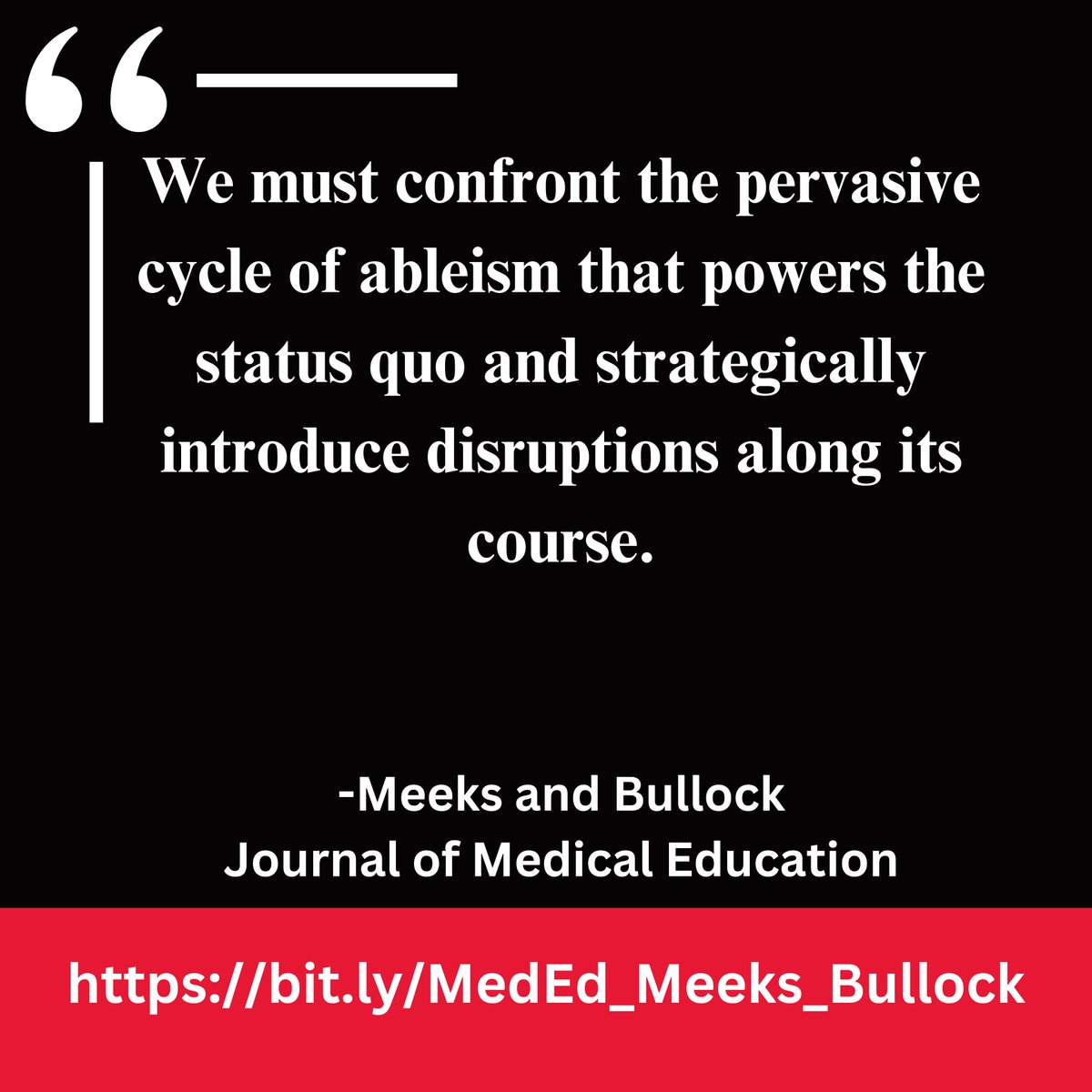
New paper alert! 🚨 "Transforming Medical Education: Implementing ‘Disruptors’ to Break the Cycle of Ableism." by @meekslisa and @jbullockruns.
🌠Strategic changes foster inclusivity in #MedEd
👉https://t.co/LzWRNSP5VO
#DisabilityInclusion#Ableism#DocsWithDisabilities
Conversations about #disability in #mathematics are often surrounded by stigma, silence, & shame. Check out this MAA blog on disrupting ableism in math and the launch of Sines of Disability. Kudos, @Dr_DanR @LisetteETorres3! https://t.co/cnBwV4g8wA #DisabilityTwitter#edequity
What works and what doesn’t in making it in academia as #DisabledFaculty? I recently shared my twisty academic disability journey in this post in @TheMindHears. Peer support matters! #DisabledInSTEM https://t.co/LgGmBd70u0