STL is a global leader in advanced connectivity solutions, providing end-to-end solutions for buildi AI-ready, FTTx, Rural, Enterprise and Data Centre networks.
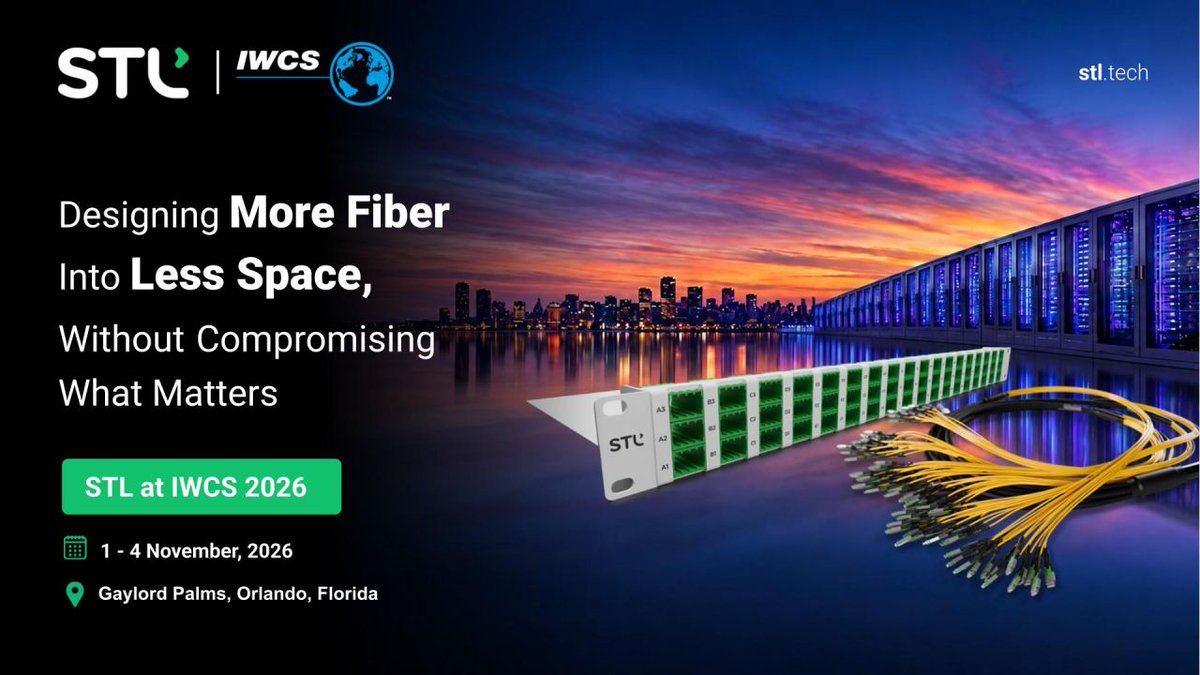
At IWCS 2026, STL will present new research on high-fiber-density plenum interconnect cables for hyperscale data centres, exploring how cable design can respond to these competing demands without treating any one of them in isolation.
The official program places this paper in Fiber Cable Design, Part 1, Wednesday, November 4, 8:30 to 11:50 AM.
Some engineering problems are best understood when you see what happens inside the cable.
AI data centres need more connectivity. Their racks and pathways do not get unlimited space.
That tension is creating some interesting engineering questions around fiber density, airflow, fire performance and the physical footprint of interconnect cabling.
Now available on-demand!
Exponential AI growth is stretching connectivity, bandwidth, and physical conduit space to their limits. Simply scaling up physical cabling is no longer sustainable.
Stream STL’s exclusive webinar recording to see how multi-core (MCF) and hollow-core (HCF) fiber innovations solve these infrastructure bottlenecks:
What's covered:
• Next-gen fiber architectures built for AI-scale workloads
• How STL is shaping global optical standards
Today’s AI compute may be replaced in two or three years, while the fibre pathways beneath it may still be in place a decade later.
That mismatch changes how AI infrastructure needs to be built. In his latest Forbes Business Council article,
The physical layer has to be designed with enough headroom to keep up.
Build for the compute you have today, without having to rebuild for the compute that comes next.
Read Ankit Agarwal’s perspective in Forbes Business Council.
As fiber counts rise, cable design begins to deal with forces that are easy to overlook from the outside.
How does the fiber behave inside a compact cable when the cable is pulled, bent, processed and eventually deployed?
At IWCS 2026, STL will present research on a non-linear model for predicting tensile fiber strain in high-fiber-count IBR uni-tube cable designs.
It is a modelling conversation with a very practical objective: understanding behaviour before infrastructure has to experience it.
India is the world's fastest-growing major economy, and Maharashtra is one of its biggest engines.
At the launch of Invest Maharashtra in Mumbai, the state set its sights on a $1 trillion economy by 2030, with 67 MoUs worth ₹8.57 lakh crore signed in a single day.
STL is increasing its global manufacturing capacity, including Maharashtra.
As the state grows, we grow with it. Thank you to the Government of Maharashtra and the Invest Maharashtra team. We look forward to building the state’s next chapter of growth, together.