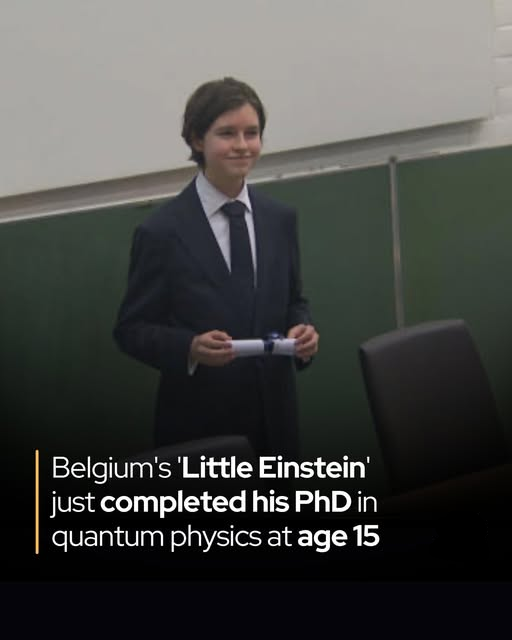
A 15-year-old has just earned a PhD in quantum physics.
Laurent Simons, a Belgian child prodigy, has blazed an academic trail unmatched by almost anyone else on the planet, accelerating through education at a velocity that defies norms.
He began primary school at age four and wrapped it up by six. At twelve, he already held a master's degree in quantum physics, delving into bosons, black holes, and the intricate mathematics unraveling the universe's deepest enigmas.
This week, the boy hailed as Belgium's "Little Einstein" defended his doctoral thesis at the University of Antwerp, cementing his status as one of the youngest physics PhDs in recorded history. His research tackled advanced concepts—like Bose polarons in superfluids and supersolids—that most scholars wouldn't touch until their twenties or thirties. Yet for Laurent, this path has been profoundly intimate: the loss of his grandparents at eleven ignited a fire in him to unravel the secrets of longevity—not for personal gain, but to grant others extended, vibrant years.
Experts marvel at his prodigious memory and IQ of 145, a rarity shared by just 0.1 percent of the population. Tech giants from the U.S. and China have dangled lucrative offers to his family, but his parents have rebuffed them, championing his right to evolve on his own terms.
Laurent doesn't claim the absolute youngest PhD title—that belongs to Karl Witte, who graduated at thirteen in 1814—but in contemporary physics, his feat stands virtually unparalleled.
Now fifteen, he's poised to pivot from quantum realms to medical frontiers, eyeing a second doctorate in medical AI to pioneer breakthroughs in aging. His audacious vision? Crafting "superhumans" through innovations that conquer mortality's puzzles—a domain exploding with promise yet riddled with enigmas.
Quantum trailblazer or medical revolutionary, Laurent Simons is poised on the cusp: his extraordinary odyssey has only just ignited.
Dr. Sivaranjani Santoshh has been fighting for 8 years against sugar-rich drinks falsely marketed as ORS.
We’ve been consuming sugary drinks when our body actually needs ORS.
Yet it took FSSAI 8 damn years to take a call.
Most Corrupt and Inefficient. That’s FSSAI.
BREAKING NEWS
The Royal Swedish Academy of Sciences has decided to award the 2025 #NobelPrize in Chemistry to Susumu Kitagawa, Richard Robson and Omar M. Yaghi “for the development of metal–organic frameworks.”
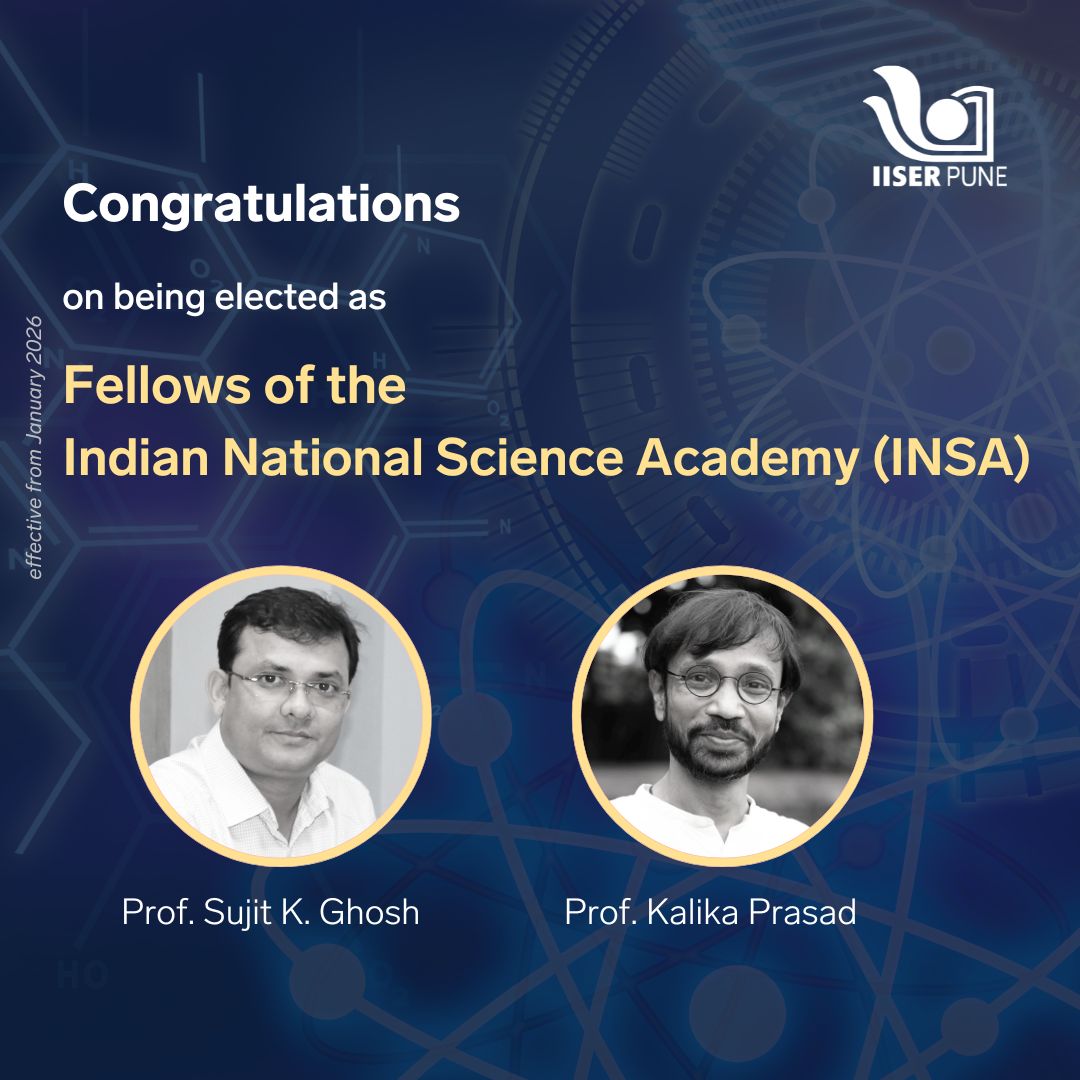
Prof. Sujit K Ghosh from the Chemistry department and Prof. Kalika Prasad from the Biology department of #IISERPune are among those elected as #Fellows of the Indian National Science Academy, New Delhi @insa_academy#Congrats and best wishes on this recognition!
https://t.co/kjpMQ0up98
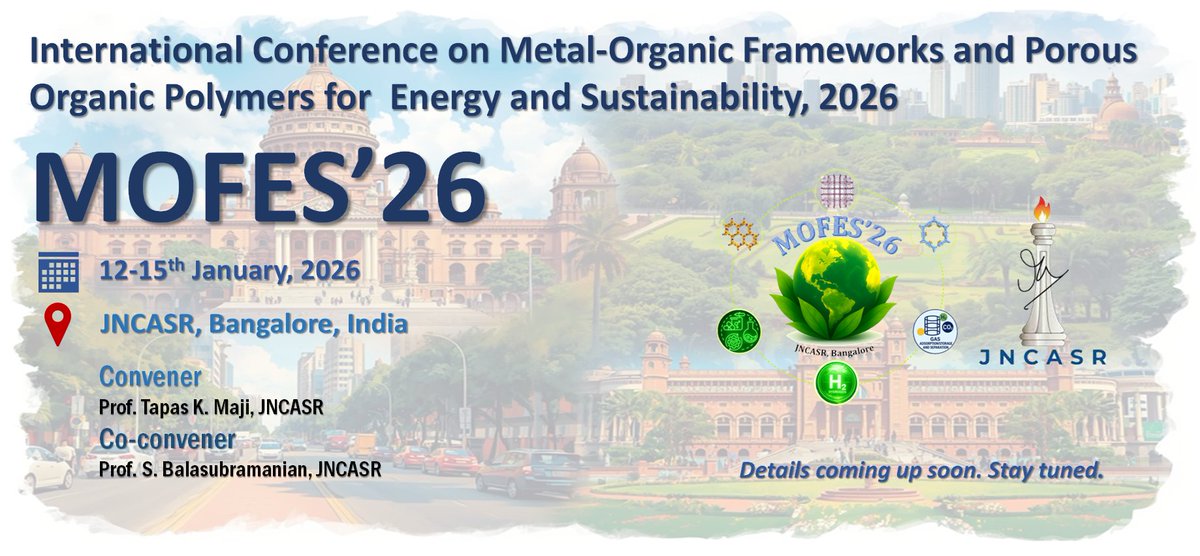
📢We are pleased to announce the 1st International Conference on Metal-Organic Frameworks and Porous Organic Polymers for Energy and Sustainability (MOFES'26) to be held at JNCASR, Bangalore from 12-15th January, 2026. @Maji_TK@jncbala@jncasr@Molmat_JNCASR
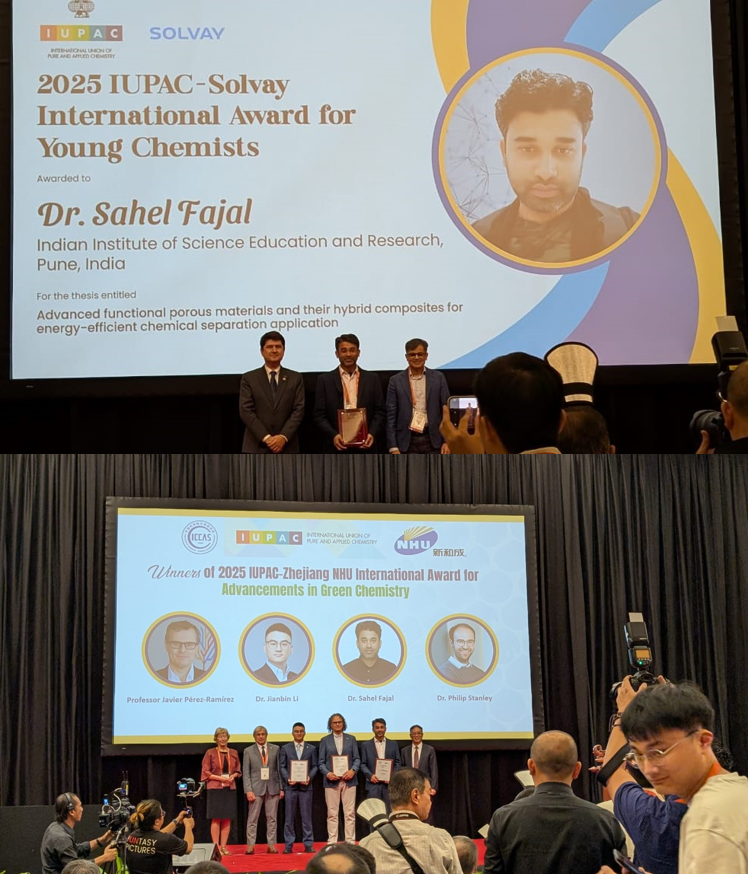
Delighted to share that Sahel got selected for two IUPAC awrads based on his thesis work from our lab. IUPAC-Solvay International Award for Young Chemists and IUPAC-Zhejiang NHU International Award for Advancements in Green Chemistry. Congratulations Sahel! @IISERPune@IUPAC
Regulating N-atom Number in Donor-Acceptor Units Covalent Organic Framework (COF) for Photocatalytic H2O2 production from Sunlight and Seawater. @GourabKD@skglab_iiserp@Sagarmani27 @_purpled_chemie @ChemistryIISERP
https://t.co/fF3SQfMBoA
Regulating N-atom Number in Donor-Acceptor Units Covalent Organic Framework (COF) for Photocatalytic H2O2 production from Sunlight and Seawater https://t.co/5Lw07XvgRZ
What is in front of the eyes is often more valuable depending on the way of looking. I am happy to share my little contribution to this area of research.
@GourabKD@skglab_iiserp@Sagarmani27 @_purpled_chemie @ChemistryIISERP
https://t.co/fF3SQfMBoA