As part of the launch of the Global Health Diplomacy and Security Program (GHDP) at the Global Health Institute (@ghiaub), Institute Assistant Director @mouradyara7 will be moderating a panel discussion on "Shaping the Future of Global Health Diplomacy: Leveraging Knowledge and Evidence." With experts from academia, policymaking, diplomacy, and global health participating, the session will explore how research, evidence, and collaboration can contribute to more effective health diplomacy and strengthen regional and global health security.
📅 Wednesday, June 10, 2026
🕒 09:15 AM – 1:00 PM (Beirut Time)
📍Hybrid | in-person - The Halim and Aida Daniel Academic and Clinical Center (Daniel ACC)
Register here: https://t.co/g09Izgc4x0
On June 8, our Institute and the Department of Economics at @AUB_Lebanon held a closed roundtable on how to manage Lebanon’s gold, evaluating the desirability of monetizing some of its holdings, its legality, and the political and technical feasibility of such an operation. The discussion gathered experts from the domains of academia, banking, finance, and the public sector, with the purpose of developing a reasoned framework for thinking about a complex policy question that can no longer be ignored.
For further background, we invite you to read two of the Institute’s most recent publications on the topic:
1⃣"Managing Lebanon’s Gold: Governance, Growth, and Financial Recovery," by Saade Chami: https://t.co/mZi9Ia4sYA
2⃣“Making use of Lebanon's Gold: A Tangible Proposal,” by @AlbertKostanian: https://t.co/HuU88W4EyC
The Middle East crisis isn't just a humanitarian emergency: it's already restructuring who works, where, and for how much across SWANA.
Under a severe escalation scenario, working hours in the Arab States could fall by 10.2% (more than twice the decline recorded during the COVID-19 pandemic).
Around 40% of regional employment sits in high-exposure sectors: construction, transport, trade, and hospitality (ILO, May 2026).
Migrant workers will absorb a disproportionate share of the adjustment, and remittance flows to labour-sending economies are already weakening. A temporary energy shock risks becoming a lasting decent work setback; unless policy responses go beyond subsidies and reach informal workers and migrants.
Read the full report to understand how the crisis is reshaping Arab labour markets and what an employment-centred response must look like. https://t.co/CzRIJDiZGw
#FutureOfWork #SWANA #MigrantWorkers #LabourMarkets #MENA #Geopolitics
The MENA gig economy is worth $30 billion. Yet most of those workers have no contract, no pension, and no sick leave. The gig economy in MENA is growing at 14% annually, but by 2024, the region contributed just 7% of the global gig market, with regulatory frameworks lagging far behind adoption (Al Habtoor Research Centre, Sept. 2025).
Flexible work is filling a structural employment gap across SWANA but without social protection reform, freelance visas and platform growth will only deepen informality. The future of work can't be built on unprotected labor.
Read the full analysis to understand why the gig economy's regional expansion demands a new policy generation and not just growth targets. https://t.co/FMJYP0fLKB
#FutureOfWork #GigEconomy #MENA #LaborRights #Informality #SWANA
Green jobs in Arab labor markets sound promising until you see that they make up just 5% of online job postings.
Green jobs account for only 5.06% of online job postings across the Arab region as of 2024, even as 23% of oil & gas sector roles are already being reclassified as green (ESCWA Skills Monitor, 2024). The green transition is happening unevenly. Without deliberate investment in green skills, education reform, and labor market intelligence, SWANA workers, especially in fossil-fuel economies, will face displacement, not opportunity.
Read the full brief to explore where the green jobs gap is widest, and which policy levers can close it before the transition accelerates.
https://t.co/FQwr00HsBp
#FutureOfWork #GreenJobs #MENA #JustTransition #ClimateAndWork #SWANA
In the Arab States, AI is more likely to upgrade your job than eliminate it, but only if you're a man.
Women hold 3x the share of jobs at risk of AI automation (5.3%) vs. men (1.6%), yet also stand to benefit most from AI augmentation. Without gender-targeted reskilling policies, the digital transition risks deepening SWANA's already stark labor market inequalities.
Read the full ILO report to understand how Arab States can turn AI into an engine of women's economic inclusion. https://t.co/yXCWeugEcH
#FutureOfWork #MENA #AI #GenderEquality #DigitalEconomy #ArabStates
Still time to apply!
The Early Career Scholars Program at @SWANA_FoWHub is accepting applications for 2026–2027.
Hosted by @AUB_Lebanon, this fully funded opportunity is designed for PhD candidates and recent grads working on AI, climate change, and the future of work in SWANA.
Apply here: https://t.co/z0INGyVIKq
Arab youth unemployment sits near 26% and automation is arriving before the labor market has fixed the basics.
The 2025 Arab Development Report finds that 11 million young people in the region are outside education, employment, or training while informality exceeds 60% of total employment in several economies.
This isn't just a jobs crisis; it's a skills architecture crisis. Digitalization without structural reform will widen, not close, the gap for Arab youth.
Read the full report to explore why the region's youth bulge could be its greatest asset or its deepest vulnerability depending on policy choices made now. https://t.co/z3rVjlCViZ
#FutureOfWork #SWANA #YouthEmployment #Jobs #SkillsGap #MENA
Climate policy is becoming labor market policy.
Recent regional work shows that the green transition is expected to create jobs in energy, infrastructure, and adaptation, while simultaneously displacing workers in carbon-intensive sectors.
In SWANA, one of the most climate-vulnerable regions, the Future of Work will be shaped by: energy transition, infrastructure shifts, and climate resilience jobs
Read more to explore how climate change is restructuring labor demand across the region:
https://t.co/pvKRC2AT8P
#FutureOfWork #GreenJobs #ClimateEconomy #SWANA #EnergyTransition
The Middle East workforce is adopting AI faster than the global average.
Recent surveys show 75% of workers in the region used AI tools at work in the past year, compared with 69% globally, reflecting rapid digital transformation across the region.
This shift is already redefining productivity, skills, and workplace expectations across MENA.
Read more about how AI adoption is shaping the region’s workforce:
https://t.co/1jW9RxTT7M
#FutureOfWork #AIinMENA #DigitalTransformation #WorkplaceInnovation
AI is not just changing jobs: it’s changing the skills workers need.
A recent article published by the IMF "New Skills and AI Are Reshaping the Future of Work" highlights that around 1 in 10 job vacancies in advanced economies now requires new skills linked to AI and digital technologies, reshaping hiring patterns and wages.
For MENA, preparing workers for AI-complementary skills will be central to the Future of Work.
Read the full article to explore how AI is transforming labor markets and why policy choices matter:
https://t.co/PzWDWyWHY6
#FutureOfWork #AI #Skills #LabourMarkets #MENA
Real-time labor data is the next frontier of FoW insight.
LinkedIn’s Jan 2026 Labor Market Report "Building a Future of Work That Works" shows which skills employers are actively hiring for today, not just predicting them.
In MENA, the most in-demand skills are digital fluency, hybrid collaboration, and analytical problem-solving; skills that link directly to opportunity.
Read the full report: https://t.co/SOuTyy42bl
#LinkedInData #FutureOfWork #SkillsEconomy #MENA
AI is no longer a future concept; it’s reshaping work today across the Middle East.
The FoW Middle East Trends report finds that AI adoption is accelerating across sectors, creating new roles and dissolving old ones. The message for MENA hubs: invest in adaptive, not static, skill sets.
Read the full article:https://t.co/YxgDbdAFZK
#FutureOfWork #AIinMENA #TechTransformation #SkillsShift
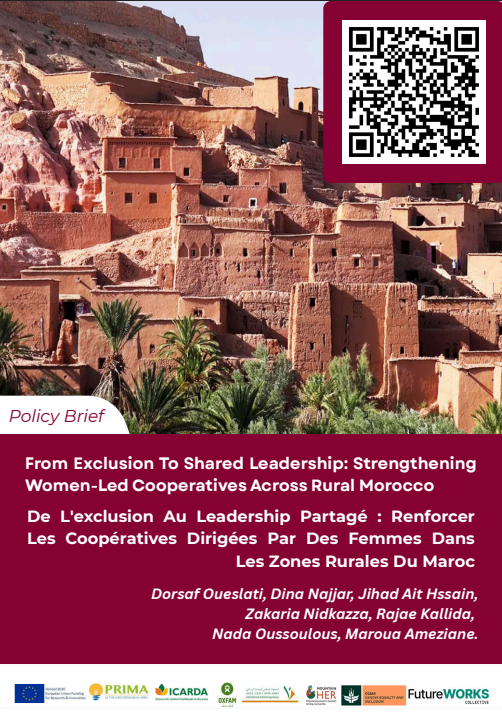
1/4 New policy briefs by ICARDA explore how to strengthen women-led agricultural cooperatives across Lebanon, Tunisia, and Morocco.
From building resilience in fragile contexts to advancing inclusive participation and shared leadership, the briefs highlight practical policy pathways to empower rural women and reinforce sustainable agricultural institutions in the MENA region.
#WomenInAgriculture #MENA #InclusiveGrowth #RuralDevelopment #FutureOfWork
4/4 In rural Morocco, strengthening women-led cooperatives means shifting from marginalization to shared governance.
The brief highlights policy actions to promote leadership, equity, and long-term sustainability.