@BlueDartCares@BlueDart_
You guys have the worst ever customer service in Bengaluru.
Like Dtdc is miles ahead.
Your delivery executives are rude as fuck, they purposely mark consignee address wring, without even calling
I’m confused by this notion of GEO working faster than SEO.
The GEO worked quickly because the language model found the article in a search engine.
So technically the SEO preceded GEO.
What am I missing?
1. Netflix / Jio Hotstar owns no Cinema
2. Spotify owns no Music
3. Amazon / Flipkart owns no Stores
4. Airbnb owns no House
5. Uber / Ola owns no Cars
6. Zomato / Swiggy owns no Restaurant
7. Phonepe owns no Bank
8. Makemytrip owns no Hotels
They just have one thing in common...
Worst businesses to get Wealthy:
- Restaurants
- House flipping
- Sneaker reselling
- Vending machines
- ATMs
Best businesses to get Wealthy:
- Private… Show more
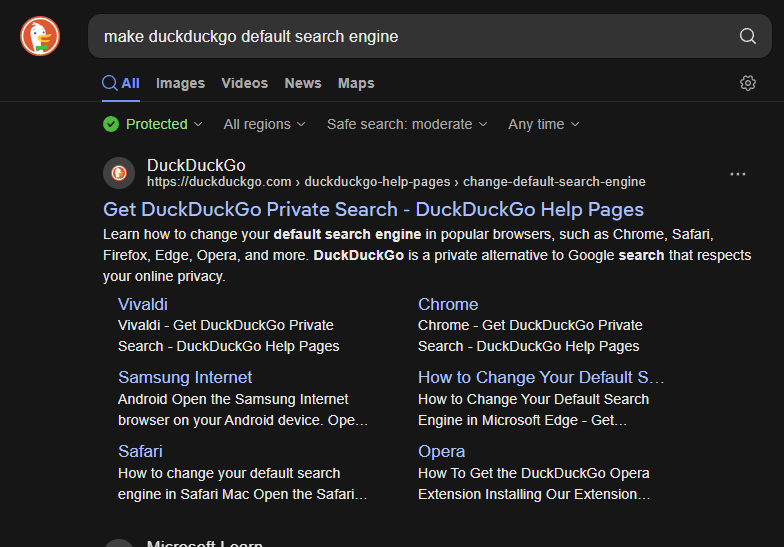
@Phil_Lewis_ Reminder that DuckDuckGo is free and all AI slop options can be fully and permanently disabled.
Imagine searching for something and getting the best result first again! Like this ⤵
🚨 Google just announced what it calls the biggest upgrade to the Search box in more than 25 years 👇
A new AI-powered Search box is designed to go beyond keywords and autocomplete. According to Google, it will:
✅ Dynamically expand so users can describe what they need in more detail
✅ Suggest better ways to formulate questions, beyond traditional autocomplete
✅ Support multimodal inputs, including text, images, files, videos, and Chrome tabs
✅ Let users continue from AI Overviews into AI Mode with follow-up questions
✅ Preserve context as users explore more deeply
✅ Still provide a range of Search results, according to Google
This is starting to roll out today in countries and languages where AI Mode is available.
Google also announced that AI Mode is now using Gemini 3.5 Flash globally as its default model.
Let's see how this impacts users search behavior, journey and ultimately, outcome towards sites.
Read announcement:
https://t.co/sGioSL84A8
Introducing Interact AI: a new interface for the web.
Add it to your website, and it talks to every visitor, answers questions, and shows your product.
Try it now -> https://t.co/qdfaFGI9a9
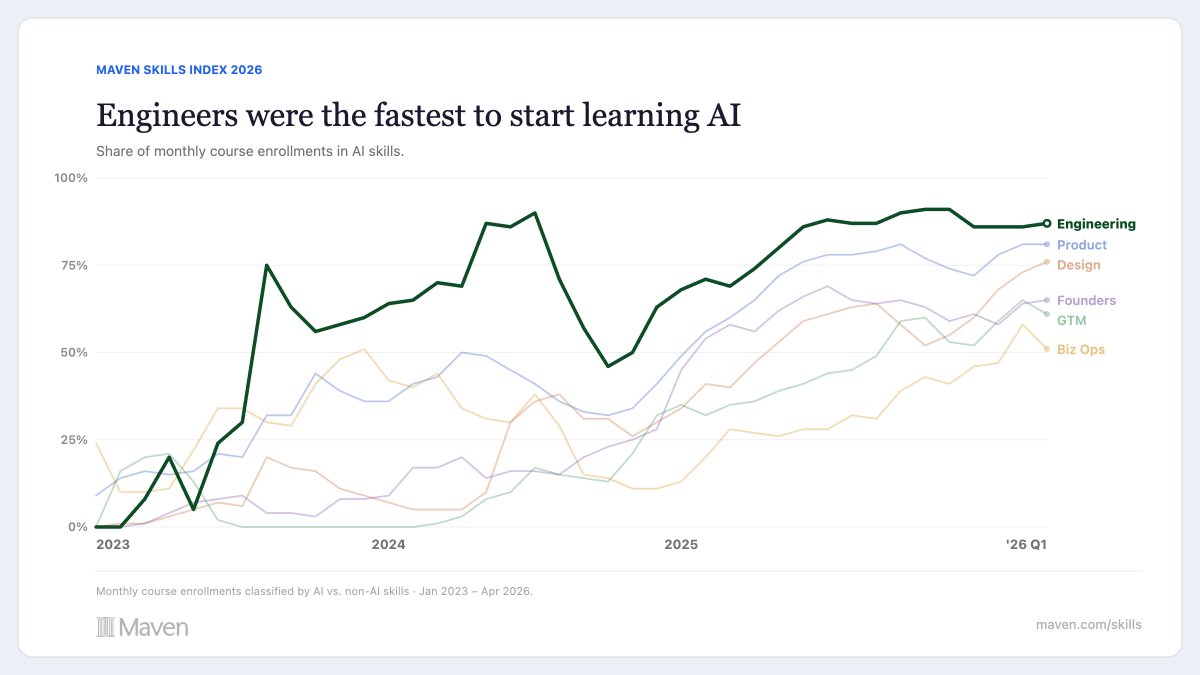
We looked at 500k+ employees at major companies like Amazon, OpenAI, Google, etc. and asked: what are the most in-demand skills in 2026? How has that changed since 2022?
It’s fascinating to see what skills have become popular over time or the salary premium you get for being an “AI” native employee.
Check out the report at https://t.co/4HcOpz8j1l.
Got rejected today from 3 companies.
Role: Remote
Company: US-based
Base: ₹62, 45, 70 LPA
Applied through Jobs24x, Underdog and Remotive.
Not even mad,
I didn’t even know these companies existed 3 4 weeks ago.
9,000 Microsoft employees got an email at lunch today.
Take the money. Go home.
The safest job in tech. Gone in an afternoon.
Nobody called it a firing.
They called it a retirement gift.
This is 2026.
RIP marketers.
Someone built a money printer… you paste a website and it just starts bringing in customers in your sleep.
It’s called Money Printer.
It reads your site, figures out who should be buying, finds those companies, and reaches out to them automatically.
I tried it on a SOC 2 compliance tool and it immediately surfaced fintech startups hiring for security roles and the Heads of Security responsible for it.
Here’s what happens:
→ Companies already showing intent for what you sell
→ The exact people to contact inside those companies
→ Personalized outreach written for each account
→ Campaigns launch automatically
→ It even calls them
No forms. No filters. No list building.
Here’s the wild part:
Most teams are still doing this manually.
Lists. Copy. Campaigns stitched together.
This replaces all of it.
You give it a URL.
It finds buyers, reaches out, and starts generating pipeline.
Insaneee 🤯
OpenAI just shipped a model that works for 8 hours straight without stopping.
GPT-5.5 isn't an upgrade. It's a different class of machine:
→ New #1 coding model. Claude just lost the crown it held for a year.
→ Solves 20-hour software engineering tasks 73% of the time.
→ Matches Claude Opus 4.7 at a quarter of the cost.
→ Runs tools on its own and checks its own work until the task is actually done.
→ Generates a fully playable game in a single prompt.
One developer set it running at night, queued up 10 prompts to keep it going, and went to sleep. Woke up 8 hours later. It was still working on the first.
Before this, models tapped out after 30 minutes.
Every builder just got a dev team.
Every solo founder just got a research partner who doesn't stop to eat.
Every long workflow that needed human babysitting just became background work.
You don't prompt this model anymore. You delegate to it.
Most startup founders today are running heavily funded charities.
In fact, they operate exactly like desperate politicians.
Think about what a politician does right before an election.
To win votes, they announce free electricity, free laptops, and cash handouts. They completely bankrupt the state’s treasury just to buy loyalty.
Their goal isn't to build a strong economy. Their goal is simply to win the election.
Modern tech founders run the exact same playbook.
Before pitching for a Series A, they slash prices. They offer 80% discounts. They spend ₹1,000 on Meta ads to acquire a user who pays them ₹200.
They bankrupt the company’s treasury just to buy "Daily Active Users."
Their goal isn't to build a profitable business.
Their goal is to show a hockey stick growth graph to win their election: The next funding round.
They are buying users with VC money to show growth, to raise more VC money, to buy more users.
If a street vendor makes a samosa for ₹15 and sells it for ₹5, there will be a massive line stretching down the street. He will show 100% week on week growth.
But he isn't a genius entrepreneur. He is just giving away free money. The moment the politician stops the freebies, the voters leave.
The moment the startup stops the 50% discount code, the users delete the app.
Why? Because the users were never loyal to the product. They were loyal to the subsidy.
Go to any traditional wholesale market. Tell a generational business owner to sell his inventory at a loss for 3 years just to capture the market.
He will laugh you out of his shop.
Traditional business owners don't subsidize their customers. They serve them.
For them, gross margin is not a future goal because it is a Day 1 requirement.
If you are giving away your product for free (or at a loss) just to show a high user count to investors, you aren't an entrepreneur. You are just running a political campaign funded by venture capital.
Whenever I say this, founders scream: "But Zomato and Uber burned cash for years!"
This single sentence has destroyed more startups than any bad product ever could.
Yes, they did. Because they were building Winner Take All platforms with massive Network Effects. They were spending billions to change human behavior at a global scale.
But here is the harsh truth: You are not Zomato. > You are building a D2C protein brand, a SaaS tool or tshirt brand. You do not have global network effects. If you are burning cash to sell a cup of coffee, you aren't building a monopoly. You are just bad at math.
Stop buying votes.
Start building a business.
RT if you agree that Unit Economics > Vanity Metrics.
Follow @ValueWithPrem for more unfiltered truths on startups, capital, and traditional wealth.
The reason most people in India never started a business was not money. It was people.
You had an idea. Maybe a good one. You could see the product in your head. You knew who would buy it. You knew how to price it. You knew the market existed.
Then you started listing what you needed to actually build it.
An engineer to build the app or the website.
A designer to make it look like something people would trust.
A copywriter for the landing page, the ads, the emails.
Someone who understood Meta ads because you had never run a campaign in your life.
A salesperson or at least someone to handle inbound calls.
Someone to manage Instagram and LinkedIn because you knew you needed to post but did not know what.
Someone to edit the reels because static posts were dead.
Or you hired agencies. An agency for ads. An agency for design. A freelancer for content. A developer on contract.
That's a lot of consultants before you earn anything. You were possibly looking at Rs 2 to 4 lakh in monthly burn before a single customer had paid you a single rupee.
You were not only spending the amount but also spending half your time managing people who did not understand your business and needed 3 rounds of revisions on everything.
The math killed the dream for most people. Not because they could not afford it eventually. Because they could not afford it at the start. Before revenue. Before proof. Before knowing if the idea would even work.
So they went back to their jobs. Not because the idea was bad. Because the cost of testing the idea was too high.
This is what AI actually changed in 2026. Not some abstract future of work nonsense. The concrete, specific, rupee-denominated cost of going from idea to first paying customer.
I watched a 26-year-old go from idea to paying customers in 4 days last month.
Day one. He described his product to Claude Code and it built him a working web application. Not a mockup. A functioning product with a client login, a dashboard, and a payment integration. The kind of thing that would have taken a developer 3 to 4 weeks and cost Rs 1.5 to 3 lakh.
Day two. He asked Claude Code to write his landing page copy, his ad copy, and his email sequences. Then he asked it to generate the design for his landing page. He had a complete marketing funnel ready by evening. The kind of output a copywriter and designer together would have produced in 2 weeks.
Day three. He set up Meta ads himself using Claude Code to help him structure the campaign, choose the targeting, and create 8 different ad variations to test. He spent Rs 2,000 on the first day of ads. An agency would have charged Rs 30,000 a month and taken 2 weeks to set up the first campaign.
Day four. First paying customer.
Total cost: Rs 10,000 and 4 days of his time. Total team size: himself.
The same business in 2022 would have required at minimum 3 people and Rs 5 lakh before the first invoice.
Now let me be clear about what I am not saying.
I am not saying AI replaces all those people forever. As the business grows, he will need a real developer for the complex features, security, maintenance.
He will need a real designer for brand consistency. He will need a real ads person when he is spending Rs 5 lakh a month on campaigns. He will need a real sales team when inbound volume exceeds what one person can handle.
But he does not need any of them to start. He does not need them to test. He does not need them to find out if anyone will pay.
That is the shift. The cost of testing a business idea went from lakhs to thousands. The time went from months to days. The team went from 5 people to one person and an AI.
When testing is free, everyone tests.
Think about what this means for India specifically.
India has never had a shortage of ideas or ambition. Walk into any chai stall near any engineering college, any CA coaching center, any law university. Every second person has a business idea. Most of them are good ideas. Many of them would work.
The filter was never quality of ideas. The filter was cost of execution. Only people with savings, or family money, or the ability to raise funding could afford to try. Everyone else watched from the sidelines.
That filter just broke.
A CA who sees an opportunity in automated compliance for D2C brands can build the first version this weekend and test it with 5 potential clients next week. If nobody wants it, he has lost a weekend. If 3 out of 5 say yes, he has a business.
A teacher who has a better way to teach math to Class 10 students can build the course, the platform, and the marketing in a week. If it works, she scales. If it does not, she is out Rs 5,000.
An engineer who sees an inefficiency in how logistics companies track shipments can build a prototype, show it to 3 logistics companies, and know within 10 days if this is a business or not.
The entire process of entrepreneurship just compressed. Not the hard parts. The hard parts are still hard. Selling is hard. Finding product-market fit is hard. Scaling is hard. Managing people is hard.
What got easy is everything before the hard parts. The setup. The first version. The first test. The first customer. Getting the PMF right.
That was always the most expensive and most risky phase. And it just became nearly free.
I think more businesses will be started in India between 2026 and 2030 than in the previous 30 years combined. Not because Indians became more ambitious. Because the tax on ambition just dropped to zero.
The golden age is not coming. It started the day a person with an idea and a laptop stopped needing permission from investors, employees, or agencies to find out if their idea was worth pursuing.
That day was about 2 months ago. Most people have not noticed yet.
🚨BREAKING: Claude has a feature called Learning Mode.
You can use it to learn literally anything, step by step, like a personal tutor.
Here’s how to access it.