Hii, I'm Saber and I'm currently 19.
Sooon enough I'll be one of the biggest web3 Developers in Africa.
when you Hear Saber you think of web3 development
clock it.
@djaikoku@dreamDEXSomnia DreamArena never liquidates anyone. Liquidations happen on @DreamDEXSomnia at their oracle mark price. Our contract only reads that event and scores the run. The liq price we show comes from dreamDEX's own SDK.
Introducing DreamArena Perps
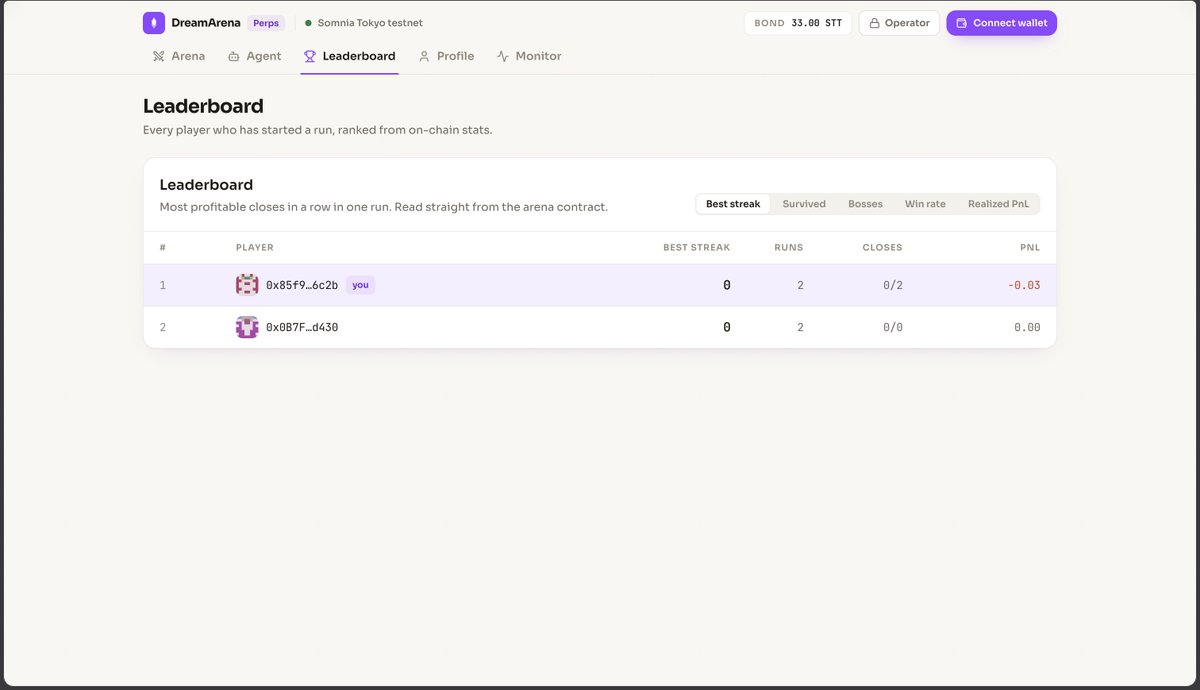
Leverage challenges on @DreamDEXSomnia perps, scored on-chain in the same block as your trade. No keeper, no backend, no fake scores.
Survivor. Streak. Boss.
Play with your own dreamDEX wallet 👇
https://t.co/bbz7P0GELM
How DreamArena keeps it fair: you pay for your own referee.
Each run prepays a little STT. Every Reactivity callback bills the player it served; leftovers come back.
Link your wallet as a bot in @DreamDEXSomnia. It trades, never withdraws.
https://t.co/qZrN0etotZ
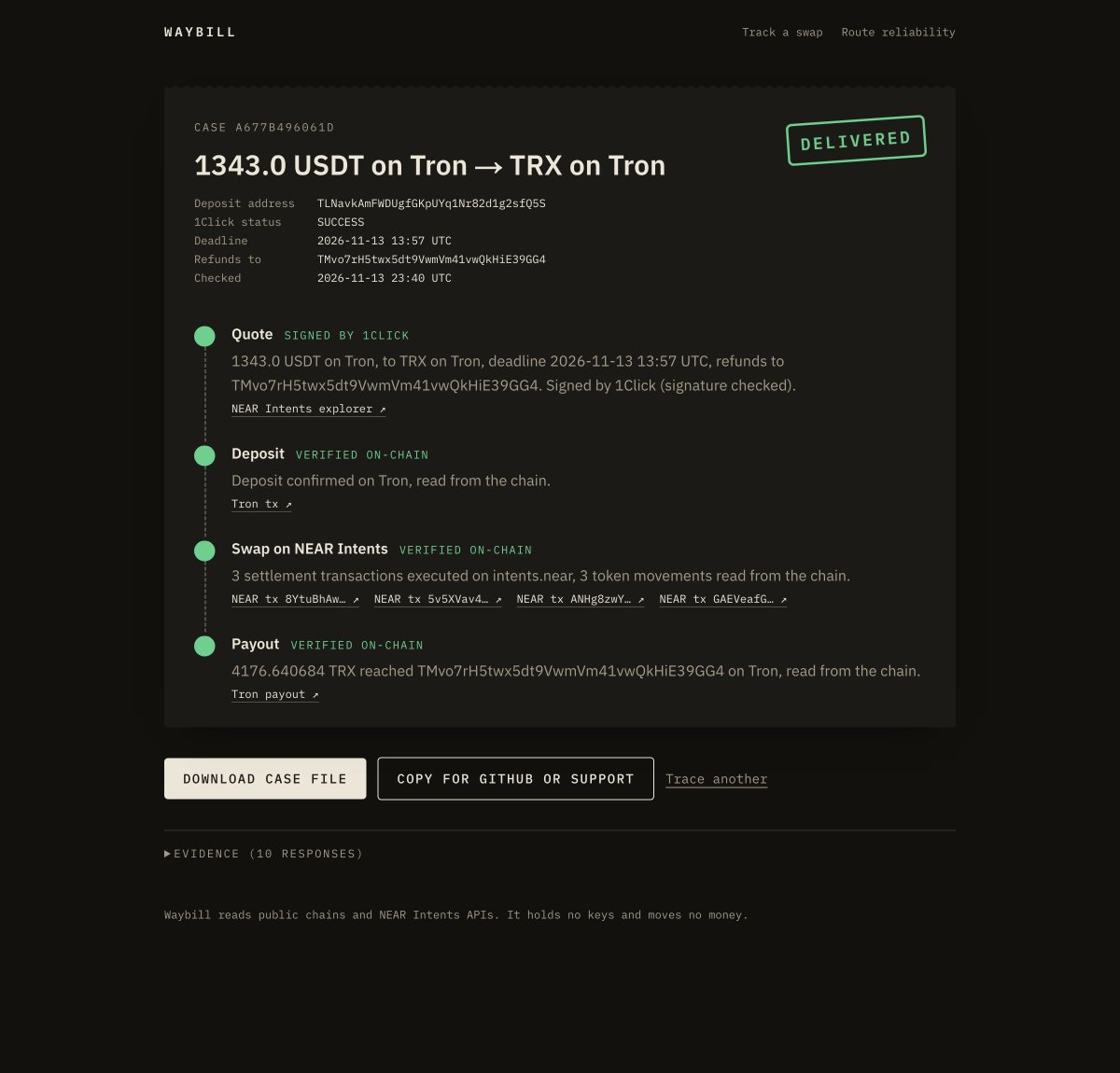
Swap stuck on PROCESSING?
Waybill, built at NEAR HACKATHON: paste a NEAR Intents deposit address. Before sending: what to send, where, by when. After: each leg read on its own chain.
Demo: https://t.co/ioe51YxfeZ
Live: https://t.co/S6pY4v8dhT
@NEARProtocol#NEARHackathon
I think a lot of people haven’t fully grasped how much the state of software engineering has changed.
The barrier to building software is dropping rapidly. AI has made it possible for more people to build, experiment, ship products and participate in hackathons than ever before.
Look at the Monad Metropolis Hack, with 885 teams participating. Compare that to the number of people building and competing in hackathons 2–4 years ago. The difference is significant.
But here’s the thing: when everybody can build, simply being able to build is no longer enough to stand out.
The entry barrier to software development is getting lower, but the competition for opportunities, employment and attention is getting tougher.
I don’t think people should panic, and I’m definitely not complaining. I just think we need to be honest about the reality we’re moving into.
Knowing how to code is still valuable. But understanding systems, making good engineering decisions, solving real problems, evaluating AI-generated work, and knowing how to ship reliable software are becoming even more important.
The goal can no longer be just to learn how to build. It’s to become an engineer who knows what is worth building, why it matters, and how to build it properly.
Congrats to everyone who participated.
I think it’s time I take a step back from X.
A lot has changed, both in engineering and in the way content works here. And honestly, I can’t keep doing the same things, putting in the effort, paying for Premium, and constantly trying to make things work when they aren’t.
More importantly, I need to prioritise my mental health and give myself room to breathe, create, learn and grow without the pressure of constantly showing up online.
I’ll be cancelling my X Premium subscription and stepping away from actively creating content here for a while. I might still pop in and post occasionally, but I won’t be as active.
I’m not disappearing, though. My DMs are still open. I’m still reachable, and I’d love to stay connected with everyone I’ve met here.
You can reach me through:
Telegram / Other socials: https://t.co/7YPsf2DFqk
GitHub: https://t.co/novQ8aNxOA
Email: [email protected]
Thank you to everyone who’s supported me, engaged with my work, checked in, or simply been part of the journey.
I just need to choose myself for a bit. No pressure, no expectations. Just taking some time to figure things out and focus on what matters.
See you in 2027. ❤️
This one is close to my heart, having seen my origin country (lebanon) go into complete economic meltdown, with its central bank seizing people’s dollars. Several of my friends and family lost everything and had to start over.
Governments seizing people’s savings is also coming to Europe. France for example is considering forcing people to lend them their savings to plug its gigantic debt hole. Imagine working your entire life, putting money aside for retirement, only to have your government take it away.
There has never been a more important time for non-custodial, private stablecoin spending and savings accounts.
Please support @raycashxyz and their mission!
Every trading leaderboard you've ever played on has the same weak spot.
Somebody's server decides your score.
A backend. A database. An admin with a password. You bring real conviction, real leverage, real nerves, and at the end a machine you can't see tells you whether you won.
We wanted to know what happens when you take that machine away.
No keeper. No backend. No admin.
Just you, a leveraged position on @DreamDEXSomnia, and a contract that watches every move you make and judges it in the same block it happens.
Three challenges.
Nobody has beaten the third one yet.
Doors open soon.
Moving tokens across chains usually means trusting a black box.
You sign. You wait. You hope it lands. No status, no fees you saw coming, and no proof when it does arrive.
So I built RelayMesh at the @ Hacker House. It moves tPOT between PortalDot's Substrate side and its EVM side, and shows you every step of it.
Here is what it does today, live on PortalDot V3 testnet:
A quote with every fee up front You choose where the funds go and see the exact cost before you pay. On a real 10 tPOT transfer: 0.0195 tPOT network fee, 0.2 tPOT RelayMesh fee, about 18 seconds. Before you sign, it decodes the exact call your wallet will sign, so nothing is hidden in the signature.
One signature, a live timeline Sign once. Then watch it move: included in block #291963, finalized 17 seconds later, funds seen on the EVM side at 19 seconds, settled at 22. RelayMesh only calls it settled after it measures the recipient's balance change on chain.
A receipt anyone can check Every transfer ends in a receipt. Its hash is written to PortalDot V3 by our ReceiptBatchLog contract, for 0.0186 tPOT per anchor. Open /verify and your browser rebuilds the hash and checks it against the chain. Change one field and it fails.
A checker for the PortalDot to BNB Chain bridge Paste a mainnet bridge deposit and RelayMesh finds the WPOT payout on BNB Chain and checks the amount after the 3% bridge fee. Deposit 860457-1: 44 POT in, 42.68 WPOT out. Verified, then the check itself anchored on V3.
A fee model that pays for itself The 0.2 tPOT fee goes straight to the relayer in the same transaction as the transfer. One fee covers about 10 anchors, so the service funds its own proofs.
An open API Everything in the app is a plain HTTP endpoint: intents, quotes, timelines, receipts, anchors, bridge checks. The /developers page lets you run each call live in the browser.
The numbers so far: 10 settled transfers, 382 tPOT moved, every receipt anchored, 5 bridge deposits verified, 212 tests.
And this is only the start. Next: the reverse EVM to Substrate route, an iBridge adapter, a TypeScript SDK and signed webhooks, then mainnet, treasury payout receipts and more chains. The goal is a verification layer for every value transfer on PortalDot, held to one rule: if it moved, you can prove it.
Try it: https://t.co/Uy40QcCTHQ
API docs: https://t.co/YKCSnxRPsr
Code and roadmap: https://t.co/SDDSWAYqYF
Full demo: https://t.co/3jyYB1MR8O