JUST IN🚨: NASA released a new Mars image showing real clouds 250 million miles away. These include rare iridescent clouds seen for the first time on another planet.
O que aquela foto de um Buraco Negro revela de verdade?
A primeira imagem do buraco negro da galáxia M87 parecia apenas um anel de fogo desfocado para a maioria das pessoas.
No entanto, os conceitos físicos envolvidos ali superam qualquer ficção científica, tanto que muita gente reclamou que o registro não lembrava o visual do filme Interestelar.
Para compreender o que está acontecendo naquela fotografia astronômica, você precisa entender estes 3 pontos:
1. Visão dupla do disco: A gravidade ali é tão violenta que distorce o tecido do espaço-tempo. Como resultado, a luz emitida pela parte de trás do buraco negro é desviada para cima e para baixo, permitindo que enxerguemos o topo e a base do disco de acreção simultaneamente.
2. A escuridão central é uma ilusão: Aquela bola preta no meio da imagem não delimita o Horizonte de Eventos real, sendo cerca de 2,6 vezes maior que ele. O que observamos ali é apenas a sombra projetada pelo buraco negro, formada porque a luz que passou perto demais acabou capturada.
3. Ângulo total em um único disparo: A distorção luminosa é tão intensa que o retrato capta, em tese, todas as faces do objeto cósmico ao mesmo tempo e de uma só perspectiva. Trata-se do efeito de lente gravitacional funcionando em sua potência máxima.
🎞️ curiosidadesindispensaveis/IG
O Telescópio Espacial James Webb fez talvez sua descoberta mais profunda até o momento. As observações do telescópio validam uma teoria intrigante de que o nosso Universo inteiro estaria dentro de um buraco negro. "Esta descoberta pode explodir sua mente"😱
The Oort Cloud: Our Solar System’s Invisible Frontier
Far beyond the planets, at the outermost edge of the Sun’s domain, lies a realm so vast and remote that it challenges the imagination: the Oort Cloud.This enormous spherical shell of icy comets and frozen debris forms the true boundary of our solar system. While Neptune orbits at about 30 AU and Pluto at roughly 40 AU, the Oort Cloud begins thousands of astronomical units from the Sun and may extend out to 100,000 AU or farther. (One AU — the average Earth-Sun distance — is roughly 150 million kilometers.)To grasp this scale: light, traveling at 300,000 km per second, takes just eight minutes to cross one AU. Yet it requires weeks to reach the inner edge of the Oort Cloud and more than a full year to arrive at its outermost fringes — over one light-year away.Human technology barely scratches this frontier. Voyager 1, our most distant spacecraft, would still need roughly 300 years just to reach the inner Oort Cloud and another 30,000 years to cross https://t.co/R6T3FjqdHD, the Sun’s gravitational grip grows incredibly weak. Icy bodies drift in a loosely bound swarm, easily nudged by the gravity of passing stars or the subtle tides of the Milky Way itself. Occasionally, one of these frozen wanderers is disturbed from its ancient orbit and sent plunging inward — becoming the long-period comets that streak dramatically across our night skies millions of years later.The Oort Cloud isn’t just far away; it represents a conceptual edge. Our solar system doesn’t end neatly at the planets or even at the Kuiper Belt — it fades gradually into interstellar space across a volume so immense that it underscores both our isolation and our subtle connection to the rest of the galaxy.A vast, invisible reservoir of ice and history, silently guarding the outer limits of the Sun’s realm — the Oort Cloud reminds us just how breathtakingly large our cosmic backyard truly is.
The James Webb Space Telescope has done it again: revealing a breathtaking structure now dubbed the “Cosmic Vine”: a string of 20 galaxies stretching across a staggering 13 million light-years!
What makes this discovery so shocking? This colossal formation dates back nearly 11 billion years, forming just 3 billion years after the Big Bang, a time when galaxies were thought to still be forming in isolated clumps. Instead, JWST captured a massive, organized structure linking galaxies together much earlier than expected.
[image: artist's impression]
Stop.
Breathe.
This is Mars.
Not a render. Not a dream.
A nuclear-powered machine we built is standing there right now, in that silence, sending light from another world straight into your eyes.
This is 140 million miles away from us!
BEHOLD🚨: you're looking at the largest map of the universe ever created!
Each bright dot you see is an entire galaxy. Earth is at the center, and the cosmic web of filaments and voids is clearly visible.
It took 9 years and 3 billion miles to get this shot.
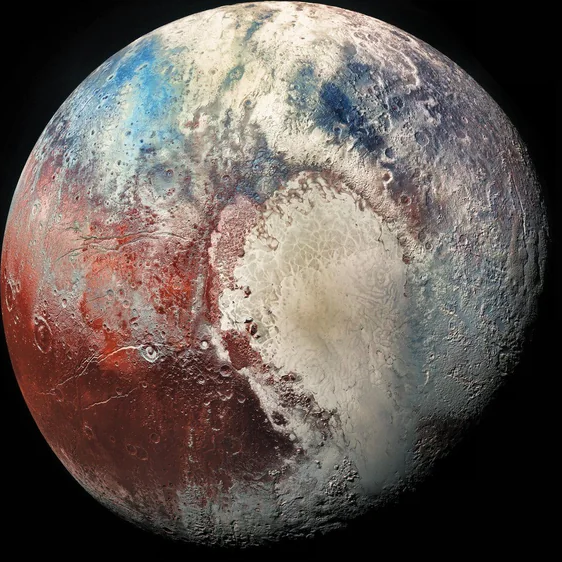
Pluto’s icy Mountains.
But how exactly did we get it? A story of one of NASA’s greatest missions:
People don't realize how absurd this view actually is.
A camera. On a robot. On Mars.
Built by humans on a planet 140 million miles away, launched on a rocket, landed using a sky crane, and now driving across an alien desert taking pictures so detailed you can count the rocks.
100 years ago, your great-grandparents thought airplanes were a miracle.
You are scrolling past Mars on your phone.
Brian Cox reveals that every tiny dot is a galaxy hosting 100 billion stars. That thin line at the top? A billion light-year span. Even at the speed of light, it would take a billion years just to cross that sliver. We are part of a cosmic ocean containing 30 sextillion stars, and yet, this is only the part we can see.
The room went completely silent as the scale settled in. It is one thing to hear the numbers, but seeing that map makes you realize we are drifting in a vast, beautiful ocean of light. This is the observable universe, a tiny fraction of a much larger reality. Pure cosmic awe is the only appropriate response to our place among the stars. It makes every earthly struggle feel both infinitely small and our existence infinitely precious.
Source: Horizons: A 21st Century Space Odyssey (Live Tour)
Scientists have created one of the most detailed 3D reconstructions of a human cell (eukaryotic cell) ever produced.
This groundbreaking model, often termed a "Cellular Landscape Cross-Section Through a Eukaryotic Cell," combines data from X-ray tomography, nuclear magnetic resonance (NMR), and cryo-electron microscopy to map molecular structures in extreme detail.









![Rainmaker1973's tweet photo. The James Webb Space Telescope has done it again: revealing a breathtaking structure now dubbed the “Cosmic Vine”: a string of 20 galaxies stretching across a staggering 13 million light-years!
What makes this discovery so shocking? This colossal formation dates back nearly 11 billion years, forming just 3 billion years after the Big Bang, a time when galaxies were thought to still be forming in isolated clumps. Instead, JWST captured a massive, organized structure linking galaxies together much earlier than expected.
[image: artist's impression]](https://pbs.twimg.com/media/HI2nEAJXkAAeFcl.jpg)


