Something humans built is now flying where the Sun’s power finally gives out.
Voyager 1 has left the giant bubble our star blows around the solar system. It pushed through the heliosheath, slipped past the heliopause, and is now cruising through real interstellar space.
How far out is that? About 25.9 billion km from home.
No human-made object has ever been farther. And it was launched back in 1977.
Still going.
The yellow structure is the Laniakea Supercluster containing around 100,000 galaxies and the red dot marks our home,
the Milky Way, which has about 300 billion stars including our Sun.
Our universe might be pixelated, made of timy discrete unites of spacetime much smaller than the atoms, known as ‘Planck-scale quatum pixels’, research reveals.
This meteorite is almost as old as the solar system itself.
Discovered near Fukang, China, in 2000, the Fukang meteorite is estimated to be approximately 4.5 billion years old, dating back to the earliest days of our solar system.
It’s a rare type of meteorite known as a pallasite, made of golden olivine crystals embedded in an iron-nickel matrix. When sliced thin and illuminated from behind, the crystals glow like stained glass, creating one of the most breathtaking sights in meteoritics.
Betelgeuse is fading again, and the most famous red star in the sky is starting to feel like a countdown.
It’s been dimming since August. Again. That word matters, because this star already pulled the same trick back in late 2019, when it dropped so hard that people genuinely started watching for an explosion.
Here’s the part that gets me. When Betelgeuse finally goes supernova, nobody will need a telescope or a live feed to catch it. The blast will be visible from right here on Earth, with your own eyes.
Step outside and find Orion. That red glow in the top left corner?
It’s living on borrowed time.
The most famous sky in art history now has a date: July 22, 1889.
For decades everyone said June. Van Gogh wrote to Theo around June 18 that he’d finished a new study of a starry sky, and an earlier reading matched it to June 19 and called the swirling stars Aries.
A Korean team thinks that’s the wrong constellation. Shape analysis matched the five central stars to the Hyades in Taurus, and his later pen drawing fits even better.
Around July 22, the Hyades rose in the east beside Venus, with a moon close to the crescent on the canvas. Weather records suggest the sky was clear enough to see it.
He may have dreamed it up in June and finished after July 22.
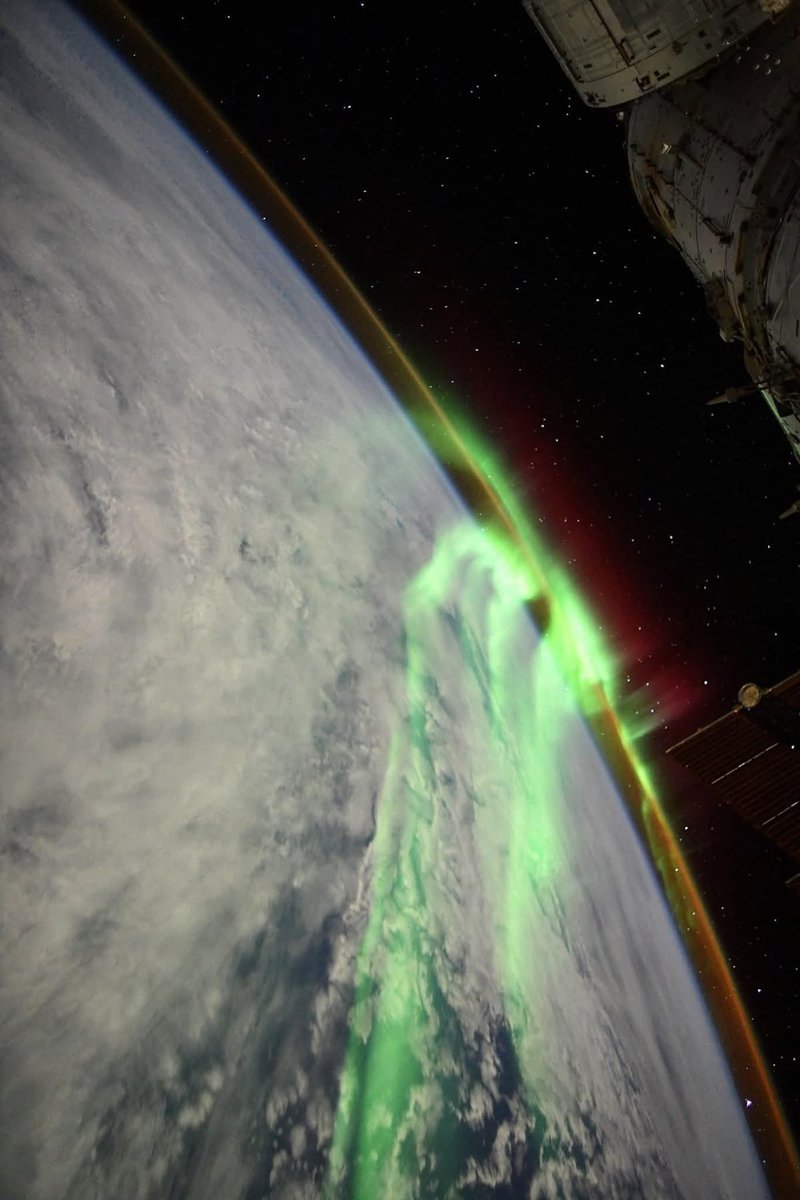
A rare Transient Luminous Event (TLE)—specifically a red sprite and gigantic jet—captured from orbit above a thunderstorm by NASA astronaut Nichole Ayers aboard the ISS.
A hole on the Moon just turned out to be the front door to a 50 km tunnel.
Japan’s Kaguya orbiter first spotted it. A pit about 50 metres wide and 50 metres deep, sitting in the Marius Hills on the Moon’s near side.
Then JAXA pointed the probe’s radar underground. The echoes came back with something huge: a lava tube roughly 100 metres wide, running about 50 km, and still intact. No collapse.
Scientists think it was carved by volcanic activity around 3.5 billion years ago. There may even be ice or water locked in the rocks inside.
That’s why JAXA thinks it could become a lunar base. Shelter from radiation, micrometeorites and brutal temperature swings, all built in.
Source: JAXA / ISAS, Geophysical Research Letters
Mars at 8:30 in the morning just gave us the most detailed look yet at cliffs scientists have waited years to see up close.
NASA’s Curiosity rover shot the scene with its Mastcam, roughly an hour after sunrise. Six frames stitched into one panorama. Those glowing crags on the horizon? Wind-carved cliffs called yardangs.
And they’re strange. JPL project scientist Ashwin Vasavada says the layer looks out of place, with the wrong colour, oddly tilted layers, and a look like it was plastered on.
Curiosity has been climbing Mount Sharp since 2014 and just passed about 1 km of elevation, the highest any rover has gone on Mars.
Next up: rolling deep into the yardangs themselves.
The woman who flew around the Moon just got grounded for good.
NASA made it official. Christina Koch will never fly in space again.
She’s been named acting deputy chief engineer starting November 1, taking over from Katherine Van Hooser, who retires after more than 35 years. Here’s the catch. The job moves her to management astronaut status, which makes her ineligible for any future spaceflight.
Think about who we’re talking about. 328 consecutive days on the ISS. Part of the first all-female spacewalk. The only woman ever to travel around the Moon, on Artemis II in April.
And NASA’s release doesn’t include a single word from Koch.