Cheers to 2026 💫
This past year, we built more than a protocol! we built trust, transparency, and a foundation for ethical, Shariah-aligned DeFi. From strategic partnerships and institutional backing to rigorous audits and innovative dual-token design, every step was about creating something lasting and meaningful.
In 2026, Quintes isn’t just aiming higher! it’s aiming for greatness. More resilience, more accessibility, and more opportunities for everyone to participate in a DeFi ecosystem built on trust and long-term vision.
Here’s to a year of growth, impact, and building the future of digital finance together.
These are recent crypto investment stats according to recent Coinlaw research:
💰In 2025, women represent only 26% of global cryptocurrency investors.
💰60% of women cite lack of crypto knowledge as a barrier to entry.
💰52% of women say they don’t feel confident making crypto investment decisions.
💰Educational content tailored to women has higher engagement rates than general tutorials and women adopt crypto at higher rates when introduced via financial education programs.
Introducing Si Her Trade, a new trading club for our Si Her DAO members. Curated for all stages of crypto trading experience, with Education 3.0 (peer-to-peer) learning guided by our members.
Explore our Si Her DAO to develop your personal Web3 brands, network, and crypto finance literacy:
👇
https://t.co/HMn60xn7iy
#web3 #crypto #womxninweb3 #cryptoliteracy #siher
Thrilled to speak on Women in Tech at this X Spaces hosted by @AjeetK + along with other amazing Women leaders from across the globe
🗓 Aug 7
🕥 10:30am ET
🔗 https://t.co/ucAh35VxY1
@unstoppableweb
Thrilled to host a "WOMEN IN TECH" Twitter Space on Aug 7 at 10:30 am ET, featuring:
@Sandy_Carter: COO, Unstoppable Domains & founder of Unstoppable Women of Web3 (scaling decentralized identity)
@SabrinaGoerlich: Design‑Sprint expert & fractional CPO in Web3 (human‑centric innovation)
@RidhiKD: Co‑Founder LXME (fintech for women, $1.2M raised, 400K+ users)
@yipclouds: CEO https://t.co/JQkmbOobaK (ethical AI, equity & Web3 education)
@Firdosh_Drife: CEO & Co‑Founder Drife (blockchain-powered ride-hailing Taxi 3.0)
@daosasha: Web3 troubleshooter, DAO strategist & community innovator
And More...
Join live: https://t.co/GT1mWjJibz
Let’s celebrate how women are shaping the future of tech.
Excited to speak in this X Spaces on Women in Tech, hosted by @AjeetK & joined by other amazing leading ladies from the Tech world.
🗓 Aug 7
🕥 10:30am ET
🔗 https://t.co/pMyzFbdpHK
We’ll talk inclusion, leadership, and design-driven innovation in web3
The buzz over DeepSeek this week crystallized, for many people, a few important trends that have been happening in plain sight: (i) China is catching up to the U.S. in generative AI, with implications for the AI supply chain. (ii) Open weight models are commoditizing the foundation-model layer, which creates opportunities for application builders. (iii) Scaling up isn’t the only path to AI progress. Despite the massive focus on and hype around processing power, algorithmic innovations are rapidly pushing down training costs.
About a week ago, DeepSeek, a company based in China, released DeepSeek-R1, a remarkable model whose performance on benchmarks is comparable to OpenAI’s o1. Further, it was released as an open weight model with a permissive MIT license. At Davos last week, I got a lot of questions about it from non-technical business leaders. And on Monday, the stock market saw a “DeepSeek selloff”: The share prices of Nvidia and a number of other U.S. tech companies plunged. (As of the time of writing, some have recovered somewhat.)
Here’s what I think DeepSeek has caused many people to realize:
China is catching up to the U.S. in generative AI. When ChatGPT was launched in November 2022, the U.S. was significantly ahead of China in generative AI. Impressions change slowly, and so even recently I heard friends in both the U.S. and China say they thought China was behind. But in reality, this gap has rapidly eroded over the past two years. With models from China such as Qwen (which my teams have used for months), Kimi, InternVL, and DeepSeek, China had clearly been closing the gap, and in areas such as video generation there were already moments where China seemed to be in the lead.
I’m thrilled that DeepSeek-R1 was released as an open weight model, with a technical report that shares many details. In contrast, a number of U.S. companies have pushed for regulation to stifle open source by hyping up hypothetical AI dangers such as human extinction. It is now clear that open source/open weight models are a key part of the AI supply chain: Many companies will use them. If the U.S. continues to stymie open source, China will come to dominate this part of the supply chain and many businesses will end up using models that reflect China’s values much more than America’s.
Open weight models are commoditizing the foundation-model layer. As I wrote previously, LLM token prices have been falling rapidly, and open weights have contributed to this trend and given developers more choice. OpenAI’s o1 costs $60 per million output tokens; DeepSeek R1 costs $2.19. This nearly 30x difference brought the trend of falling prices to the attention of many people.
The business of training foundation models and selling API access is tough. Many companies in this area are still looking for a path to recouping the massive cost of model training. Sequoia’s article “AI’s $600B Question” lays out the challenge well (but, to be clear, I think the foundation model companies are doing great work, and I hope they succeed). In contrast, building applications on top of foundation models presents many great business opportunities. Now that others have spent billions training such models, you can access these models for mere dollars to build customer service chatbots, email summarizers, AI doctors, legal document assistants, and much more.
Scaling up isn’t the only path to AI progress. There’s been a lot of hype around scaling up models as a way to drive progress. To be fair, I was an early proponent of scaling up models. A number of companies raised billions of dollars by generating buzz around the narrative that, with more capital, they could (i) scale up and (ii) predictably drive improvements. Consequently, there has been a huge focus on scaling up, as opposed to a more nuanced view that gives due attention to the many different ways we can make progress. Driven in part by the U.S. AI chip embargo, the DeepSeek team had to innovate on many optimizations to run on less-capable H800 GPUs rather than H100s, leading ultimately to a model trained (omitting research costs) for under $6M of compute.
It remains to be seen if this will actually reduce demand for compute. Sometimes making each unit of a good cheaper can result in more dollars in total going to buy that good. I think the demand for intelligence and compute has practically no ceiling over the long term, so I remain bullish that humanity will use more intelligence even as it gets cheaper.
I saw many different interpretations of DeepSeek’s progress here in X, as if it was a Rorschach test that allowed many people to project their own meaning onto it. I think DeepSeek-R1 has geopolitical implications that are yet to be worked out. And it’s also great for AI application builders. My team has already been brainstorming ideas that are newly possible only because we have easy access to an open advanced reasoning model. This continues to be a great time to build!
[Original text: https://t.co/yiOHeGJgLZ ]
NEW! @VitalikButerin joins the @greenpillnet podcast today to talk about Web3 Public Goods Funding in 2025.
This episode is part 1 of a 2 part series. In ep 1 we
discuss:
TIMESTAMPS
00:00 - Intro
2:18 - Why Public Goods?
03:17- Private vs. Public Goods
05:20 - Challenges of Funding Public Goods
06:13 - Intrinsic Motivation and Public Goods
07:16 - Funding Models for Public Goods
09:18 - Digital Ecosystem and Public Goods
10:12 - Revenue Curve and Public Goods
11:36 - Decentralization vs. Domination
13:05 - Competitive Advantage of Public Goods
15:01 - Resilience Through Public Goods
17:07 - Broader Impact of Ethereum
19:18 - Escape Velocity Theory
19:51 - Importance of Public Goods
21:31 - Diversity in Funding Entities
23:44 - Challenges in Funding Public Goods
26:02 - Scaling Funding Needs
27:04 - Hybrid Funding Models
29:09 - Institutionalizing Funding
31:00 - Layer Two Solutions
31:59 - Importance of Scaling Funding
34:00 - Moralism in Ecosystem Dynamics
36:22 - Quality Allocation of Funding
37:26 - Diversity of Funding Mechanisms
39:34 - Stability in Funding Mechanisms
41:09 - Prediction Markets for Public Goods
42:27 - Info Finance Concept
44:36 - Distilled Human Judgment Mechanism
46:52 - Governance as a Lego Concept
47:58 - Forking Protocol Guild
50:54 - Discussion on Ethereum Critique
51:57 - Auto Public Goods Funding
53:11 - Tokenization and Open Source Funding
53:49 - Evaluating Funding Mechanisms
54:48 - Finding High Leverage Projects
56:19 - Challenges in Distribution
57:32 - Public Goods Funding in 2025
59:36 - Outro
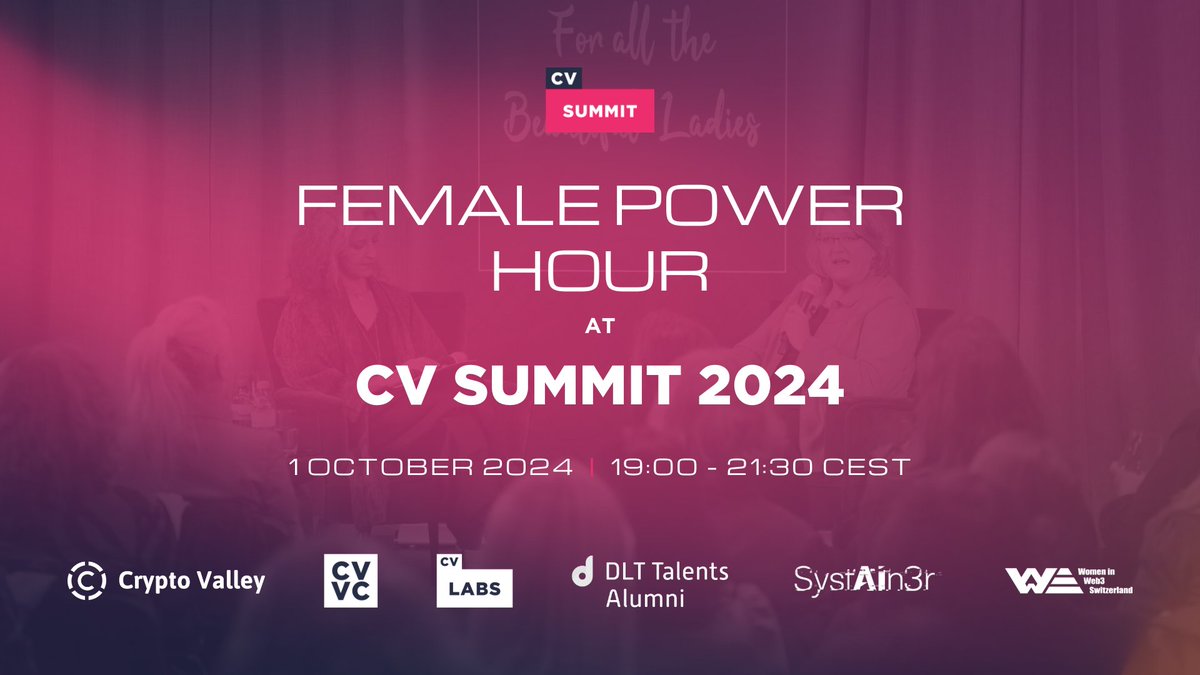
Join WiW3Ch and our partners @CV_Labs@DltTalents@thecryptovalley and @SystAIn3r at #CVSummit2024 Oct. 1 for Female Power Hour at 7 PM CEST! 🚀
Expect a short meditation, networking circles, and complimentary apèros.
CV Summit tix holders sign up here: https://t.co/EZw4DmyyiZ
🌟 Shoutout to our #NFT Supertalents - Sabrina Goerlich, Sandro Breu, & Nina Hildenbrand! 🌠
Voted by peers for their outstanding engagement in our NFT program, they're true pioneers in #Blockchain & #Web3 🚀
👏 Thanks for your inspiring leadership & contributions!