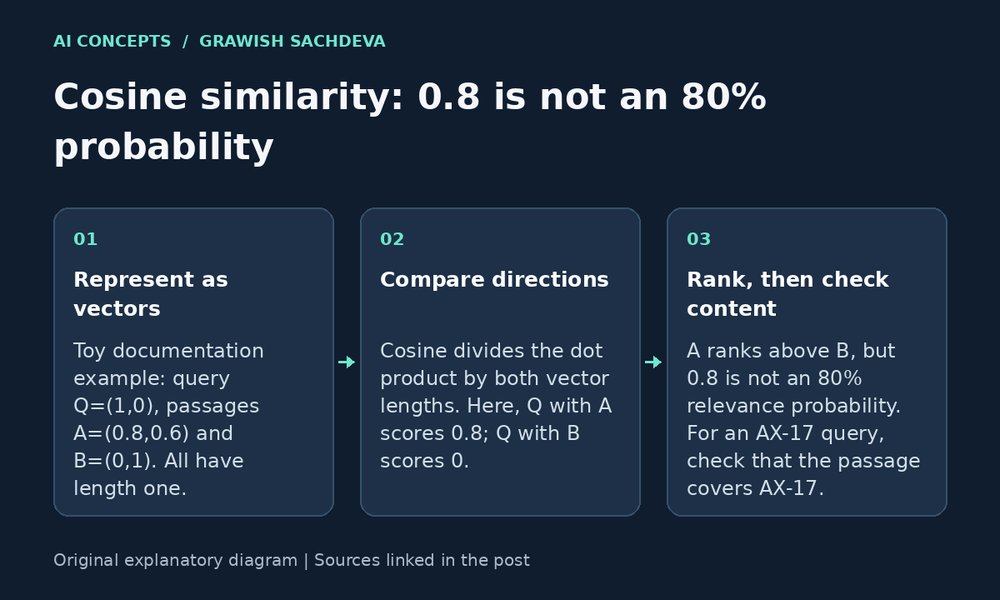
4/4 For an AX-17 query, inspect whether the top passage actually covers AX-17. A similarity score alone cannot establish relevance.
https://t.co/BEAHIgrx0U
https://t.co/9gBMy1isTr Original diagram: Grawish Sachdeva.
1/4 An embedding turns text into a numerical vector. Cosine similarity compares vector directions. A score of 0.8 can help rank search results; it does not establish an 80% probability that a result is relevant.
3/4 Semantic similarity can connect paraphrases while missing an exact product identifier. A passage about AX-18 may resemble an AX-17 query. Matching terms with a method such as BM25 can complement embedding retrieval; the content still needs checking.
4/4 Measure startup, first use and warm requests separately. Remove a dependency in a test to check when failure surfaces.
https://t.co/R2YFZiubFv
https://t.co/cEDMgThrDa Image: Python Insider.
1/4 Python 3.15's lazy imports defer loading errors as well as loading work until first use. For an AI service, that means successful startup can leave a dependency failure waiting for the first request that needs it.
3/4 I'd keep required request paths in readiness checks or warmup, and consider lazy loading for optional features. The first use still pays the loading cost. The new syntax is module-scope only, excluding functions and try/except blocks.
4/4 Require cross-server routing and recovery of acknowledged writes before committing to migration.
https://t.co/VvgRKoKmBj
https://t.co/EtBoezSqeF Image: Cloudflare Blog.
1/4 Deno's move to Cloudflare targets a concrete self-hosting gap: workerd's Durable Objects currently operate within one instance. For stateful AI apps, running the code elsewhere is only part of a migration.
3/4 For an AI app with one object per conversation, evaluate routing and recovery across machines. Cloudflare plans to combine celld and workerd; the announcement does not establish a finished merged platform.
4/4 Compare matched uploads: verify routing and complete downstream payloads, then measure transfer usage and TTFB.
https://t.co/fcCXd1Lw1s
https://t.co/Qqi7tkyCOD Image: Vercel.
3/4 I'd check every middleware helper before enabling it. URL-based routing is a candidate; parsing JSON to choose a destination still needs the body. Logging and validation helpers can create the same dependency.
2/4 Set skipMiddlewareRequestBody to true and redeploy. Vercel says skipping body forwarding reduces incoming Fast Origin Transfer usage for middleware and may improve time to first byte. No latency benchmark is provided.
1/4 Vercel now lets request bodies bypass Routing Middleware while still reaching Functions and rewrite targets. For upload endpoints, this can remove unnecessary transfer if routing never reads the payload.
4/4 Check accuracy by evidence position across representative questions before trusting a larger context window.
https://t.co/mZtzXKGSps
https://t.co/YRRO80i80x Original diagram: Grawish Sachdeva.
1/4 A model's context window sets how much information it can accept. It does not guarantee correct use of every fact inside it. Evidence can fit in the input while the generated answer still misses it.
3/4 Lost in the Middle (2023) found position-dependent performance in the models studied. That motivates testing today's systems; it does not predict their scores. Finding one fact also does not establish reliable reasoning across documents.