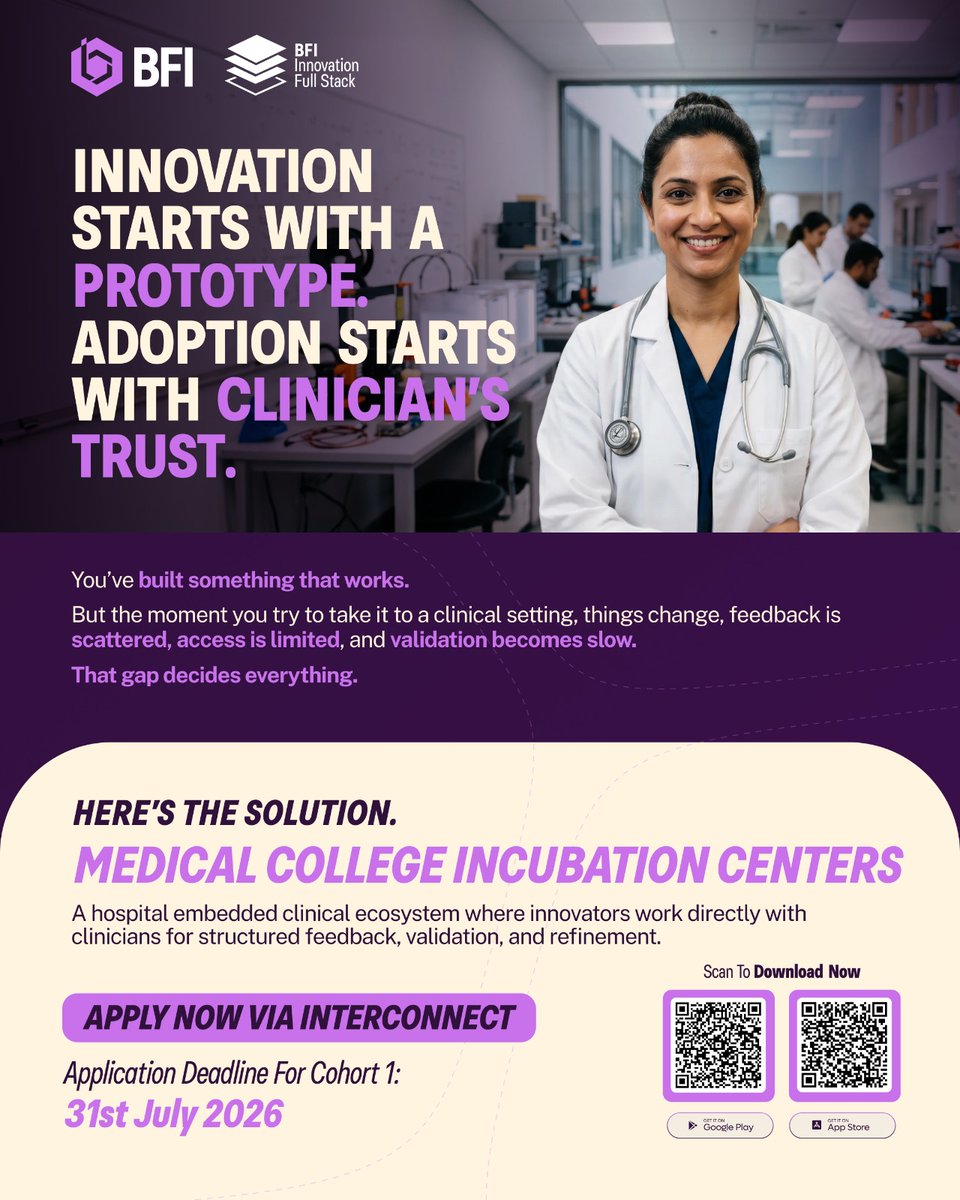
BFI Innovation Full Stack brings prototyping, clinical validation, large scale field studies, and market access onto one platform, with structured support at every stage, and room for innovators to join at any point in their journey, from prototyping to near market readiness.
Deadline's approaching, don't wait to apply.
Application deadline for Cohort 1: 31 July 2026
Apply now via Interconnect: https://t.co/XTLtMPGtLM
Learn more: https://t.co/FoKKWoLcnE
@GITAMUniversity@NimsUniversity@iiscbangalore@bitspilaniindia@IGIBSocial@AIC_CCMB@iitbombay@aiims_newdelhi@AshokaUniv@THSTIFaridabad
Every cell in our body carries genes that carefully regulate its growth and trigger cell death when something goes wrong. These built-in safeguards prevent damaged or abnormal cells from multiplying uncontrollably. However, cancer cells find ways to bypass these natural defenses.
One of the mechanisms they use involves proteins called Histone Deacetylases (HDACs), which can switch off genes responsible for controlling cell growth and initiating cancer cell death. Among them, HDAC3 plays a critical role in helping cancer cells survive, proliferate, and even resist existing therapies. While several HDAC inhibitor drugs are already available, most target multiple HDAC proteins simultaneously, often causing unwanted side effects by affecting healthy cells.
Supported by BFI-BIOME, Prof. Balaram Ghosh and his team at BITS Pilani Hyderabad Campus are developing AH22, a novel and highly selective HDAC3 inhibitor designed to precisely reactivate the body’s natural cancer-suppressing genes. By selectively blocking HDAC3, AH22 aims to restore the cell’s ability to eliminate cancer cells while minimizing damage to healthy tissues.
The team is now advancing AH22 through preclinical translation, generating the critical safety and efficacy data needed before it can enter human clinical trials. If successful, this targeted therapy could pave the way for safer, more effective cancer treatments that overcome drug resistance and improve outcomes for patients.
Applications for BFI Innovation Full Stack are open until 31st July.
Applying is simple:
• Download the Interconnect app from the Google Play Store or Apple App Store.
• Register yourself or your organization.
• Publish your project on Interconnect (this is a mandatory step before applying).
• Start your application, choose the BFI Innovation Full Stack program that best fits your needs, complete the required details, and submit.
Learn more: https://t.co/2vbNYjgp27
Download Interconnect: https://t.co/D2SRCxtxBF…
Read more
@sandeepnailwal
Imagine a patient waiting for a life saving medicine, unaware that the medicine may have already lost its effectiveness before it reaches the hospital or clinic.
For temperature sensitive therapies, even a few minutes at the wrong temperature can compromise its effectiveness. The result? Millions of dollars’ worth of medicines are wasted every year, treatments are delayed, and patients may not receive the care they need. In fact, an estimated 25% of biologics are discarded due to temperature excursions during storage and transportation.
That’s where Phloton comes in.
Phloton is an active cooling solution that continuously maintains the required 2–8°C temperature range during transport. Unlike conventional cold boxes that rely on ice packs and passive cooling, Phloton actively regulates temperature to help ensure temperature-sensitive healthcare products reach their destination safely and remain effective.
As biologics and other advanced therapies become more common, innovations like Phloton are helping make healthcare delivery more reliable, efficient, and accessible.
If you want to connect with innovators like Prerit Mittal, Suraj J R, and hundreds of others tackling some of healthcare’s most pressing challenges, join Interconnect, a platform where biomedical researchers, clinicians, founders, investors, and industry experts connect, collaborate, and build the future of healthcare together.
Download Interconnect today.
Google Play: https://t.co/zAUUvNFiu6
App Store: https://t.co/yCmmyuFMiQ
@prerit_mittal@sandeepnailwal
BFI signed a historic MOU with IIT Bombay under Bharat Innovates Program at NICE France. Partnership was announced by Hon. Commerce Minister Shri Piyush Goyal and Principal Scientific Advisor to PMO Dr Ajay Sood. The event was graced by Prime Minister Narendra Modi and French President Emmanuel Macron.
BFI along with IIT Bombay will work to support biomedical startups from ideation to market access in collaboration with European ecosystem of Universities, hospitals and Investors.
After product development and validation, one of the biggest challenges healthcare startups face is achieving real market adoption.
Establishing presence within hospitals, navigating procurement systems, building clinical trust, generating clinical prescriptions, and scaling commercially can often be more difficult than developing the innovation itself.
The Product Promotion Program is designed to address this challenge by connecting innovators with the right stakeholders, enabling clinical adoption, and helping innovators reach the right markets.
Apply now via Interconnect: https://t.co/XTLtMPGtLM
Learn more: https://t.co/FoKKWoLcnE
@GITAMUniversity@NimsUniversity@iiscbangalore@bitspilaniindia@IGIBSocial@AIC_CCMB@iitbombay@aiims_newdelhi@AshokaUniv@THSTIFaridabad
The best conversations begin with great questions.
Have a question about biosciences, digital health, healthcare innovation, or the future of research? Share it with us for the upcoming Science.Unblocked Podcast featuring Dr. Anurag Agrawal, hosted by Dr. Gaurav Singh.
Submit your question using the QR code or via: https://t.co/wlQY0nGp2a
Over 1.5 million people are diagnosed with cancer in India every year, and a significant proportion of them require chemotherapy as part of their treatment.
While chemotherapy remains one of the most effective cancer treatments, it is not selective, it attacks rapidly dividing healthy cells along with cancer cells.
As a result, patients often experience debilitating side effects such as fatigue, nausea, hair loss, immune suppression, and organ toxicity. These side effects can reduce quality of life, limit the dose of chemotherapy that patients can tolerate, and sometimes even interrupt treatment.
Exsure is working to address this challenge through an exosome-based targeted drug delivery platform. Exosomes are tiny, naturally occurring vesicles released by cells that act as biological messengers. Exsure engineers these exosomes to carry anti-cancer drugs directly to tumors, allowing medicines to be delivered more precisely to cancer cells while minimizing exposure to healthy tissues. The platform is also being designed to target cancer stem cells, which are believed to contribute to tumor recurrence and treatment resistance.
By making chemotherapy more targeted, Exsure aims to improve treatment effectiveness while reducing its harmful side effects. If successful, this approach could enable safer cancer therapies, improve patients’ quality of life during treatment, and reduce the likelihood of cancer relapse, ultimately benefiting a large number of cancer patients who depend on chemotherapy each year.
We co-organized the convening, “Advancing Innovation and Investment for Equitable Global Health Impact,” hosted by NIMS University on the sidelines of the World Health Assembly 2026 (#WHA2026) in Geneva.
As part of the fireside chat on “Pathways for Innovation to Impact,” our CEO, Gaurav Singh, shared perspectives on enabling healthcare innovation through ecosystem building, strategic partnerships, and scalable impact-driven models.
Thank you to all the speakers, delegates, and partners for the insightful conversations and meaningful exchanges.
@NimsUniversity