Every prophet before the Holy Prophet Muhammad (sa) warned their people against the Dajjal, according to Islamic tradition. The Holy Quran further states that every nation received a warner. Could traces of this warning have survived in the scriptures and traditions of other peoples?
This article explores a fascinating research direction, tracing possible parallels between the Islamic concept of Dajjal and the Zoroastrian, Hindu and Norse traditions.
The Promised Messiah, Hazrat Mirza Ghulam Ahmad (as), explained the Dajjal as a collective force of deception, identifying Christian clergy and European philosophers as its two jaws, which “devour people’s faith like a python”.
In the Zoroastrian Avesta, the concept of Druj represents falsehood, deceit and the lie, standing in opposition to Asha, or truth. The article examines its linguistic similarities with the Arabic word Dajjal, alongside Persian drogh and Sanskrit druh, which carry related meanings.
The parallels extend beyond language. The Zoroastrian figure Aži Dahāka appears as a three-headed serpent associated with the Lie, while later Zoroastrian texts describe his confinement and eventual release. The article compares these accounts with Islamic traditions concerning the Dajjal.
In the Hindu Rigveda, the concepts of Druh, the serpent Ahi and the three-headed figure Viśvarupa offer further points of comparison. The investigation then turns to Norse mythology, where the draugr is described as an imitation of life, recalling the Dajjal’s deceptive imitation of resurrection.
These connections are presented as a research theory rather than established doctrine. Could linguistic similarities and recurring mythological motifs preserve traces of a warning shared across ancient traditions?
From Druj to Dajjal, this comparative exploration asks whether the warnings preserved in different scriptures may point towards a common theme: the struggle between truth and deception.
It may simply have been waiting, in a word here and a myth there, to be recognised for what it always was: Dajjal.
حضرت مسیح موعودؑ سراج الدین عیسائی کے متعلق فرماتے ہیں
میں نے ایک بشپ کے لیکچر کا خلاصہ پڑھا تھا۔اس نے بیان کیا ہے کہ ہم ۲۰ لاکھ عیسائی کرچکے ہیں تو یہ لوگ اس قسم کے تھے جو دوسروں کے اعتراضات سے متاثر ہو گئے اور ایمان کمزور ہو گیا۔ نتیجہ یہ ہوا کہ اپنے مذہب کو ہاتھ سے چھوڑ بیٹھے اور عیسائیت کو قبول کر لیا۔سراج الدین عیسائی بھی ایسے ہی آدمیوں میں سے تھا۔یہ لوگ کسی صادق کی صحبت میں کامل زمانہ نہیں گزارتے اور طرح طرح کی خواہشوں کے اسیر اور پابند ہو کر اپنے مذہب اور ایمان جیسی قیمتی چیز کے بدلے عیسائیت خرید لیتے ہیں۔
(ملفوظات حضرت مسیح موعودؑ جلد دوم صفحہ ۱۳۶، ۱۳۷ ایڈیشن ۲۰۲۲ء)
https://t.co/yRKREyfCtq
Atfal Ahmadiyya UK @AtfalUK Uganda school charity challenge is now a reality. They have come face to face with reality, seen the need, laid the foundation stone & prayed for Allah' Blessings. @HumanityFirstUK@HFI1995@UKMuslimYouth@NewsMTA
The Beautiful Simplicity of the Holy Prophet’s (sa) Gatherings.
Highlighting the exemplary character, humility and kindness of the Holy Prophet (sa), Beloved Huzoor (aba) described the atmosphere of his gatherings:
“The Holy Prophet’s (sa) cheerfulness, generosity and excellent morals extended to every person. The Holy Prophet (sa) became like a father to them. In terms of rights, everyone was equal in his eyes.
His gatherings were those of knowledge, modesty, patience and trustworthiness. Voices were never raised, nor were sacred things desecrated, nor were anyone’s weaknesses mentioned.
Everyone was equal to one another and was only greater than others by way of piety. They would speak to one another with humility, respect their elders, have mercy on the youth, would prefer the needy to themselves and would especially look after strangers.”
▶️ Stream the full Friday Sermon now on the MTAi App, via https://t.co/llmBJUuPfp, or via https://t.co/q8CMK2dJIm.
(Friday Sermon, 23rd October 2026)
#FridaySermon #MTAi
30 Years of Hope on Good Hope: The Story of Bait-ur-Rahman
Marking 30 years of establishment of Baitur Rahman Mosque in the USA - watch now: https://t.co/SXqz33ZJOO
#MTAi#Ahmadiyya
“I shall describe my own practice. Whenever I come to the grave of the Promised Messiah (as) to pray, my established practice is first to pray for the Holy Prophet (sa) and then for the Promised Messiah (as). This is the prayer I offer:
“‘O Allah! I possess nothing that I can present as a gift to these revered personages. Whatever I possess cannot benefit them. Thou, however, possessest all things. I therefore pray and beseech Thee that, out of Thy kindness to me, Thou bestow upon them, on my behalf, a gift in Paradise such as they have never received there before.’
“They then surely ask, ‘O Allah! From whom has this gift come?’ When God tells them, they pray for that person, and in this way the spiritual ranks of the person offering the prayer are also raised. This is established by the Quran and the Ahadith. It is an established principle of Islam, which no one can deny, that prayers certainly benefit the deceased.
“The Holy Quran, too, draws attention to this through the words فَحَيُّوا بِأَحْسَنَ مِنْهَا, ‘greet ye with a better prayer’ [Surah an-Nisa’, Ch.4 : V.87]: when someone presents you with a gift, give them a better gift in return or at least give them as much as they gave you.
“In accordance with this Quranic verse, when we pray for the Holy Prophet (sa) or the Promised Messiah (as) and invoke blessings and peace upon them, God Almighty will, as a result of that prayer, bestow a gift upon them on our behalf. We do not know all the blessings that exist in Paradise, but Allah the Exalted knows them well.
“Therefore, when we pray, ‘O God! Bestow upon the Holy Prophet (sa) a gift such as he has never received before,’ it necessarily follows that, when the gift is bestowed upon him, Allah the Exalted will also inform him that it is a gift from such-and-such a person.
“How, then, could he remain silent after learning this and not pray for the person who sent the gift? At such a moment, his soul will spontaneously fall in supplication at Allah the Exalted’s threshold and say, ‘O God! Now grant this person, on our behalf, a better reward.’’
“In this way, in accordance with فَحَيُّوا بِأَحْسَنَ مِنْهَا, ‘greet ye with a better prayer’, that prayer will return to the person who invoked blessings and will become a means of raising their spiritual rank. This, then, is a means by which both we ourselves and the Jamaat can benefit, without any act of associating partners with Allah [shirk] being involved.”
(Mazar Hazrat Masih-e-Maud Par Du‘a aur Is Ki Hikmat, Anwar-ul-Ulum, Vol.17, pp. 182-183)
📢 This Week With Huzoor - 23 October 2026 [PROMO]
Hazrat Mirza Masroor Ahmad (aba) graciously grants a Mulaqat to Ansarullah from the New York and Houston Regions of the USA. 🇺🇸
Some questions from the Mulaqat include:
◽️ What can we do as Ahmadi’s to ensure we can rebuild the world after WW3?
◾️ Is it permissible to take out commercial loans and pay interest on them?
◽️ How do we know if our lives are truly successful in the sight of Allah?
Full episode of ‘This Week With Huzoor’ out now!
https://t.co/qNm46pp23n
The Holy Quran employs the terms “Iblis” and “Satan” in a manner that suggests a subtle yet meaningful distinction between the two. While both names can refer to the same being, each carries its own significance.
The name Iblis appears 11 times in the Holy Quran, most often in connection with the command given to the angels to prostrate before Adam and Iblis’ refusal to comply. Yet, when the Quran narrates the temptation of Adam, the tempter is described as Satan rather than Iblis.
Hazrat Khalifatul Masih II (ra) explains that Adam had already been directly warned against Iblis and had no determination to disobey God. Therefore, Adam was approached by an agent or physical representative operating under Iblis’ influence – a satan, so to speak – whom Adam failed to recognise as a threat and mistook for a genuine advisor.
While Iblis is the name of a particular being, Satan functions as a broader term. A Satan is any being or influence that turns away from truth or seeks to lead others away from it. The Quran therefore applies the term not only to unseen beings but also to certain human beings.
The distinction also reflects two dimensions of spiritual decline: the stage of Iblis, marked by ignorance, loss of good, confusion and despair of God’s mercy; and the stage of Satan, an advanced phase of evil in which one actively works to misguide, envy and corrupt others.
Yet Satan possesses no coercive authority over human beings. His methods are deception, fear, false promises, greed and the exploitation of human weaknesses.
Understanding this distinction highlights the Quranic portrayal of evil and the moral responsibility placed upon every individual to resist influences that lead away from righteousness.
For more than 50 years, a group of timekeepers has been quietly sneaking extra seconds onto the world's clocks. Now they've voted to stop, and the moon is getting its own clock.
Al Jazeera's Basel Ghazoghli breaks it down.
Daghe Hijrat: The Scar of Migration | Episode 2
The story continues.
Discover the next chapter of this powerful historical documentary, revisiting the events surrounding the Partition of India in 1947 and the historic migration of the Ahmadiyya Muslim Community.
📺 Watch on MTA International
📅 Friday 30 October
🕔 17:00 GMT
📅 Saturday 31 October Repeat Broadcast
🕖 19:00 GMT
Watch Episode 1 now on MTAi and YouTube.
#DagheHijrat #MTAi #Partition1947
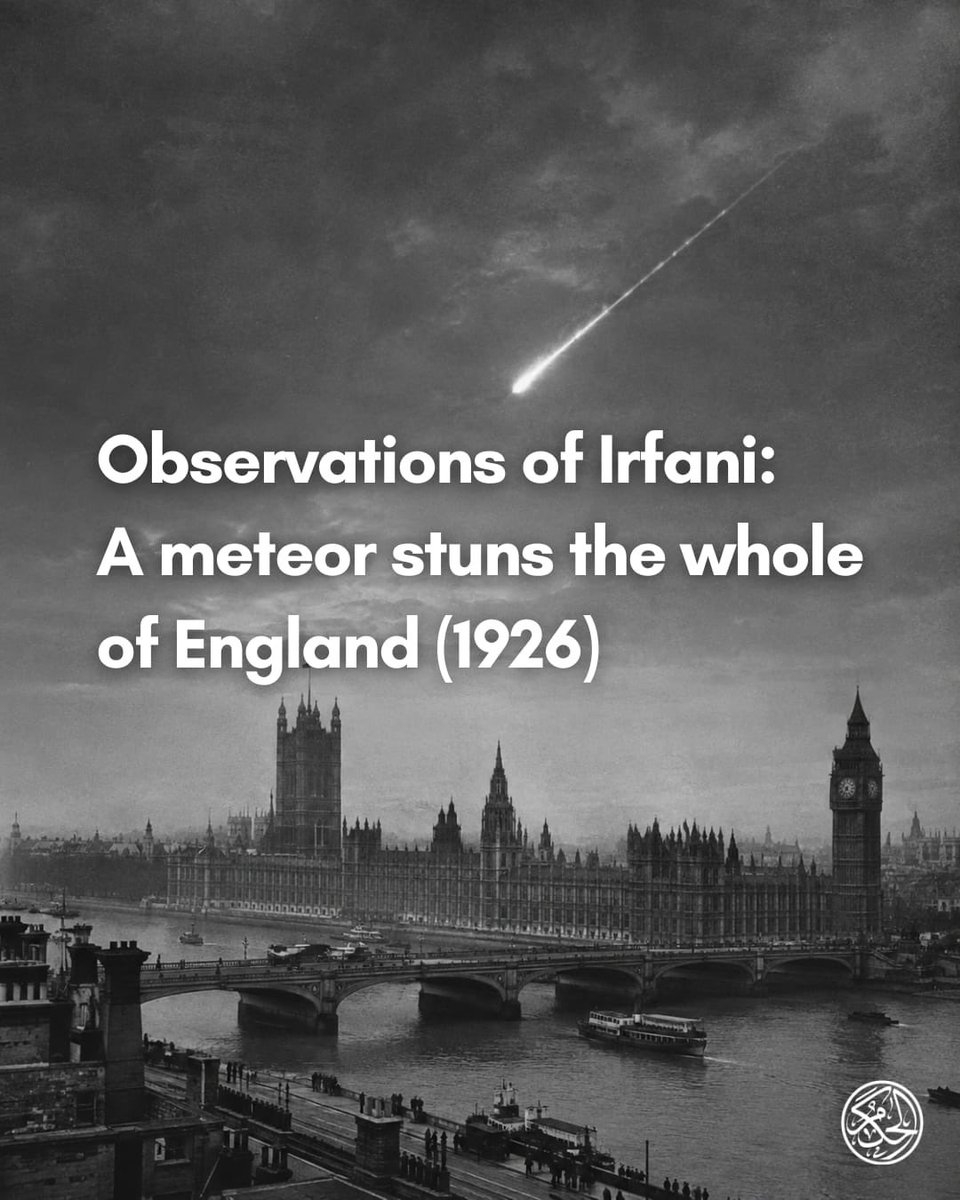
In recounting the early days of his divine mission, the Promised Messiah (as) wrote that numerous stars had fallen from the sky during that period. If I am not mistaken, he discussed this phenomenon in considerable detail in Aina-e-Kamalat-e-Islam [The Mirror of the Excellences of Islam]. I was only a child at the time, but I witnessed this spectacle in the sky while I was conscious enough to remember it. I distinctly recall that everyone in our household was saying that the Imam Mahdi would now appear. It was not merely my family; people in general were saying the same thing.
In short, the Promised Messiah (as) identified meteors as precursors to certain momentous events. Although they occur according to natural causes and circumstances, the divine practice is such that they may be appointed as signs preceding certain great events.
During the night between Monday, 6 and 7 September 1926, at approximately 9:45 pm, a magnificent meteor streaked across the sky, leaving the whole of England astonished. The Daily Express, in its issue dated 8 September [1926], reported:
“The whole of England is engaged in discussing the mystery of the luminous phenomenon that traversed the country on Monday night at 9:45 pm, passing from northern Yorkshire to South London.”
The phenomenon appeared in various colours, generally red, white, green and blue. Its dazzling light persisted for several seconds. In the northern region, it was accompanied by a tremendous sound that frightened people and caused certain buildings to shake.
Various opinions and theories were put forward concerning the phenomenon. However, Sir Frank Dyson, the Astronomer Royal and other experts stated that a very large meteor had fallen.
🟠 UPCOMING: THE DIALOGUE 🟠
Two thought-provoking topics. Two important discussions. Don’t miss the next edition of The Dialogue, broadcasting LIVE and exclusively on MTA Africa!
📌 24th Oct – Is the Holy Qur’an a Copy of the Bible?
📌 25th Oct – The Holy Prophet (sa) Through the Lens of Christian & Orientalist Writers
🕡 Time: 18:30 GMT
📞 Call in: +233 504 594 846
🎙️ Have questions? Want to share your thoughts? Join the conversation and put your questions directly to our panel LIVE on air!
Among the many misconceptions about Islam, one persistent claim is that it permits forced marriage. There is only one right answer – Islam does not permit forced marriage. Yet Islam distinguishes clearly between arranged marriage and forced marriage, and the two should never be confused.
Islam encourages arranged marriage as a means of protecting men and women from illicit relationships that can lead to heartbreak, emotional harm and dishonour to their families. Families may express interest in a potential match and get to know one another within Islamic boundaries, while praying for guidance through istikharah. However, the relationship can only proceed towards engagement or nikah when both the man and woman freely and happily consent.
Consent is the crux of the matter. In his guidance on marriage, Hazrat Khalifatul Masih V (aa) explained that if a person develops a clear feeling of aversion towards a proposal, one should refuse to proceed, regardless of parental wishes. This guidance recognises an individual’s right to act according to one’s own conscience, even when doing so goes against the wishes of one’s family.
Nevertheless, in some communities, the distinction between arranged and forced marriage becomes blurred. A person may technically have the right to refuse, but social shame, family conflict or the fear of being ostracised can make exercising that right difficult. Such pressures represent a gap between Islamic teachings and cultural practices.
Islam’s teaching is unequivocal: no marriage is valid without the genuine, free consent of both parties. Where this principle is disregarded, the fault lies with those who impose their customs and pressures, not with the religion itself.
Islam also encourages choosing a spouse on the basis of character and faith rather than appearance or wealth alone. The purpose of marriage is to build a bond of love and companionship between two people who freely choose to become life partners.
Far from permitting forced marriage, Islam places genuine consent at the heart of marriage.
Simplicity is a Part of Faith.
Highlighting the importance of simplicity and contentment in Islam, Beloved Huzoor (aba) shared a saying of the Holy Prophet (sa):
“One day, the companions of the Holy Prophet (sa) mentioned worldly affairs in his presence.
Upon this, the Holy Prophet (sa) said, ‘Do you not listen? Do you not listen? Surely, simplicity is a part of faith. Surely, simplicity is a part of faith.’”
Beloved Huzoor (aba) further explained:
“A person can avoid begging only when they live simply and are content. It should not be that, as soon as even a few needs arise, a person resorts to wrongful means to fulfil their desires or begins to complain.”
▶️ Stream the full Friday Sermon now on the MTAi App, via https://t.co/llmBJUuPfp, or via https://t.co/q8CMK2dJIm.
(Friday Sermon, 16th October 2026)
#FridaySermon #MTAi
“I Wish the Prophet's (sa) Homes Had Been Preserved”
Beloved Huzoor (aba) related that when the modest chambers of the Holy Prophet's (sa) wives in Medina were demolished, Hazrat Sa‘id bin al-Musayyib expressed the wish that they had been left standing. He said that the people of Medina and visitors from elsewhere would then have been able to witness how little the Holy Prophet (sa) had considered sufficient during his blessed life, discouraging people from boasting about their wealth and possessions. Hazrat Abu Umamah similarly wished that the chambers had been preserved so that people might exercise restraint in constructing elaborate buildings and see what Allah had chosen for His Prophet (sa), even though the keys to the treasures of the world were within his reach.
(Friday Sermon, 16th October 2026)
#FridaySermon #MTAi
Prayers for Ahmadis of Pakistan and Malaysia
On Friday, 16 October 2026, in his Friday Sermon, Hazrat Mirza Masroor Ahmad, Khalifatul Masih (V) highlighted the persecution of Ahmadis in Pakistan and Malaysia, including the involvement of some government authorities and urged increased supplications and voluntary prayers for Allah’s protection.
Huzoor (aa) said:
“At this time, I also wish to remind you once again to pray for the Ahmadis in Pakistan. In the name of Allah the Exalted and His Messenger (sa), oppressors – who are in fact terrorists or people with vested interests of their own – are persecuting Ahmadis with the utmost cruelty. At times, government officials too are backing them. For fear of the mullahs, the asiran-e-rah-e-Maula [those imprisoned for their faith] are not granted bail or judges are afraid to rule in their favour. There are some courageous officials and there are also judges who occasionally show courage. Generally, however, those who foment disorder in the name of Islam have created an atmosphere of fear in the country and the entire state machinery is afraid of them. May Allah the Almighty soon bring about the means for these wicked people and those who foment disorder to be brought to account. [Amin.]
“Ahmadis in Pakistan should also place particular emphasis these days on durood [invoking blessings upon the Holy Prophet (sa)], istighfar [seeking Allah’s forgiveness] and the [special] prayers I mentioned previously. They should give particular attention to nawafil [voluntary prayers] and pray most earnestly to seek refuge with Allah the Almighty from these oppressors. May Allah the Almighty also enable them to do so.
“Similarly, the Jamaat in Malaysia is also facing very difficult circumstances. There too, certain government bodies are treating Ahmadis harshly. Our mosques are raided and arrests are also made without any cause. May Allah the Almighty keep the Ahmadis of Malaysia too in His protection and care.”
A Prayer for Stronger Faith and Trust in Allah.
Concluding his Friday Sermon, Beloved Huzoor (aba) prayed for mankind to turn towards Allah and for believers to continue strengthening their faith and reliance upon Him:
“May Allah the Almighty grant wisdom to the worldly people, enabling them to turn towards Him and to reform their worldly lives as well as their Hereafter. And may He increase the faith and certainty of those of us who have accepted the Promised Messiah (as). May He enable us to attain ever-higher standards of reliance upon Allah (Tawakkul) alongside our prayers, and continue to progress in this.”
▶️ Stream the full Friday Sermon now on the MTAi App, via https://t.co/llmBJUuPfp, or via https://t.co/q8CMK2dJIm.
(Friday Sermon, 9th October 2026)
#FridaySermon #MTAi