Empowering businesses with AI automation, cybersecurity compliance, and reliable IT. Saving hours, cutting costs, and building safer, smarter companies.
Ransomware decisions get expensive when they are made for the first time during the attack. Who calls customers? Which systems come back first? Can payroll run? Decide before the screens go dark.
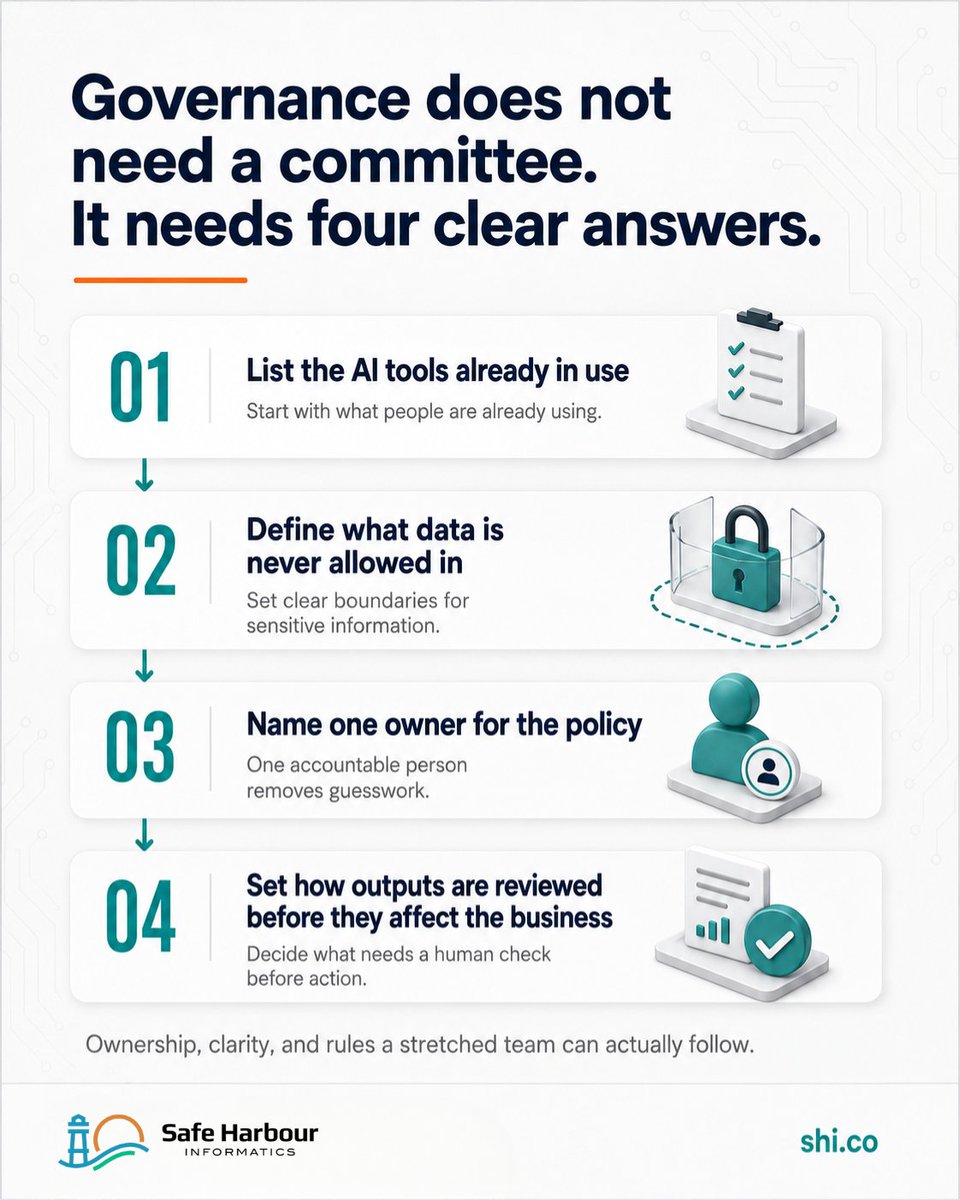
The riskiest AI policy is silence. When employees do not know what is allowed, they guess. And when sensitive data is involved, guessing becomes a business risk.
Cloud tools reduced server headaches, but they also changed the dependency. The internet connection is no longer just a utility. It is the single wire many businesses run through.
Attackers do not need to know your business by name. Automated scanners look for known, unpatched software exposed to the internet. Size does not hide an open door.
Your competitor’s AI edge may not be a secret tool. It may be one rebuilt workflow: clear ownership, secure data, connected handoffs, and human review before anything reaches a customer.
Most owners compare managed IT to the repair bill. The better comparison is managed IT versus the cost of a half-day where the team is paid but the business is stuck.
AI should not remove people from the workflow. It should move them to the right part of it: reviewing outputs, catching exceptions, making judgment calls, and protecting the customer experience.
Ransomware does not stop IT. It stops dispatch, billing, phones, customer records, and revenue while payroll keeps running. That makes it a business continuity problem.
AI phishing works because it pressures one person at the wrong moment. Urgency, authority, clean wording, familiar tone. The defense is not suspicion. It is a second-channel rule.
Shadow AI rarely starts with bad intent. It starts with pressure: a proposal due, a spreadsheet to clean, a client note to summarize. The risk is not AI usage. The risk is not knowing where the data went.
Every minute counts when you're leading a small business. ⏰ See how Microsoft 365 Copilot Business can help your team save time, simplify work, and accomplish more. Watch the video. 📹 https://t.co/hfaaRSGldU
Every minute counts when you're leading a small business. ⏰ See how Microsoft 365 Copilot Business can help your team save time, simplify work, and accomplish more. Watch the video. 📹 https://t.co/8BRApi2Fha
Most owner-led businesses are not short on AI awareness. They are short on a structured path forward: which workflows to start with, which tools to trust, which data to protect, and what the team should do Monday morning.
AI and IoT are not only about preventing breakdowns. They can help manufacturers protect quality by spotting drift in machine behavior before defects become a margin problem.
When employees override AI recommendations, the issue may not be resistance. It may be trust.
If job details, customer records, or approvals are messy, the team will choose the old process.
Predictive maintenance does not begin with prediction. It begins with trustworthy field signals: consistent capture, clean validation, connected records, and visibility before downtime happens.
Security teams often waste time chasing threats across multiple tools. Discover how St. Luke's leveraged AI with Microsoft Security Copilot to streamline their response and enhance protection. 🛡️ @Microsoft365 https://t.co/jThcYomp3l
Small businesses do not need to automate everything first. Start with one process that happens daily, causes rework, delays billing, or forces skilled staff into manual entry. That is where ROI becomes visible.
AI adoption may be slowing for a reason. This ITPro article explains why cloud maturity is becoming the real bottleneck. Learn why it matters and contact Safe Harbour Informatics Inc to plan your next steps. https://t.co/8Muyl4L4kd
The fastest AI opportunity may already be inside the weekly spreadsheet. Connect the systems, clean the data flow, reduce manual re-entry, and the business gets better decisions sooner.