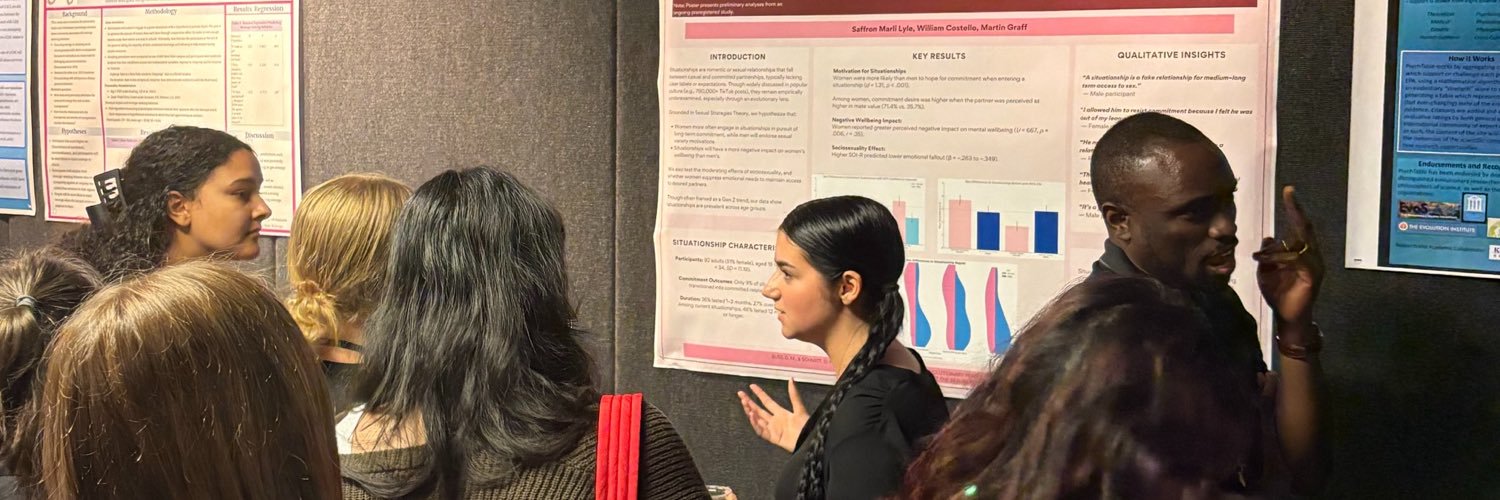
Huge thank you to everyone who attended my #NEEPS2026 talk: “Situationships: A Modern Arena for Sexual Conflict in Human Mating.”
Incredibly grateful that it won the AEPS (Applied Evolutionary Psychology Society) award! 🏆
So many brilliant talks, and such an intellectually stimulating and welcoming space where ideas can be openly debated, exactly what healthy science should look like!
Excited to continue this work into my PhD this autumn with @DrThomasAG@NEEPSoc
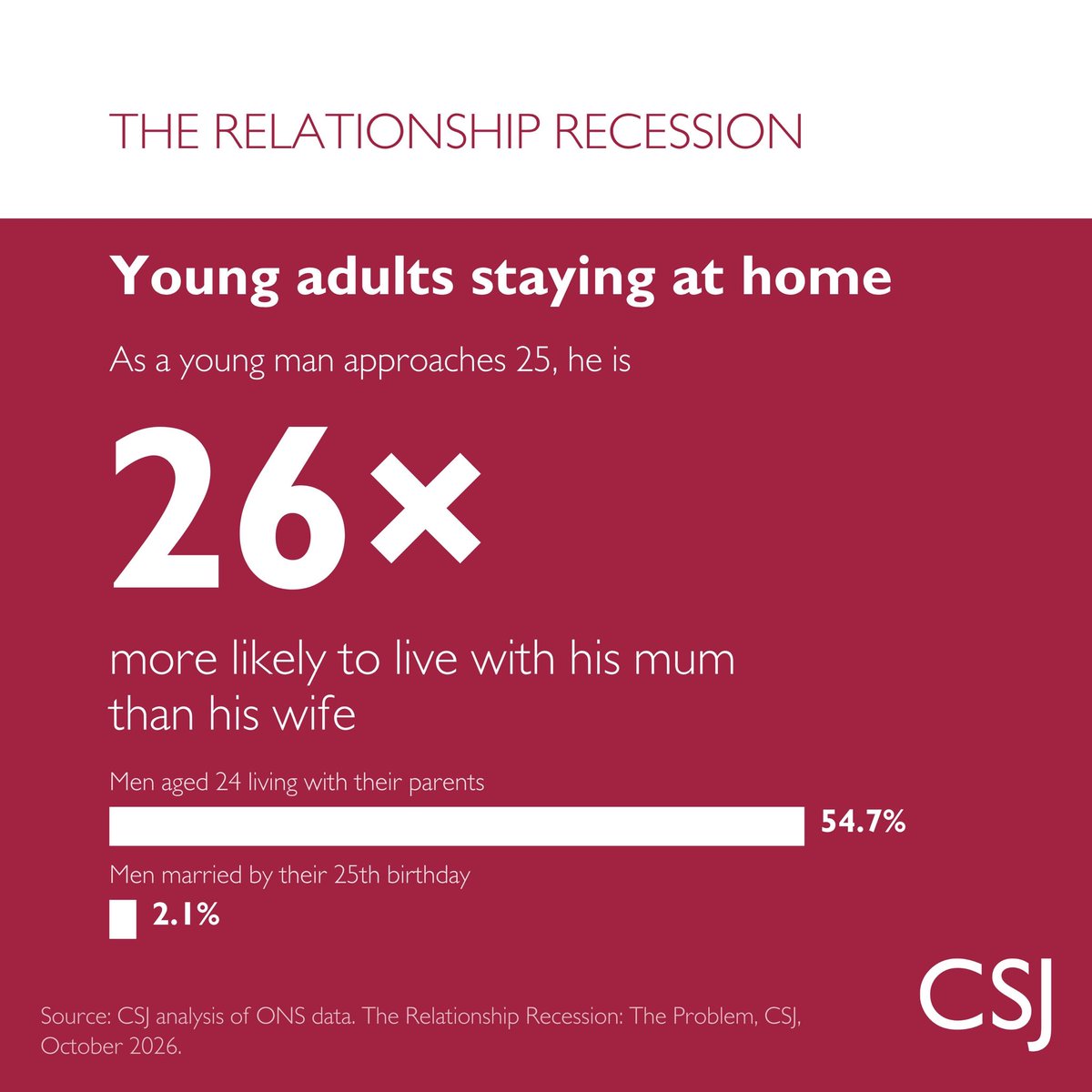
Relationships in the UK are on the decline.
Today, we reveal that a 25 year old is 26 times more likely to live with his mum than his wife.
Why does it matter? Because the quality of our relationships is one of the strongest predictors of a happy, healthy life.
New project (1/3)👇
'We do have something to worry about, but it’s not a health threat from toxic masculinity. The problem is that masculinity itself is being treated as toxic. That ends badly for us all.'
Melanie McDonagh argues that labelling male behaviour as a public health hazard risks alienating young men and driving an even deeper wedge between the sexes ⤵️
https://t.co/MraRvLAOqX
A California couple with 27 children, most born via surrogates, have been charged in what US authorities have described as a "house of horrors" abuse case.
Sky's @marthakelner examines the case in California - and what it means for the multibillion-dollar surrogacy industry.
"status matters...it attracts women. In fact, having high status is probably the single most desirable feature in a man. Which is why you often see elderly billionaires, drug-addled rock stars and overweight crypto bros with young, beautiful girlfriends." https://t.co/CRfnbV4GW7
@JasperWhalen1@CostelloWilliam The playing field has changed. We’re not going back to a society built around single income households. Traditional principles can still be useful, but guidance has to help people form and sustain relationships in today’s mating market.
From parents to partners, relationships are foundational.
Boys in single parent homes: 2.3×
suicide attempt risk.
Divorced men: 2.8× suicide odds.
Adults neither married nor cohabiting: 86% higher odds of depressive symptoms.
We need better education on forming and sustaining healthy relationships.
Valuable research from @RichardvReeves, @aibm_org and @ThirdWayTweet on the challenges facing men.
“Women” appears in all three word clouds summarizing responses about men’s biggest challenges.
I’d argue that romantic relationships may also connect several of the other concerns raised here.
Employment, education and financial security all have implications for men’s relationship prospects. Women’s preferences for stability, ambition and status help explain why success in these domains can matter to men as prospective partners. For men who hope to become fathers, finding a partner is also central to building the family life they want.
These aspirations are closely connected to mental wellbeing.
In our study of 6,338 people across 12 countries, people in good relationships reported greater wellbeing and life satisfaction, while unwanted singlehood was associated with poorer outcomes. Our research on involuntary celibacy also highlights the severe distress that can accompany difficulties forming relationships.
Understanding how men form and sustain flourishing romantic relationships, and the barriers they face, is an important goal. There is much to learn about how relationship difficulties interact with employment and mental health, and what helps men build the relationships and family lives they want.
Happy Birthday to my husband!
The smartest, sweetest and funniest person I know. Not a day that passes that you don’t make me laugh & there’s no one I admire more.
I feel so lucky to get to watch you grow and make incredible progress each year.
You make us all immensely proud and I’m so lucky I get to share it all with you.
Penblwydd hapus handsome ❤ @CostelloWilliam
A common misunderstanding of Sexual Strategies Theory is that men want sex and women want relationships.
But the theory hypothesises that both sexes have short- and long-term mating strategies, with predictable sex differences therein.
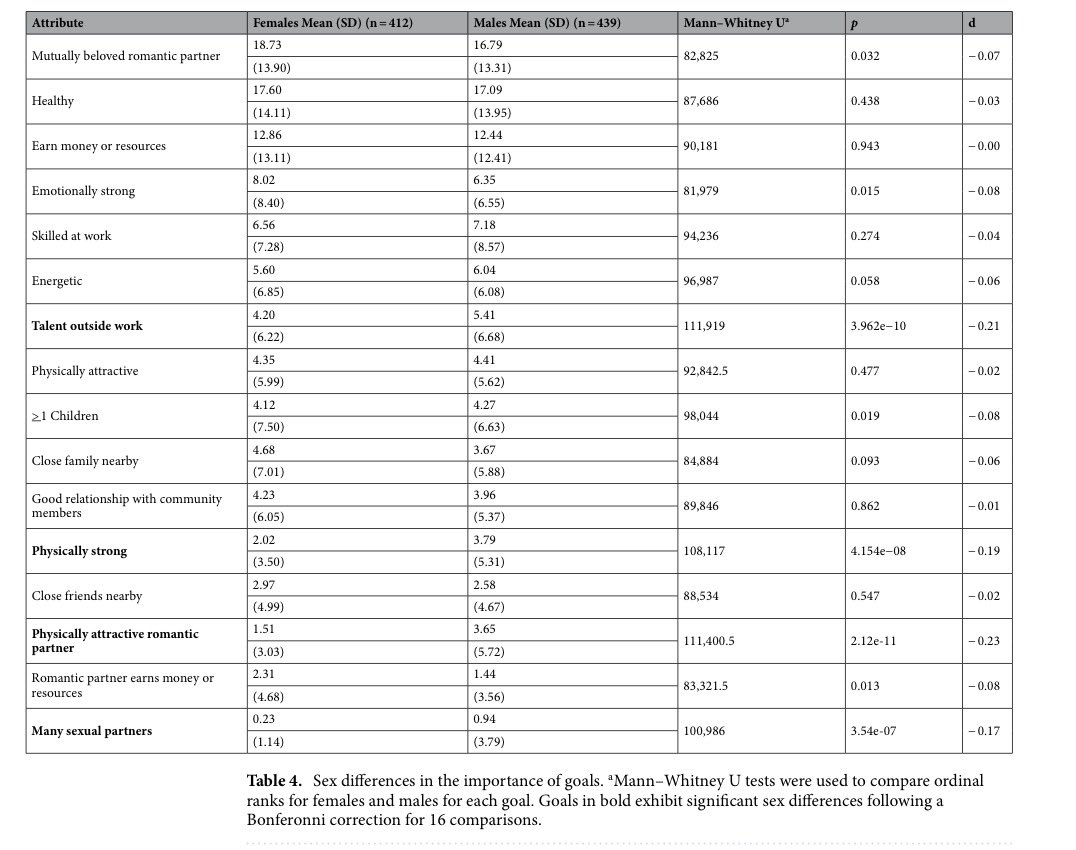
A nice recent illustration is that Benenson & Markovits (2024) found that a mutually loving relationship was a top life priority for both sexes. Men nevertheless placed more weight on having many sexual partners and a physically attractive romantic partner.
Both desires can coexist.
Men’s greater desire for sexual variety doesn’t mean they don’t want love and commitment.
An old adage is that “Worrying is like a rocking chair: it gives you something to do, but gets you nowhere.”
But from an evolutionary psychological perspective, this is wrong.
Emotions evolved to solve adaptive problems. Jealousy motivates us to guard relationships against rivals. Disgust motivates us to avoid sources of pathogens.
Anxiety motivates vigilance, preparation and precautions.
An alternative explanation for these findings is that some dreaded outcomes never happened because anxiety motivated people to take action to prevent them.
If worrying about failing an exam prompts you to study and pass, the fact that the dreaded outcome never materialised hardly makes the worry pointless.
As Randolph Nesse puts it, there are “good reasons for bad feelings.”
“Anxiety is the handmaiden of creativity”
- Chuck Jones
Anticipating problems can inspire solutions.
Error management theory offers an explanation. Some mistakes are costlier than others. For ancestral men, missing a genuine mating opportunity could have carried a greater reproductive cost than making an unsuccessful advance. Selection could therefore favour overperceiving sexual interest when signals are ambiguous. More mistakes overall, potentially, but fewer costly missed opportunities.
Overestimating her interest is distinct from overestimating your own attractiveness. But confidence can itself be attractive, so it might also help win over someone who was initially unsure about you, provided it doesn’t tip into arrogance.
The TikTok guy falling in love after a friendly dance at a Bruno Mars concert typifies a lot of research.
Men tend to overestimate women’s sexual interest, particularly when they find the woman attractive (Perilloux et al., 2012).
Men also tend to fall in love faster (Bode et al., 2025).
Some studies find that men overestimate their own attractiveness more than women do (Yoder et al., 2017).
Dating-app research also finds men pursuing women more desirable than themselves (Topinkova & Diviak, 2025), although aiming higher on dating apps isn’t exclusive to men (Bruch & Newman, 2018).
Research also tells us what might happen next…
Rejection can lower mating aspirations (Kavanagh et al., 2010). Repeated romantic rejection is also associated with lower partner standards and greater willingness to compromise on them (Charlot et al., 2020).
As Dirty Harry put it: “A man’s got to know his limitations.”
"If a man can be a woman, there is no such thing as a woman. That might not matter to you personally, but it matters to millions of women who don’t have the luxury of pretending that their sex doesn’t matter."
One possibility is that people infer different motives behind men’s and women’s affairs.
Women who cheat are far more likely than men to cite relationship dissatisfaction and an uninvested partner as motivations for their affairs.
People may intuit that women’s affairs are seeking an alternative to a deteriorating relationship with a partner who has withdrawn investment or begun inflicting costs, including through his own infidelity.
A cheating husband, meanwhile, may more readily evoke the image of someone pursuing additional sex while his wife continues investing heavily in him and their family.
Those inferred circumstances could make people more willing to entertain mitigating explanations for women’s affairs.
There may also be a deterrent element. If both sexes perceive men as more tempted by affairs, stronger moral condemnation could partly reflect an attempt to constrain that temptation.
Marriage luxuries we forget are luxuries:
* Morning kisses
* Having a permanent plus-one
* "Text me when you get there"
* Knowing each other's orders by heart
* Car rides with your favorite person
* Going to bed together
* Someone noticing when something's off
* Celebrating the little wins
* Late night laugh attacks
* Doing absolutely nothing together
* Being cared for when you're sick
* Building a family
* Creating traditions of your own
* Being completely yourself
* Choosing each other every day
* A sleepover every night with your favorite person.
The little things are actually the big things.