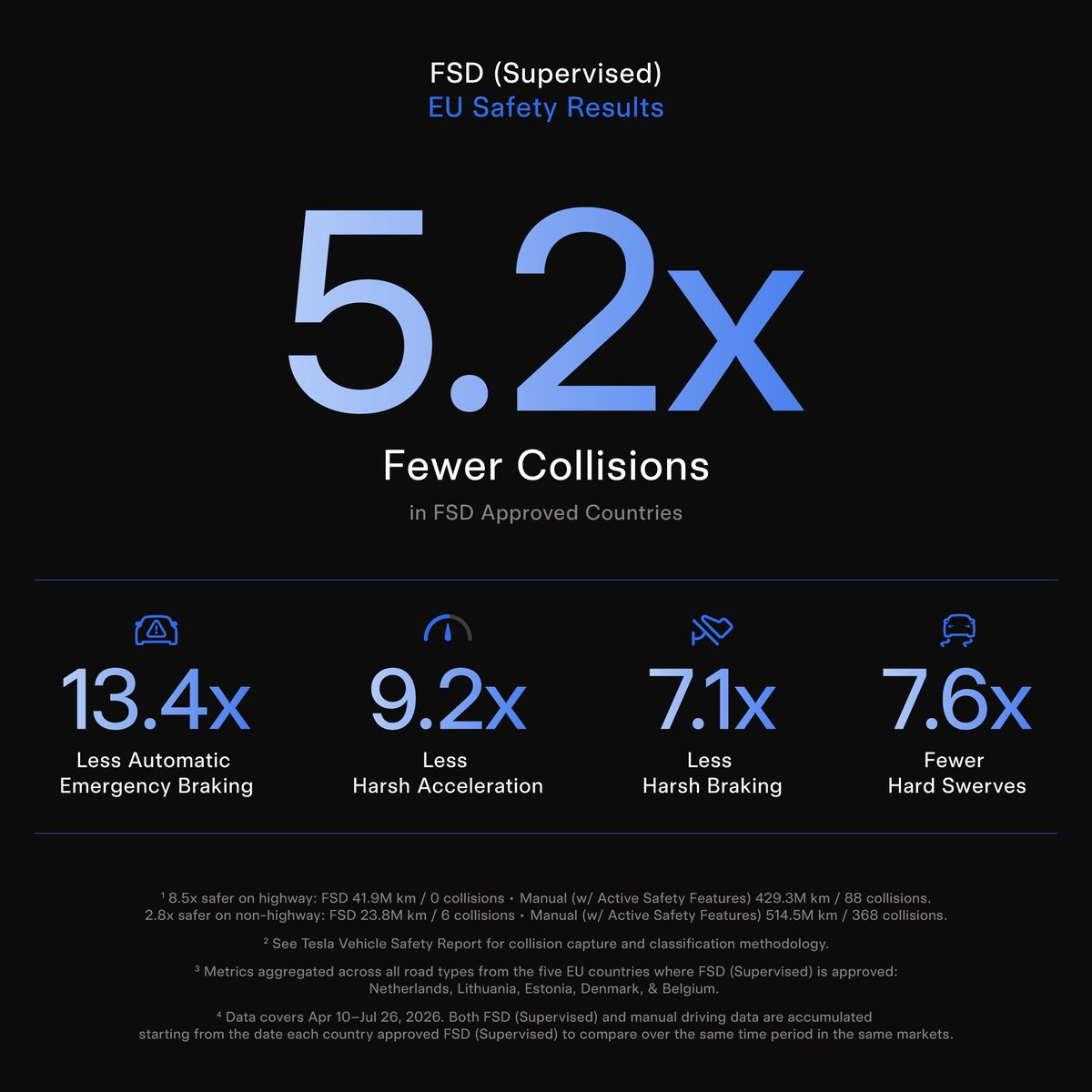
It was shocking and appalling to hear french officials make the case to delay life saving self-driving technology.
Their proposed changes, to require hands on the wheel and to not allow speeding, could, of course, be implemented but would actually make the software less safe. Millions of people are now using this software all over the world, including in Europe. The design has been honed over the years to be incredibly safe. Rather than demanding software changes for the French market, I recommend regulators try to understand why their suggestions would actually decrease safety.
Requiring people to keep their hands on the wheel sounds like a great idea, until you realize that NHTSA cited accidental disengagement as a top reason for ADAS crashes. When people are required to touch / pull on the wheel to satisfy the torque sensor, they sometimes accidentally turn the system off and don't realize it. That can cause a crash.
That's why Tesla and the rest of the industry have moved away from requiring users to pull on the wheels. Instead, they now use advanced camera-based driver monitoring systems that can check whether the user is looking at the road and whether their hands are free and ready to take over. This is much safer than requiring them to pull on the wheel every few seconds. Requiring hands on the wheel also dramatically decreases usage of the feature, which reduces the positive safety impact.
Insisting that the system follow the speed limit also sounds reasonable at first, until you start to think about it. Cruise control and lane keeping system can already be set at a higher speed than the speed limit today. Why should a more advanced ADAS be held to a different standard than a primitive lane keeping assist? Will users actually turn off self-driving and use cruise control or lane keeping assist features that are less safe so that they can set the speed they choose?
The problem is, these systems can sometimes pick up the speed limit incorrectly. The model will choose the speed by looking at the speed limit, the road conditions, and the speeds of other cars on the road, so it can maintain safe driving even if the speed limit is off much like a human. But if you force the system to never drive faster than the detected speed limit, a minor error could become a disaster.
Let's say there is a highway with a speed limit of 70 mph. Earlier in the day there was construction and a temporary construction sign that said Slow speed limit 15 mph. If someone accidentally left that sign behind, for example, but construction had ended and traffic had cleared up, the car might incorrectly register the speed limit as 15 mph. If the system is forced by law to never exceed the speed limit, it would slow down to 15 mph on the highway abruptly and possibly cause a crash. It's important that the driver ultimately retains control and makes a decision about what speed a car should travel — not the legislature. This is a supervised ADAS system and the driver maintains legal liability for any speeding that happens. They still get to set the speed, and if they make an unsafe decision you can enforce that the same way you always have — through speed cameras, police officers, etc. But don't cripple the system in a way that will dramatically reduce usage, and increase crashes.
Just look at the examples in the clip below. Are you seriously going to justify delaying this technology for your citizens when your neighboring European countries are using it safely? If a kid is about to get hit by a car, like in some of the examples below, does it matter if the driver had their hand on the steering wheel or not when the AI stopped the car and prevented the crash?
The only explanation for such a backwards policy stance is protectionism. Simply put, the French are purposefully delaying life saving technology to protect their local industry and unions — even if it means letting their own citizens get injured and killed in the process. I hope there is still some sense left somewhere in the European Union. All you have to do is try the software for one hour to understand its potential to transform road safety.
https://t.co/OuW4kmrw5M
Voor alle duidelijkheid: het ongeval gebeurde blijkbaar doordat de automobilist overnam en een onvoorzichtig manoeuvre uitvoerde, dus zelfs niet op conto FSD technologie te schrijven. Wij hebben die info gisteren nog bezorgd aan de journaliste in kwestie (die dat vervolgens blijkbaar “vergat” mee te nemen in het artikel).
I took @Tesla FSD for a spin through the streets of Leuven, Belgium 🇧🇪 City traffic, tight turns, cyclists, pedestrians — it handled everything perfectly. The system is safe, smooth, and honestly impressive. The tech is improving with each OTA update. Thank you for building the future — one mind-blowing drive at a time!
@elonmusk@teslaeurope
@dm_jns Here in Brussels, and a lot of rides to Ghent and Antwerp.. super!
A few times wrong lane in front of the lights in complex situations, that’s all.