Last one on this topic, and I have been holding this in myself for a while.
For centuries, class divides kept the labor of the poor invisible to the rich. Factory workers toiled behind walls, farmers in distant fields, domestic help in backrooms. The wealthy consumed the fruits of that labor without ever seeing the faces or the fatigue behind it. No direct encounter, no personal guilt.
The gig economy shattered that invisibility, at unprecedented scale.
Suddenly, the poor aren't hidden away. They're at your doorstep: the delivery partner handing over your ₹1000+ biryani, late-night groceries, or quick-commerce essentials. You see them in the rain, heat, traffic, often on borrowed bikes, working 8–10 hours for earnings that give them sustenance. You see their exhaustion, their polite smile masking frustration with life in general.
This is the first time in history at this scale that the working class and consuming class interact face-to-face, transaction after transaction. And that discomfort with our own selves is why we are uncomfortable about the gig economy. We want these people to look our part, so that the guilt we feel while taking orders from them feels less.
We aren't just debating economics. We are confronting guilt. That ₹800 order might equal their entire day's earnings after fuel, bike rent, and app cuts. We tip awkwardly, or avoid eye contact, because the inequality is no longer abstract. It's personal.
Pre-gig era, the rich could enjoy luxury without moral discomfort. Labor was out of sight. Now, every doorbell ring is a reminder of systemic inequality. That's why debates explode. It's not just policy. It's emotional reckoning. Some defend the system (“they choose it”), others demand change (“this isn't progress, its exploitation”).
And here’s the uncomfortable twist: the unsaid ask of clumsy ‘solutions’ isn’t dignity. It is about returning to invisibility.
Ban gig work and you don’t solve inequality. You remove livelihoods. These jobs don’t magically reappear as formal, protected employment the next day. They disappear, or they get pushed back into the informal economy where there are even fewer protections and even less accountability. Over-regulate it until the model breaks, and you achieve the same outcome through paperwork instead of slogans: the work evaporates, prices rise, demand collapses, and the people we claim to protect are the first to lose income.
And then what happens?
The rich get their old comfort back. Convenience returns without faces. Guilt dissolves. We go back to clean abstractions and moral posturing from a distance. The poor don’t become safer, they become invisible again: back in cash economies, back in backrooms, back in shadows where regulation rarely reaches and dignity isn’t even debated.
The gig economy just exposed the reality of inequality to the people who previously had the luxury of not seeing it. The doorbell is not the problem. The question is what we do after opening the door.
Visibility is the price of progress. We can either use this discomfort to build something better (which we keep doing continuously as delivery partners are our backbone), or we can ban and over-regulate our way back into ignorance. One of those choices improves lives. The other simply helps the consuming class feel virtuous in the dark.
Zomato and Blinkit delivered at a record pace yesterday, unaffected by calls for strikes that many of us heard over the past few days.
Support from local law enforcement helped keep the small number of miscreants in check, enabling 4.5 lakh+ delivery partners across both platforms to deliver more than 75 lakh orders (all-time high) to over 63 lakh customers during the day. This happened without any additional incentives for delivery partners - NYE does see higher incentives than usual days and yesterday was no different than the past NYE days.
I am grateful to local authorities across the country and to our teams on the ground for clear enforcement and swift coordination.
Most importantly, thank you to our delivery partners who showed up despite intimidation, stood their ground, and chose honest work and progress.
One thought for everyone: if a system were fundamentally unfair, it would not consistently attract and retain so many people who choose to work within it. Please don’t get swept up by narratives pushed by vested interests.
The gig economy is one of India’s largest organised job creation engines, and its real impact will compound over time, when delivery partners’ children, supported by stable incomes and education, enter the workforce and help transform our country at scale.
Once upon a time, people believed the Earth was flat. And then they didn’t. Then they believed the sun revolved around the Earth. Until they didn’t.
Humanity has built rockets, sequenced genomes, and cloned cells. Yet, in all our brilliance, we may have missed something glaringly simple.
At Continue, we’ve been chasing a crazy insight into why we age; a pattern that’s been hiding in plain sight for eternity. We’ve tried desperately to disprove it. We couldn’t.
Two years later, clues from biology, physics, evolution, and medicine are all pointing in the same direction.
In 48 hours, I’ll share what we’ve found and how one element of our environment may hold the key to slowing human aging.
Stay tuned.
So many people keep asking me about Continue. What is it? What are you up to? Here you go...
Continue started as a research effort two years ago, with the belief that if the human body is a system, it should also have its leverage points. The simple levers that, when adjusted, could fundamentally alter how we age and live.
Along with a team of initially skeptical researchers, we've been investigating a penny-drop insight about human aging. Something that's been hiding in plain sight for eternity. But more on that in a few weeks. We are at the tail-end of the research on this hypothesis, which if true, could fundamentally change our understanding of biology and aging.
But today isn't about that. It's bigger than that.
Today, we are expanding Continue Research to include a $25 million fund (entirely personally backed) to support researchers across the world who dare to ask simpler questions than anyone else. Who believe biology might be far simpler than we've made it.
For over a decade, I have believed that most of the world’s problems stem from our short human lifespans. Continue Research’s goal is to extend healthy human function long enough that humans stop making short-term decisions.
Read more about Continue’s purpose at – https://t.co/2jbRl1CHvq
This will be a multi-decadal journey. Our goal here is to become a small catalyst in humanity's journey of conscious evolution. To lead us into the Post-Darwin era.
Researchers, please look us up and apply for funding/grants at – https://t.co/3bbtOyXEPf
———
PS: Continue is not a part of Eternal
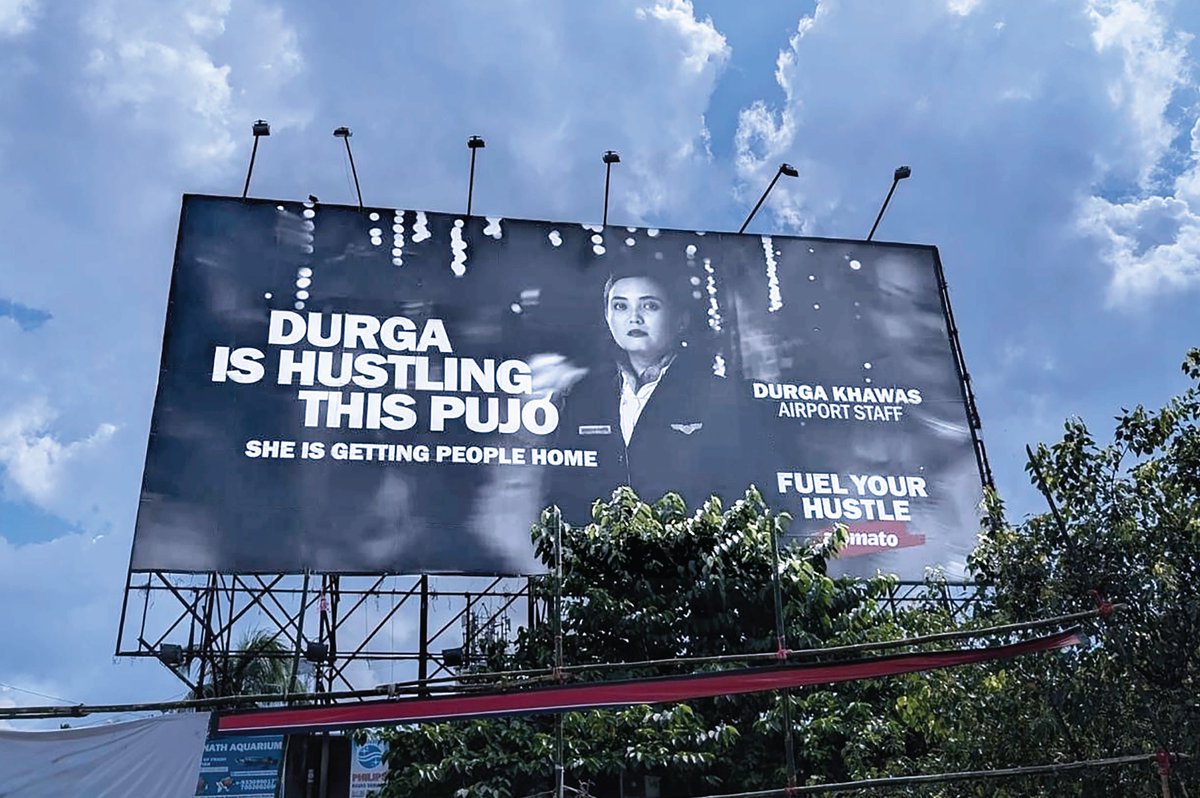
Some women carry Durga's name. All women carry her spirit.
Celebrating everyday hustlers ft. Durga Khawas, Durga Shaw, Durga Ghosh.
@zomato | #DurgaPuja
Every few years, the world reminds us of our place. A threat here, a tariff there. But the message is the same: stay in your lane, India.
Global powers will always bully us, unless we take our destiny in our own hands. And the only way to do that is if we collectively decide to become the world's largest most unapologetic superpower in the world. In economy, in technology, in defense, and most importantly, in ambition.
There is absolutely no other way.