By refusing to implement Security Council resolutions on Jammu and Kashmir, India continues to disregard its obligations under the UN Charter, including Article 25, which requires Member States to accept and carry out the decisions of the Security Council.
India's efforts to divert attention through allegations against Pakistan cannot conceal its own troubling record: sponsoring terrorism in Pakistan, perpetrating state terrorism in the IIOJK, conducting state-backed assassination campaigns in foreign countries, stoking violence against minorities, support for destabilizing activities in the region and disregard for international law, including its unlawful attempt to hold the Indus Waters Treaty in abeyance.
Counsellor Gul Qaiser Sarwani, who is also a Political Coordinator at the Pakistan Mission, claps back at the Indian representative during the General Assembly session on the presentation of the Security Council Annual Report
Please listen to Pakistan's Right of Reply (RoR)
🇵🇰 Youm-e-Takbeer 28 May, is more than a date, it’s a declaration written in the courage of a nation. A declaration that our sovereignty is non-negotiable. That our unity cannot be broken. That our commitment to peace, for our region and beyond will never waver.
Today, we stand together as one people, honoring the past and building toward a future worthy of every sacrifice made.
Long Live Pakistan 🇵🇰🇵🇰🇵🇰
#PakistanZindabad #YoumeTakbeer
Look who’s talking! A monster who patronizes and promotes the rape of Palestinian prisoners — women, men, and children — by Israeli soldiers, prison guards, and dogs.
Humanity’s head hangs in shame.
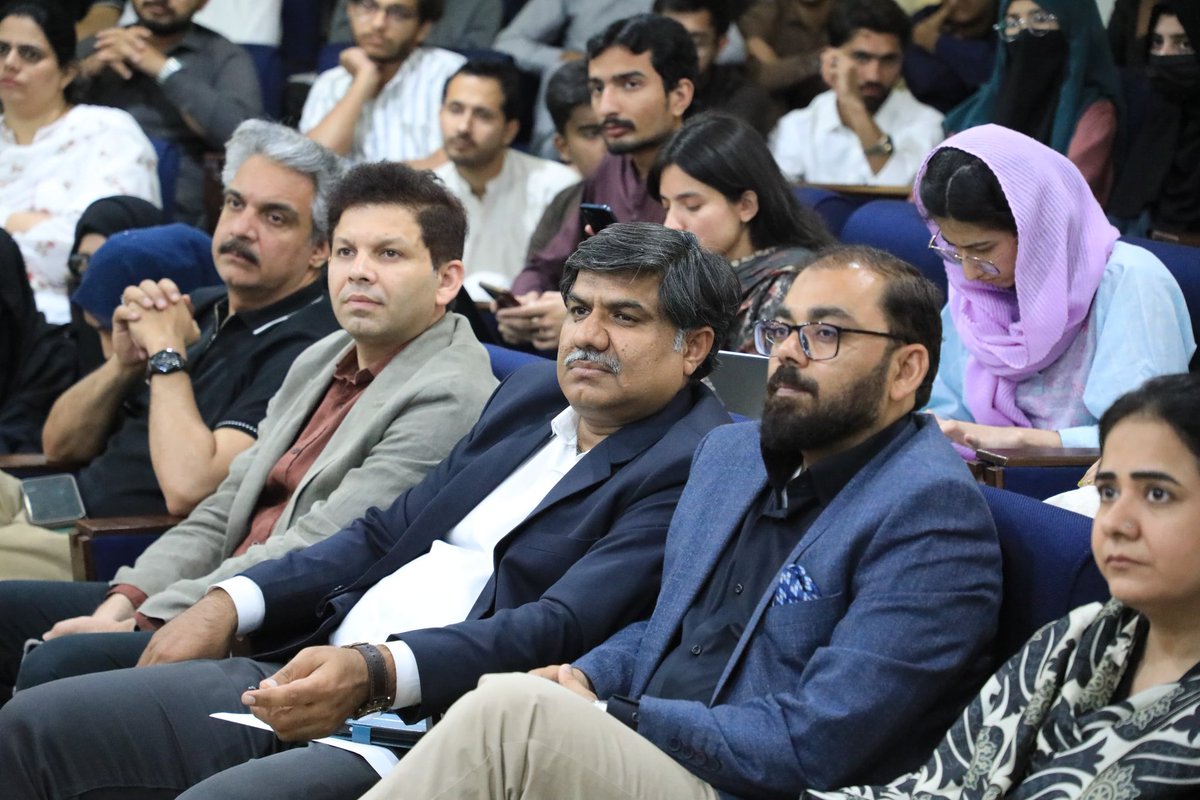
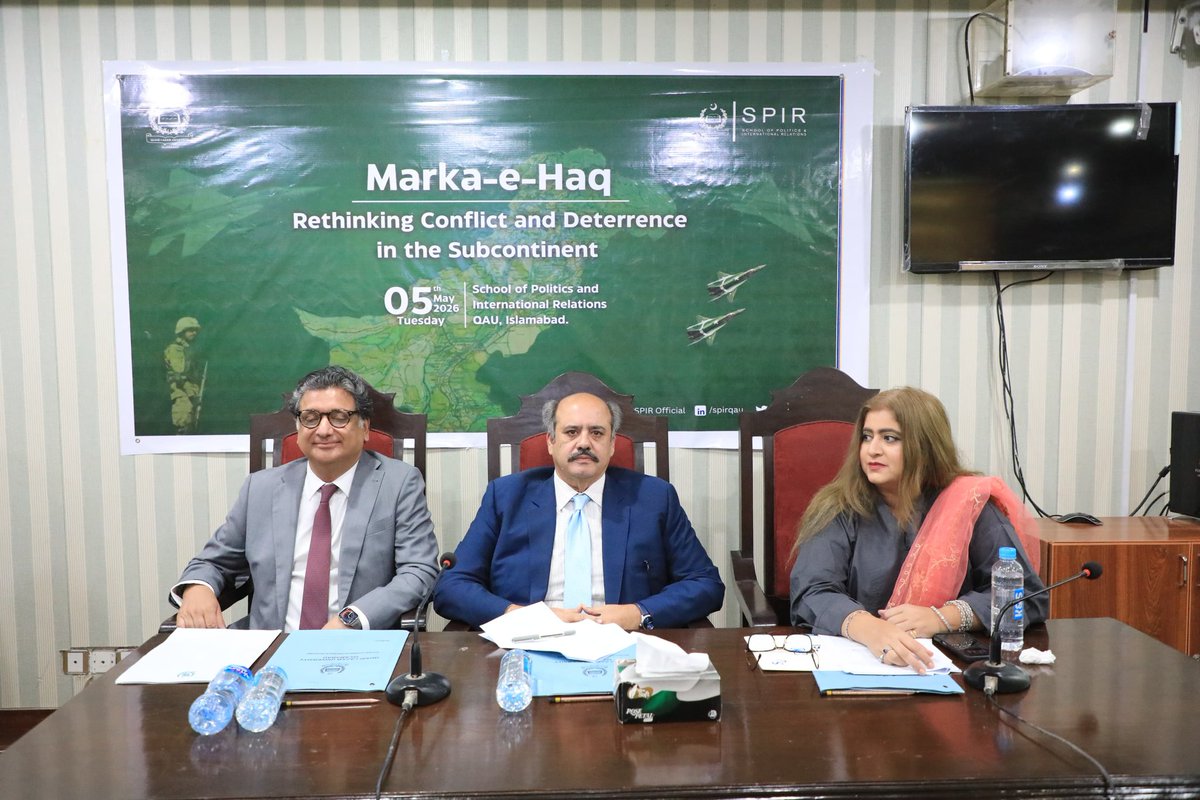
The School of Politics and International Relations (SPIR), Quaid-i-Azam University, convened an academic seminar titled “Marka-e-Haq: Rethinking Conflict and Deterrence in the Subcontinent”. Dr Muhammad Nadeem Mirza, Director SPIR welcomed the distinguished guests and noted that the events of May 2025 have changed the geopolitical configuration of the region and elevated Pakistan’s position in the international community.
Prof. Dr. Zafar Nawaz Jaspal, Meritorious Professor of International Relations and Vice Chancellor Quaid-i-Azam University, situated the May 2025 conflict within the broader theoretical frameworks of international relations, contending that the episode signified a recalibration of regional power perceptions. He argued that the conflict challenged the prevailing notion of India as an uncontested regional power, thereby reintroducing a strategic parity between India and Pakistan in international discourse. He further maintained that Pakistan’s calibrated response contributed to the restoration of a conventional balance of power, which, in turn, reinforced deterrence dynamics in the region.
Dr. Maria Sultan, President of the South Asian Strategic Stability Institute (SASSI), examined the conflict through the prism of contemporary transformations in the character of warfare. She posited that the May 2025 episode constituted a paradigmatic case in which strategic outcomes were substantially shaped during the pre-kinetic phase, without extensive land mobilization. She identified three principal determinants of Pakistan’s operational effectiveness: the strategic employment of information warfare, the real-time construction and dissemination of narratives, and the technical validation of outcomes through battle damage assessments. Dr. Sultan further highlighted the increasing salience of multi-domain warfare, wherein cyber capabilities, electronic warfare, and strategic communications operate in conjunction with conventional military means.
Ambassador Zaheer Aslam Janjua, former Ambassador of Pakistan to Russia and Belarus and an expert in strategic policy formulation, analyzed the conflict from the perspective of nuclear deterrence and strategic stability. He characterized the crisis as a significant stress test for the existing deterrence architecture in South Asia, revealing underlying vulnerabilities and escalatory risks. In particular, he underscored concerns regarding doctrinal ambiguity, including shifts in India’s declaratory posture on the “No First Use” principle and the employment of systems with potential nuclear capability. Ambassador Janjua argued that Pakistan’s policy of Full Spectrum Deterrence has effectively constrained the prospects of limited war under the nuclear threshold.
The speakers collectively underscored that South Asia remains characterized by a fragile strategic equilibrium, wherein long-term stability will depend upon sustained strategic adaptation, credible communication, and the institutionalization of effective conflict management and resolution mechanisms @zafar_jaspal@hecpkofficial
As part of the celebrations of Marqa-e-Haq, the Taxila Institute of Archaeology and Civilizations (TIAC) and the Institute of Information Technology (IIT), Quaid-i-Azam University, Islamabad, organized a series of academic and creative activities to commemorate the occasion.
At TIAC, Dr. Tahir Saeed, former Director of the Department of Archaeology and Museums, Islamabad, delivered an insightful lecture emphasizing the vital role of army museums in preserving military heritage, safeguarding national history, and reinforcing cultural identity.
Meanwhile, the Institute of Information Technology marked the occasion through a range of creative competitions held across multiple categories, including painting, short video production, AI-based content creation, and Milli Naghma. These activities were designed to promote patriotism, foster national unity, encourage resilience, and engage youth through innovative and digital platforms. The one-year commemoration of Marqa-e-Haq at, QAU, not only served as a tribute to a significant national milestone but also provided a dynamic platform for students to showcase their creative talents @zafar_jaspal
بھرپور لعنت بھیجئے اور بھیجتے رہئیے ان تمام چہروں پر جنہوں نے اس موقع پر بھی ناامیدی، وطن دشمنی، بے چینی، جھوٹ اور تعصب پھیلایا۔
وطن کو چاہنے والوں کی خیر !
پاکستان زندہ باد
#Pakistan_Zindabad
On this day (June 21) in 1967, President Ayub Khan laid the foundation stone of the Quaid I Azam University (originally named the University of Islamabad). Always been a great privilege to be associated with QAU. May its light continue to shine for centuries to come.
🚨 *Announcement: Gaza Solidarity Camp at Quaid-i-Azam University!* 🚨
The Punjab Student Council is proud to announce the establishment of a Gaza Solidarity Camp at Quaid-i-Azam University! Join us in raising awareness and showing our unwavering support for the people of Gaza.
(1/5)
Bulleh Shah (Syed Abdullah Shah Qadri) ( 1680–1757 )
His real name was Abdullah Shah, is believed to have been born in the small village of Uch, Bahawalpur in modern day Pakistan. His ancestors had migrated from Bukhara in modern Uzbekistan, in 1680.
#PunjabiPoet