Physics Professor. SPACE & MATERIAL are ultimate frontier. Learn from 4-billion-year of R&D from Earth lab. Enrich YOU with Wonder of WORLD and FUTURE.
I believe everyone should have access to superintelligence, and I wrote a long piece about Meta's philosophy and values for building a positive future for everyone. https://t.co/2ZoNZXZ39T
Warren Buffett on what actually makes a life successful:
1. "if you get to be 65 or 70 and the people you want to love you actually love you, you're a success."
i've met very rich men. testimonial dinners. schools named after them. and nobody loves them. their own kids say "he's in the attic."
2. the best investment you'll ever make is in yourself.
learn to communicate. on paper and in person. if you can't get your idea across, it's like winking at a girl in the dark. nothing happens. get good at it and you raise your own value 50%. and nobody can ever take it from you.
3. you get one mind and one body.
that's the whole deal. say i gave you a car and told you it's the only one you get for the rest of your life. you'd read the manual. keep it in the garage. baby it. you get exactly one body like that. you can't start caring for it at 50. by then it's rusted out.
4. you become whoever you spend your time with.
you drift in the direction of the people around you. so pick people better than you. the biggest pick of your life is your spouse. marry someone a little better than you. and hope they don't figure it out too fast.
5. with money, doing nothing beats doing something.
a farm or an apartment, you can't sell it tomorrow. so you just hold it. stocks you can sell in a second. so people can't help themselves. but moving your money around isn't smarter than leaving it alone. buy a piece of america and stop touching it.
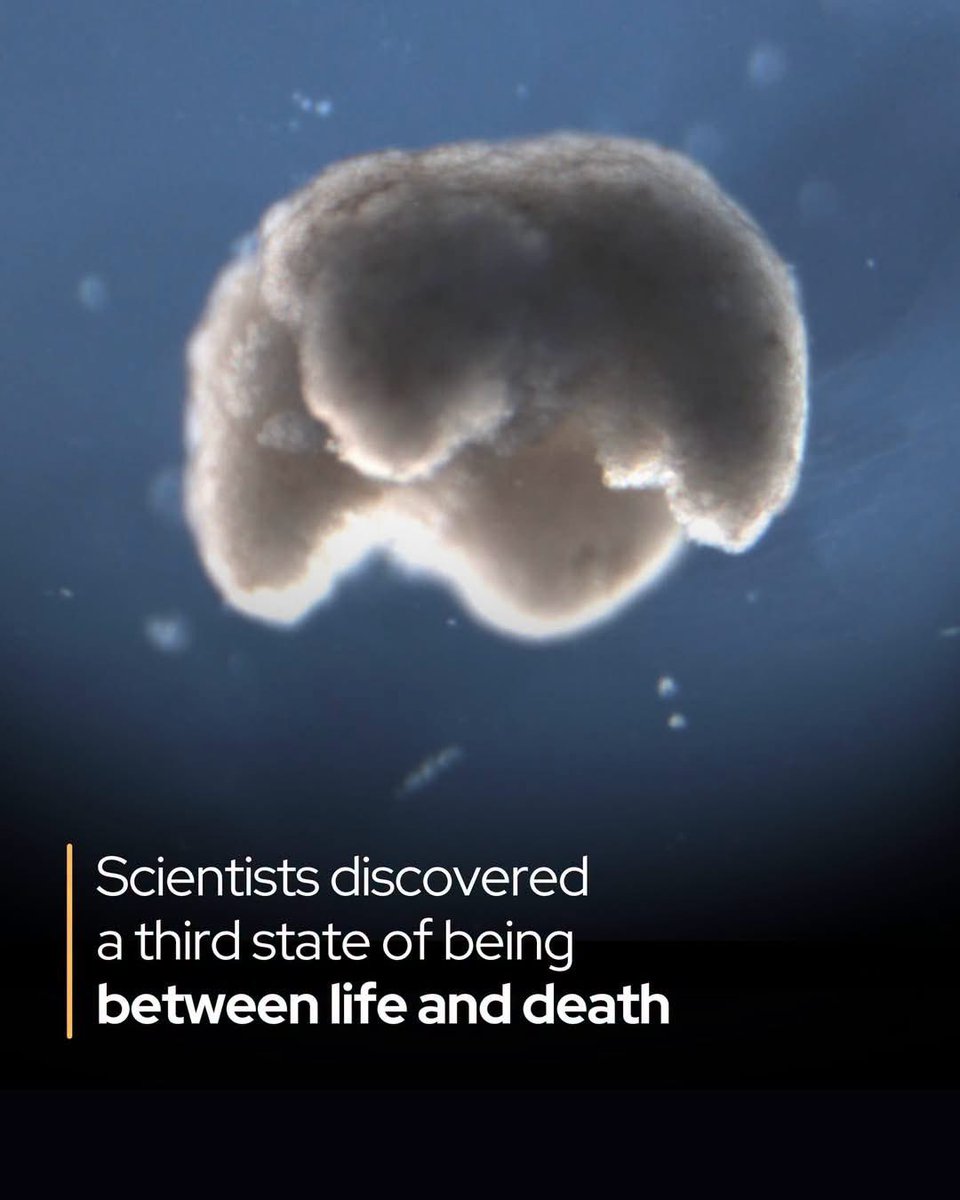
We’ve officially found a “third state” between life and death.
Some cells don’t die when we do. They adapt, reorganize, and sometimes rebuild.
Scientists have discovered that certain cells – when removed from a dead organism and given the right environment – can take on entirely new life. In some cases, they organize themselves into living, mobile structures with unique behaviors and functions. This state, researchers say, isn’t truly life or death. It’s something in between: a third state.
In one experiment, skin cells from a deceased frog embryo were placed in a petri dish. There, they spontaneously assembled into tiny organisms now called xenobots. Unlike ordinary cells, these structures could move on their own, heal damage, and even replicate – not through growth, but by shaping other cells into copies of themselves.
Later, scientists discovered similar behavior in human lung cells. These formed anthrobots – small blobs that navigated their surroundings and even helped repair nearby nerve cells.
This plasticity – the ability of cells to change identity and build new structures – suggests that even after organismal death, some cells retain not just function, but creative potential. And it’s raising new possibilities in regenerative medicine.
In the future, biobots could be designed to deliver drugs, clear arteries, or repair tissues – all built from a patient’s own cells. They degrade naturally within weeks and don't trigger immune rejection.
It’s a strange new frontier: one where death isn’t always the end and cells may still have more to do.
Learn more:
"Biobots arise from the cells of dead organisms − pushing the boundaries of life, death and medicine." The Conversation.
📸Credit: Douglas Blackiston
There is a process that I have used, and still use, to reignite life...
Create two timelines—6 months and 12 months—and list up to five things you dream of having (including, but not limited to, material wants: house, car, clothing, etc.), being (be a great cook, be fluent in Chinese, etc.), and doing (visiting Thailand, tracing your roots overseas, racing ostriches, etc.) in that order.
If you have difficulty identifying what you want in some categories, as most will, consider what you hate or fear in each and write down the opposite.
Do not limit yourself, and do not concern yourself with how these things will be accomplished. For now, it’s unimportant. This is an exercise in reversing repression.
Be sure not to judge or fool yourself. If you really want a Ferrari, don’t put down solving world hunger out of guilt. For some, the dream will be fame, for others fortune or prestige. All people have their vices and insecurities. If something will improve your feeling of self-worth, put it down.
Drawing a blank? In that case, consider these questions:
1) What would you do, day to day, if you had $100 million in the bank?
2) What would make you most excited to wake up in the morning to another day?
Don’t rush—think about it for a few minutes.
If still blocked, fill in the five “doing” spots with the following:
— one place to visit
— one thing to do before you die (a memory of a lifetime)
— one thing to do daily
— one thing to do weekly
— one thing you’ve always wanted to learn
What does “being” entail doing?
Convert each “being” into a “doing” to make it actionable. Identify an action that would characterize this state of being or a task that would mean you had achieved it. People find it easier to brainstorm “being” first, but this column is just a temporary holding spot for “doing” actions.
Here are a few examples:
1) Great cook —> make Christmas dinner without help
2) Fluent in Chinese —> have a five-minute conversation with a Chinese co-worker
Determine three steps for each of the dreams in just the 6-month timeline and take the first step now.
Define three steps for each dream that will get you closer to its actualization.
Set actions—simple, well-defined actions—for now, tomorrow (complete before 11 A.M.) and the day after (again completed before 11 A.M.). Once you have three steps for each of the four goals, complete the three actions in the “now” column.
Do it now. Each should be simple enough to do in five minutes or less. If not, rachet it down. If it’s the middle of the night and you can’t call someone, do something else now, such as send an e-mail, and set the call for first thing tomorrow.
If the next stage is some form of research, get in touch with someone who knows the answer instead of spending too much time in books or online, which can turn into paralysis by analysis.
The best first step, the one I recommend, is finding someone who’s done it and ask for advice on how to do the same.
😴 Research shows sleep dramatically changes how your body responds to your diet.
Sleep isn’t just rest—it’s a powerful regulator of metabolism, and new research proves just how dramatically it influences how our bodies respond to food.
A study published in the Annals of Internal Medicine found that participants who slept just 5.5 hours per night lost 55% less fat and 60% more muscle than those who slept 8.5 hours, despite eating identical diets.
This means sleep deprivation can flip the switch on weight loss—causing you to lose muscle instead of fat, and sabotaging your progress even if your calories are in check.
The culprit? A cascade of hormonal disruptions. Short sleep boosts ghrelin (which makes you hungry), suppresses leptin (which tells you you’re full), and elevates cortisol, encouraging the body to cling to fat. Add to that a spike in insulin resistance, and suddenly your body is storing more calories as fat while struggling to use food for energy or muscle repair. In essence, sleep deprivation rewires your metabolism, making the same meals more likely to pad your waistline and less likely to fuel your fitness goals.
Source: Nedeltcheva et al., Annals of Internal Medicine
Your morning cup of coffee—even up to five cups a day or decaf—could be a powerful shield against chronic liver disease and liver cancer, according to a massive new decade-long study.
A groundbreaking study tracking over 354,000 participants for more than a decade has revealed that drinking coffee daily is associated with a significantly lower risk of liver cirrhosis, liver cancer, and death from liver disease.
Published in the journal Clinical Gastroenterology and Hepatology, the research indicates that this protective effect generally increases with the amount consumed, showing strong benefits even for those who drink five or more cups a day.
Lead author Dr. Hyunseok Kim, a transplant hepatologist at Cedars-Sinai Medical Center, highlighted that the findings represent some of the most comprehensive long-term data on coffee’s relationship with liver health to date.
Strikingly, the study suggests that caffeine may not be the primary driver behind these protective benefits, as decaffeinated coffee drinkers experienced similar reductions in risk. Instead, researchers attribute the liver-protecting qualities to coffee's rich concentration of antioxidants, which combat cellular damage and inflammation.
This means that whether you prefer your coffee regular, decaf, black, or even slightly sweetened, maintaining your daily brew is a simple, highly effective way to naturally support long-term liver health.
source: Rogers, K. (2026). Even high amounts of coffee may lower your risk for liver disease. CNN.
ELON MUSK RUNS THE SAME 5-STEP ALGORITHM ON EVERYTHING HE BUILDS
He calls it a mantra. Says he's made every one of these mistakes more times than he cares to remember.
Here's the process, in order:
1. Question every requirement. No matter how smart the person who set it, the requirement is still wrong to some degree.
2. Delete the part or the process step. If you're not later forced to add back at least 10% of what you deleted, you didn't delete enough.
3. Simplify and optimize. But only after the first two steps.
4. Speed it up.
5. Automate it.
The order is the whole point. His most common mistake from a career of building:
"The most common mistake of smart engineers is to optimize a thing that shouldn't exist."
Speeding up or automating a step you should have deleted just means you spend effort perfecting something that never needed to be there.
When we sit for 20 minutes, blood flow to the brain decreases slightly, which can slow neural processing and reduce alertness.
Extended sitting can lead to temporary drops in cognitive performance, including attention, memory, and problem-solving speed.
In contrast, walking increases blood circulation, delivering more oxygen and nutrients to the brain.
This enhanced blood flow stimulates neural activity, boosting creativity, processing speed, and overall cognitive function.
Even short periods of walking can make the brain more alert, improve mood, and enhance mental clarity compared to prolonged sitting.
Bees lives less than 40 days, visit at least 1000 flowers and produces less than a teaspoon of honey. For us it is only a teaspoon of honey, but for the bee it is a lifetime of work.
Thank You Bees!