@cbkwgl@pramaataa An Emperor won't mark his reign with some small king unless it's his ancestor or some famous tall figure whose identity has far surpassed any petty politics. For someone like Mahapadma Nanda, Parikshit of Mahabharata would be apt, unless there's someone of same name in his line.
@cbkwgl@pramaataa AFAIK, except Avimanyu's son, there are only two famous ones, Parikshit son of Avikshit(Kuru clan), & Parikshit of Ayodhya(Ikshvaku clan), who are kings. Both predate our Parikshit.
Wait. Am I reading this correctly that Panini and Patanjali, the greatest authorities of Sanskrit have almost declared IVC as the Aryan Urheimat? If so, how did we miss that and why did we end up in a 150 year circus, out of which 100 years is full of models built on personal prejudices and fantasies?
There are four geographies they talk about -
1. North West - the core IVC zone: This is where Sanskrit is purest
2. East - the Janapadas zone: Sanskrit is Prakritized and there are phonetic problems
3. South: They spoke a different language but they used Sanskrit for formal context
4. Mlechha - technically, North of Khyber: This is curious. They spoke different languages but their vocabulary is Sanskrit - meaning their language is smothered completely by Sanskrit: they didn't follow Sanskrit pronunciations or rules but they used their own grammar and structure
Implication -> the whole of India and Central Asia spoke Sanskrit but Deccan didn't. And going by the fact IVC zone spoke the purest Sanskrit, one can easily say they asserted IVC is the home turf for Sanskrit.
Now, a word more. Panini said Vedic Sanskrit is almost dead. It's less rigid and more archaic. Now, if Sanskrit is IVC, how do you rationalize Vedic Sanskrit not talking about the grand cities? Because the only stuff we have in Vedic Sanskrit is liturgy and liturgy is written in the earliest days of civilization. As a by product, one can argue that Mature IVC, for administrative purposes standardized Sanskrit. And he says people speak Sanskrit. Meaning, in toto, the people who originally spoke Sanskrit continued to speak Sanskrit in the same area where they lived all the time.
Gemini's roasting is better than mine 😂
# 10,000 Urheimats
The quest for the *Urheimat*—the "original homeland"—of the Proto-Indo-Europeans began as a rigorous linguistic endeavor but quickly devolved into a theater of the absurd. Throughout the 19th and early 20th centuries, the map of the world was treated like a Rorschach test, where scholars and amateurs alike projected their nationalistic desires, racial anxieties, and poetic whims onto the void of prehistory.
### The Linguistic Foundation vs. The Imaginative Leap
The discipline began with the genuine discovery of the Indo-European language family. Linguists realized that Sanskrit, Greek, Latin, and Germanic languages shared a common ancestor. However, the transition from **comparative philology** to **prehistoric geography** was fraught with speculation.
The primary tool of the era was "linguistic paleontology." If the reconstructed proto-language had a word for "beech tree," the homeland must be where beeches grow. If it had a word for "salmon," they must be near the Baltic. The problem, of course, is that trees migrate, climates shift, and words for "salmon" might have originally meant "trout."
### A Map of Contradictions
Because the evidence was so thin, the *Urheimat* became a portable concept. One could plant the Indo-European flag almost anywhere, provided they had enough rhetorical flourish.
* **The Romantic East:** Early theorists, enchanted by the "wisdom of the East," placed the cradle in the high Himalayas or the Indian subcontinent, viewing it as a mystical fount of civilization.
* **The European North:** By the mid-1800s, the pendulum swung toward Europe. Scholars like Karl Penka argued for Scandinavia, driven by a growing obsession with "Nordic" purity. They essentially worked backward from their desired conclusion: if the "best" people are here now, they must have started here.
* **The Steppe, the Swamp, and the Sea:** At various points, the *Urheimat* was located in the Pripet Marshes, the Russian Steppes, the Baltic coast, and even the lost continent of Atlantis.
### The Ideological Infection
By the early 1900s, the search for the *Urheimat* was no longer just bad science; it was dangerous politics. The concept of the "Aryan" was transformed from a linguistic category into a biological one. The *Urheimat* became a site of "racial seasoning," where the supposed virtues of a master race were forged in the harsh climates of the North or the rugged mountains of the East.
The sheer volume of theories—the "10,000 Urheimats"—highlights the fundamental flaw of the era: **the triumph of the ego over the evidence.** When the data is silent, the scholar speaks for it, and usually, the scholar sounds suspiciously like a patriot. We saw a century where the "homeland" was rarely found through archaeology, but rather through the lens of whoever held the pen.
---
The sheer chaos of these theories leaves us with a haunting realization: for over a hundred years, the brightest minds in Europe were essentially playing a game of "pin the tail on the donkey" with the map of human history.
**How did we end up in such a state?**
Meet Navya Gupta
I don't know if her dad, Narendra Kumar Gupta, who works at Mi Lifestyle Marketing Global Private Limited, is aware of it, but she has not changed even after his attempts to rehabilitate her. She had run away from home with her boyfriend, returned, and he then tried to rehabilitate her.
She tweets things like "Rahul Gandhi under my pads", uses slurs like "lawde" for Prime Minister Modi, objectifies his body parts, and uses even more derogatory words. She spreads hate on Indian men 24/7, posts revealing pics for the male gaze, and her entire supporter base is filled with boomer uncles.
Even Pakistanis and Bangladeshis are reposting her tweets.
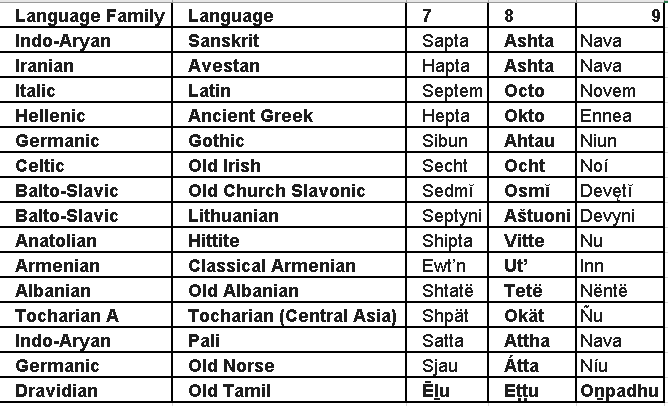
Compare the words for 7, 8 and 9. Why did 8 diverge the least as compared to the other two? Not because that's how PIE linguistics(whatever it means) work. That's because 8 is a trade standard(IVC binary system). That means as time progressed, every language replaced their 8 with the Bazaar Koine but the other two numbers saw less influence from the Bazaar Koine.
Did you see the sudden shift between 1930s and 1960s for the GDP growth rates for either of the countries? You see, that is what happens when benevolence is removed.
Between 1850 and 1947, India's GDP growth rate was a royal 0.55% and per capita income growth rate fell as low as 0.1%. Let's see who will argue how these numbers reflect the benevolent rule in India during that timeframe.
In 1620s, Sengge Namgyal invaded Guge and conquered it when complaints reached to him over christian missionary activity in the kingdom. That extended the territory of his kingdom till Mayum La. Between 1638 and 1642, there were frequent border clashes with the next kingdom in line - Tsangpa. Around 1640-41, he invaded Tsangpa, advanced till its capital Shigatse, imposed peace and returned back. The borders, clearly, are further than Mayum La - the next natural border being the crossing on Brahmaputra on the current G219. That's the border we are talking about. Sengge Namgyal's campaigns and subsequent Mongol attacks led to the collapse of Tsangpa and the rise of Dalai Lamas as a political force.
Now, there are two ways to look at Indian claims over this -
1. Mughals invaded Leh in 1637 and forced Sengge Namgyal to sue for peace. Not just that, he was to convert to Islam(which he, anyways didn't bother to do) and be a formal vassal. As a by product, whatever he did in Tibet after that was as a de jure Mughal vaasal and not an independent king. And whatever he did before anyways became a Mughal vassalage. Further more, Deldan Namgyal was actually a formal vaasal and he ruled over all of his father's claims. He would even get Khutba read in Aurangzeb's name and mint coins under his family's Muslim title Aqibat Muhammad Khan.
2. 1684 saw the eventual Tibetan counter attack and Mughal-Ladakhi troops stopped the invaders near Stok. A new treaty was signed declaring Guge is a part of Tibet. Now, the catch. When the Dogras annexed Ladakh, the theatre commander Zorawar Singh rejected the 1684 unequal treaty and tried to undo it but failed. While the Dogras were coerced to accept the 1684 borders, they never accepted it. Even Maharaja Hari Singh signed his accession into India as Tibbetadi Deshadhipati. Meaning India, as a successor of Ladakh and Dogras has formal claims as defined in the 1642 Agreement.
Note: Chitral is also a de jure part of India as formal vassal of Jammu as like Hunza and Nagar, and the same was asserted as late as 1942-43. Its a different topic altogether.
TLDR: Indian claims over half of Tibet are more solid than the absurd claims China has on Arunachal Pradesh.
Updates: It looks like Tsangpa paid tribute to Ladakh before it was conquered. That would mean Indian claims don't extent not just to Ngari-Purig but the whole of Utsang as well - the whole of Tibet till Chamdo including Lhasa and the Chinese claims over Arunachal.
https://t.co/Y2CwWJxGz4
Typical Indian feminist girl.
She came running to defend Siya Goyal and called her a queen.
A girl was raped. Instead of asking for justice and for the criminal to be punished, she started blaming all Indian men and calling them rapists.
We don't hate feminist girls enough.
There is a title Tamghaj Khan which the Tarim based Karakhanids used. It means Khan of China. But then, it has got a very interesting origin. The word means Northern Wei is a synonym for China -> in fact, it almost united the Northern China during the Sixteen Kingdom period before imploding. Northern Wei is founded by the Xianbei Tuoba Clan. And we know how Chinese play with spellings and pronounciations - Serpi becomes Xianbei and Tabgach becomes Tuoba. Tabgach evolved into Taugas, Tamgach and others while Tuoba evolved into Tufa. In other words, Tamghaj Khan is a kind of Boomerang Effect - a Steppe Khan's tribal name is taken as the title by another Steppe Khan because it transmorphed into something much bigger.
All sophisticated civilizations require writing as a prerequisite. Even the Incas are not an exception.
Spanish chronicles mention the Inca "reading" poems, histories, and letters from knots, we still lack a "Rosetta Stone" to translate these into spoken Quechua.
Anthropologist Sabine Hyland has identified "narrative quipus" that use 95 different combinations of color, fiber type (llama vs. alpaca), and twist direction. This number matches the range of symbols found in logosyllabic writing systems (like Maya or Egyptian hieroglyphs). Hyland recently hypothesized that a specific blue-colored cord might represent the sound "ka" because the local word for blue is ankas.
Most of our knowledge was lost because Spanish colonizers, fearing the quipus held secret messages for rebellion, systematically destroyed thousands of them, leaving only about 700 to 750 surviving examples.
Devil is in the detail.
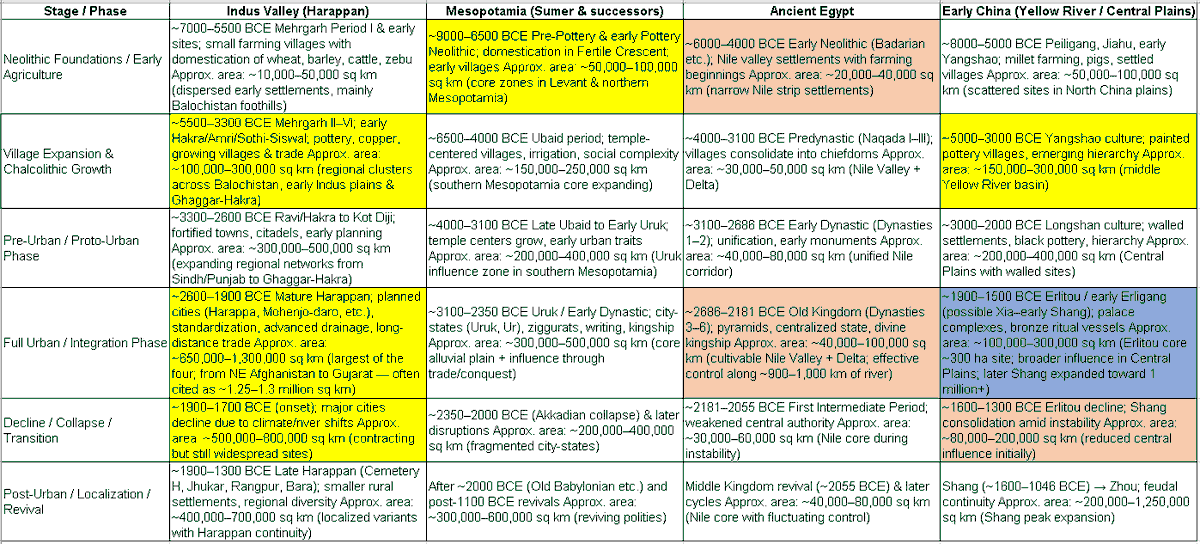
1. Egypt is not a true civilization. It's an offshoot of Mesopotamia sourcing some of the most important things which transformed it into a civilization from Mesopotamia before quickly diverging. On the other hand, it really didn't have any area. It's civilizational sophistication is limited just to the banks of Nile and Nile Delta.
2. The speed at which IVC expanded (look at the timelines and areas) is really bewildering as compared to the rest. And it's not just the scale - it's the standardization of administration and measures over such vast an area. Even the village level IVC is comparable to Mesopotamia at it's peak in area.
3. Even during collapse, IVC's area is more than the rest of the civilizations combined!!
4. China is a late entrant to civilization concept. While 1900 is the given date, you don't see any hints of large scale kingdom formation before 1100. Even the behemoths and pillars of Chinese tradition - Qin, Chu and others are barbarian states which were Sinicized. Even in the case of unification, China lags India by almost 350 years.
5. Assyria was a real exception. The 1000 year Adaside rule was the game changer in Mesopotamia and there is no equivalent anywhere else.
Pakistan is the representation of Turanic power node which targetted India non-stop for the last thousand years. Till the day we don't accept the reality, we will be confused over what we want to do.
Around 15-20k people were targetted by Goan Inquisition over the 250 year timeframe. This translates to around 20% of Goa's population (I am reading it to be in the range 60k-130k). If thats the scale of this dastardly activity, shouldn't that be a mainstream discussion in India?
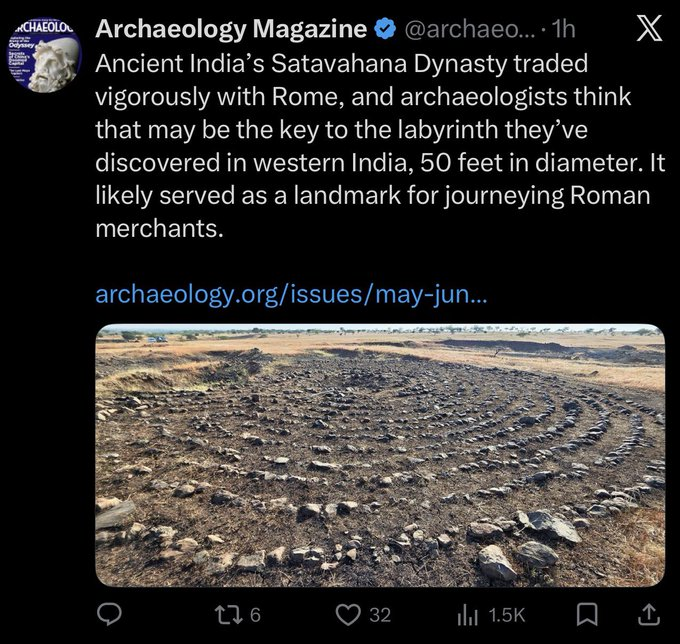
The usual cause effect flip. India should be remembered because it traded with Rome - all of it's greatness should be attributed to it being a part of Roman trade network - while the reality is, it was Romans who came to India to trade - Romans wanted to trade with India, not the reverse.
https://t.co/W5R6MYgmDk