He was Satyendra Nath Bose, an Indian physicist whose quiet brilliance in the 1920s forever altered our understanding of the quantum world.
In 1924, Bose, then a 30-year-old professor in British India, sent a groundbreaking manuscript directly to Albert Einstein. The paper offered a novel, more elegant derivation of Planck's law for blackbody radiation by treating light quanta (photons) as indistinguishable particles—a radical departure from classical statistical methods. Impressed by its insight, Einstein personally translated the work into German and facilitated its publication in the prestigious Zeitschrift für Physik.
This exchange sparked a brief but profound collaboration. Einstein extended Bose's statistical approach to material atoms, predicting a bizarre new state of matter at ultra-low temperatures: what we now call a Bose-Einstein condensate (BEC), where particles behave as a single quantum wave. Bose's original framework became known as Bose-Einstein statistics, and the class of particles that obey it—those with integer spin, including photons, gluons, W and Z bosons, and the Higgs boson—was later named bosons in his honor by Paul Dirac.
Unlike fermions (matter particles like electrons), which obey the Pauli exclusion principle and cannot occupy the same quantum state, bosons can pile into identical states en masse. This "social" behavior underpins extraordinary macroscopic phenomena: the coherent light of lasers, the zero-resistance flow in superconductors, and the collective quantum coherence in BECs.
Despite the monumental impact—his statistics describe half of all fundamental particles and enabled key advances in quantum field theory, condensed matter physics, and particle physics—Bose remained remarkably unassuming. He continued teaching at universities in Dhaka and Calcutta (now Kolkata), mentored students, pursued ideas in X-ray crystallography, unified field theory, and other areas, and never sought the spotlight. Nominated several times for the Nobel Prize (notably for Bose-Einstein statistics and his later work), he was never awarded it, and his name rarely appears in popular accounts of 20th-century physics.
There's a poignant humility in his story: a man whose legacy literally names one of the two fundamental families of particles in the universe, yet whose personal fame never matched the scale of his contribution. Bose reminds us that true influence often arrives without fanfare. Some breakthroughs echo through textbooks and technologies, while their creators work in the background, content to let the universe carry their ideas forward—even if history's spotlight rarely finds them.
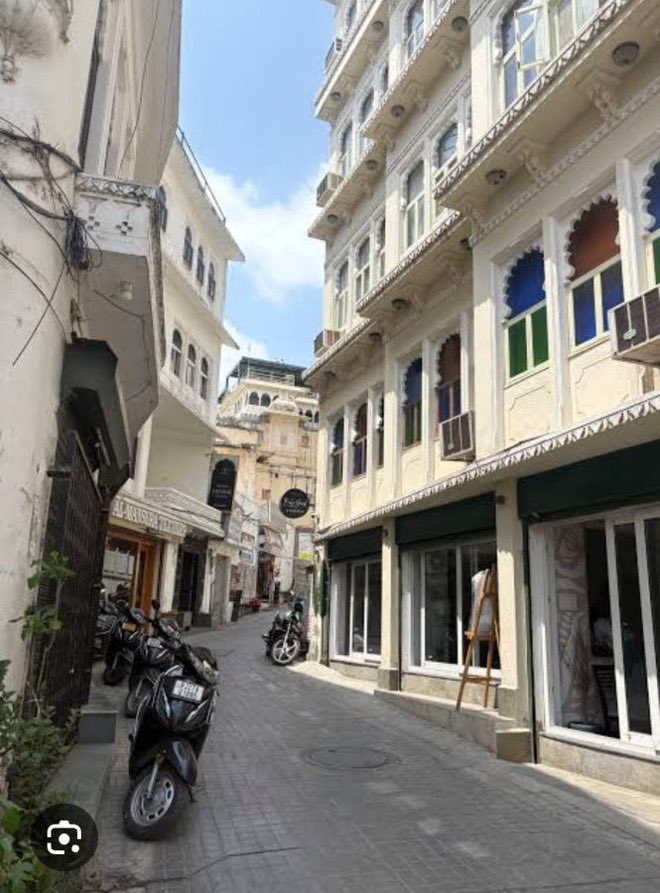
Udaipur’s Old City.
Narrow lanes. Clean, quaint, charming.
Founded in 1559.
There is no reason this should draw fewer visitors than the medieval towns of Europe. None at all.
We travel far to discover new places.
Sometimes the discovery begins closer home.
#SundayWanderer
🇦🇺 Australia has officially created the world’s largest gold bar: 521.2 kg (1,149 lb) of 99.999% pure gold.
At current prices, this beast is worth roughly $77 million.
Proving once again that everything's bigger Down Under
Writers: Mhedi, Ian
On This Day | World Vada Pav Day
In the 1960s, Dadar became the birthplace of Mumbai’s most iconic snack. Ashok Vaidya (and some say Sudhakar Mhatre) served the first vada pav to mill workers. This is the photo of first stall.
Which is your favourite vada pav stall in the city?
While restoring a nearly 500-year-old stepwell in Patna, our team uncovered this unusual geometric stone pattern buried beneath the soil.
It appears to be a deliberate architectural design, but what exactly is it? A map, a traditional geometric/ritual pattern, a water-management layout, or something else?
We’re looking for historians, archaeologists and architecture experts to help us identify it.
What do you think we’ve discovered?
Lets do some Math
Global Private wealth is estimated to be $350T
The estimated investment is 2% in Gold
@RayDalio is suggesting 15%. (in my view that is still conservative but lets play along)
Lets say 2% goes to only 3% (forget 15%)
That means $3.5T has to move to Gold
Annual demand for Gold today is 3500Tonnes valued at $0.5T. so 7 Times annual demand will need to be satisfied.
All available above ground Gold is worth about $35T
So a 10% demand on existing Gold means Gold mvoes to maybe $15-20K (nobody really knows)
And remember we just went 2% to 3%.
Have Gold ??
@JanGold_@KingKong9888@riteshmjn@LukeGromen@GoldTelegraph_@GOLDCOUNCIL@IGWTreport@gold@Macrobysunil
What if we told you there’s a town in India where political banners don’t last more than 24 hours?
In Sulthan Bathery, cleanliness isn’t just a rule, it’s a way of life. From midnight clean-ups to strict fines and active citizens, this place is setting a benchmark most cities haven’t even thought of yet.
Watch this video to see how an entire town came together to make it happen and stayed consistent.
#CleanIndia #Kerala #SulthanBathery #civicsense #civicsenseIndia
[Sulthan Bathery, Kerala, Civic Discipline, Civic Sense India]
On August 17, 2026, Singapore officially unveiled the world’s first independently managed biological data center prototype, integrating 16 million living human neurons with traditional silicon hardware.
The project, hosted at the National University of Singapore Medicine, is a strategic collaboration between the university, digital infrastructure developer DayOne Data Centers, and bio-computing startup Cortical Labs. This infrastructure marks a shift from purely digital architecture to wetware, combining synthetic biology with computational processing power.
The system departs completely from traditional server farms based solely on microchips. The prototype is housed in a single standard rack that contains 20 CL1 biological computing units. Each unit holds approximately 800,000 neurons cultivated in a laboratory from human stem cells. These living neurons sit on silicon chips equipped with electrodes, where electrical impulses from the digital system stimulate the cells, causing them to alter their synaptic connections.
The neural activity is then transmitted back and translated into computational data by a proprietary operating system named biOS. Because these are living cells, the servers require a literal life-support system, which is why technicians feed the neurons every three days with a cocktail of sugars, micronutrients, and pH buffers, while specialized mixers regulate oxygen, nitrogen, and carbon dioxide levels.
The transition toward biological processing aims to solve two of the biggest challenges in the artificial intelligence era, which are energy consumption and learning efficiency. A single CL1 biological unit consumes about 25 to 30 watts, compared to the hundreds of watts required by a conventional silicon data center chip. Consequently, the entire biological rack demands only between 800 and 1,000 total watts, whereas traditional infrastructures consume tens of kilowatts for AI workloads.
Furthermore, the technology offers high data flexibility, delivering strong efficiency with small datasets and unpredictable scenarios without needing the massive data volumes required to train traditional models. This approach drastically lowers environmental impact and intense cooling requirements, aligning with Singapore’s Green Data Center Roadmap.
The prototype does not aim to replace the entire global cloud infrastructure immediately, but focuses instead on specific tasks where biology outperforms current computer architecture. A primary field is advanced biomedical modeling, which uses the neurons to better understand the development of neurodegenerative diseases directly on the integrated hardware-software platform.
Another application involves accelerating pharmaceutical research to test the efficacy of new drugs and molecules, which drastically cuts laboratory testing timelines. Finally, the technology enables the development of predictive AI algorithms that leverage the natural ability of the human brain to adapt to contextual changes without requiring massive computational recycling. This initiative is part of DayOne’s long-term plan to expand next-generation computing capabilities across Asia and Europe, while construction of their first local AI-ready traditional data center, named SG1, is set for completion in early 2027.
விவசாய கிணற்றில் தனி ஆளாக இறங்கி 35 அடி ஆழத்தில் மோட்டார் பகுதியில் சுற்றி இருந்த கொடிய விஷத்தன்மை கொண்ட நல்ல பாம்பை லாவகமாக பிடித்து பாதுகாப்பாக வனப்பகுதியில் விட்ட 54 வயது வன அதிகாரி அம்பலவாணன்..
#Tenkasi | #Snake | #Rescue | #PolimerNews
Madras Day 2026 ❤️
Vanakkam, Madras!
A city woven with history, heritage and countless memories.
Celebrating 387 years of our timeless city — from the iconic Ripon Building to the historic Chennai Central, Madras continues to inspire generations.
Happy Madras Day!
August 22 | Celebrating the spirit of our Chennai!
#MadrasDay2026 #MadrasDay #Chennai #NammaChennai #VanakkamMadras #SafeChennai
Every smart investor had reasons
to wait on Dholera.
Expressway open?
Airport AAI testing done?
Approved Plan Layout + NA-NOC?
Every excuse is gone.
Govt Approved plots from ₹10L.
Tata plant next door.
Book for ₹50,000
Mrityunjoy Chakraborty, IIT Kharagpur professor:
"Jane Street pays a 22 year old $500,000 a year for one skill: turning uncertainty into a number you can bet on. that number is the first thing this professor teaches, and it is free"
this free lecture is the foundation every quant bot and hedge fund model is secretly built on.
before the AI, before the strategy, there is one question. what is the chance this happens, exactly.
get that number right and every bet after it is just math. get it wrong and no model, no bot, no amount of compute can save you.
Chakraborty builds probability from the axioms up, on a blackboard, in notation a 15 year old can follow.
Wall Street sells this as a $500,000 edge. an IIT professor hands you the source code for nothing.
F&O data tells a brutal story:
• Under ₹1L capital: only 10% profitable
• ₹10L–₹1Cr: 32% profitable
• Option buyers: 10% profitable
• Option sellers: 56% profitable
But there’s a catch.
Losing option sellers lost an average ₹51.7L, compared with ₹1.3L for buyers.
And experience didn’t save traders:
91% lost money after 1 year.
95% were still losing after 5 years.
The market doesn’t reward experience alone.
It rewards risk management.