BREAKING: A breakthrough deal between the U.S. and Iran could be announced as soon as this week, sources familiar with mediation efforts told Al-Araby Al-Jadeed.
It follows Iran’s president saying Friday that Tehran isn’t seeking nuclear weapons and is ready for dialogue.
BREAKING: Banks are taking back more homes.
Lenders repossessed 5,794 homes in August, up 42% from a year ago and 22% from July, per ATTOM.
That’s far faster than the 13% rise in overall foreclosure filings, meaning more distressed homeowners are reaching the end of the process.
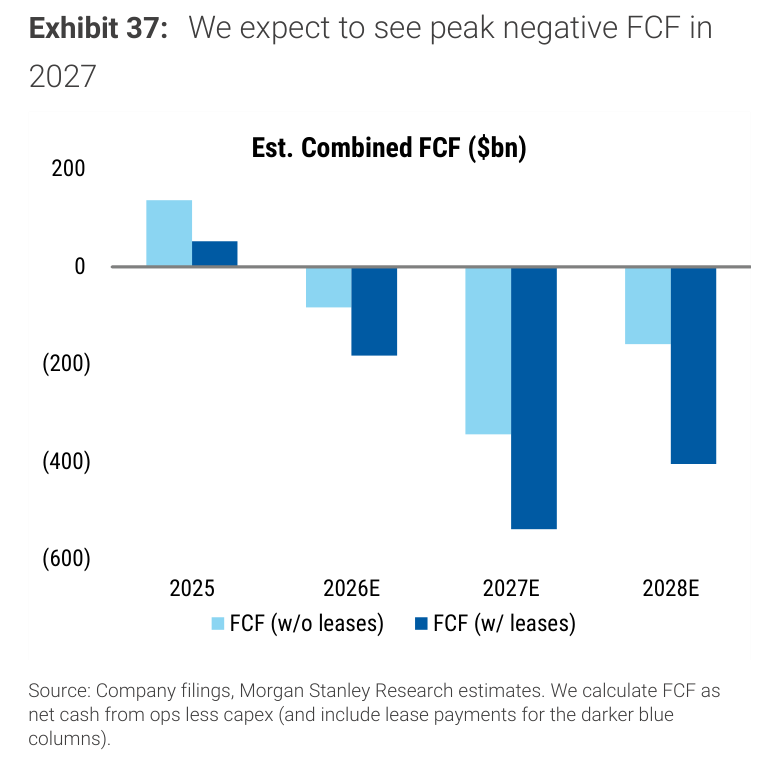
2027 is about to get crazy: according to Morgan Stanley, hyperscaler and neocloud free cash flow to hit its most negative point in 2027, with the shortfall even bigger once lease payments are include: just shy of $600BN in cash burn.
In other words, the year with the biggest capex bill is also the year with the biggest funding gap.
BREAKING: Elon Musk says he will donate one share of SpaceX stock, $SPCX, to every American child in 2027.
There are currently ~73 million children in the US and SpaceX is trading at $146/share.
This makes Elon Musk’s donation worth $10.7 billion based on current share price.
This aged well.
3 hours into the supposed "Black Monday" stock market crash and Nasdaq 100 futures are now up nearly +1%.
The S&P 500 is set to add +$350 billion in market cap at the open again.
As we stated 24 hours ago: Ignore the noise.
Car buyers are stretching loans to seven years or more just to afford the monthly payment, per CNBC
And payments are still hitting records.
Average new-car payment: $787 a month
Average amount financed: a record $44,664
Average interest rate: 7%
BREAKING: America’s $1.7 trillion auto loan market is headed for a crash, per Reuters.
Auto loans are now one of the biggest sources of household debt, bigger than credit cards.
And the strain is showing: 1 in 5 Americans is behind on at least one loan, the highest since 2010, and the average car on the road is now nearly 13 years old, a record.
Barack Obama weaponized the federal government like no president ever has.
If Ilhan Omar broke immigration laws, she shouldn't get a pass.
And let's not forget: The Obama-started Russiagate hoax was exactly that: a hoax.
On my way to the office this morning, I passed a group of young people protesting, a Palestinian flag draped over their shoulders.
And I asked myself a question I can't shake: why does this generation always fall into the same trap? No matter the history. No matter the context. Even the ones from wealthy families, who went to the best schools, who were dealt every good card. Always the same trap.
I don't think it's stupidity. I think it's a mechanism. And a mechanism can be taken apart, piece by piece.
A. The observation: everything the state touches becomes unaffordable.
Look at economist Mark Perry's famous chart, the one people call "the chart of the century." It tracks US prices since 2000.
At the top, what explodes: hospital services, college tuition, textbooks, childcare, housing. Increases of +100%, +150%, up to +250%, far above general inflation.
At the bottom, what collapses: TVs, software, phones, toys, clothing. A TV today costs a fraction of what it did in 2000, for an infinitely better product.
Look at what separates the two groups. It isn't technology. It isn't complexity. It's one variable: how much the state is involved.
At the top, sectors that are subsidized, regulated, shielded from competition, where the state funds demand and blocks supply. At the bottom, sectors where companies fight every single morning to serve you better and cheaper.
B. The mechanism: why it's systematic.
When the state subsidizes demand without freeing supply, prices rise. Every time. Guaranteed student loans, and universities raise tuition. Housing aid plus blocked building permits, and rents skyrocket. Administered healthcare, and bureaucracy eats the budget before it ever reaches the patient.
In France it's even more vicious, because the price doesn't disappear: it hides. You never see the hospital bill, you pay it through payroll contributions. You never see the cost of school, you pay it through taxes. Public spending at 57% of GDP, one of the heaviest tax burdens in the world, more than €3.4 trillion in debt. And the result? Overflowing ERs, falling PISA scores, young people who can't afford to live in the city where they work.
The market didn't fail in these sectors. It was never allowed in.
C. Suffering demands a culprit.
A 22-year-old lives all of this in their bones. They can't find a place to live. Their degree either buries them in debt or opens no doors. The future feels blocked. That suffering is real, and I don't deny it for a second.
But human beings can't stand suffering without a culprit. They need a face. A scapegoat.
And this is where everything is decided: who taught them how to read the world?
D. Whoever tells the story picks the villain.
Schools are public. Universities are public. Culture runs on grants. Film goes through funding committees. Public broadcasting shapes the narratives. The people handing down the interpretive framework are, overwhelmingly, paid by the very system that creates the problem.
Do you really think that system is going to name itself as the culprit?
No. It names the capitalist. The boss. The landlord. "The rich." The multinational. The commercial West. Same role, same casting, every time.
E. One lens, a thousand causes.
And this brings me back to that flag. A generation taught to read every situation through a single lens, oppressor on one side, rich, Western, capitalist, oppressed on the other, will apply that lens everywhere. To housing. To climate. To conflicts on the other side of the world. The cause changes, the lens stays. That's why the trap is always the same: it's not the cause that draws them in, it's the way of thinking that was installed in them.
F. The perfect inversion.
Here's the irony. Capitalism is the force that drove down the price of almost everything it touched. The state is the force that blew up the price of almost everything it captured. And young people blame the first for the crimes of the second.
It's like blaming the firefighter for the fire because you saw him at the scene.
G. The ballot box confirms it.
In the US, a few weeks out from the midterms, a large share of urban young voters is getting ready to vote Democrat for more state, more spending, more regulation. New York elected a self-described socialist mayor, carried by young voters, on promises of rent freezes and city-run grocery stores. Rent freezes, the policy that has made housing scarcer everywhere it's been tried. The cure that worsens the disease.
In France, it's the same play in two acts. Part of the youth votes for the radical left, which promises more state. Another part votes for the center, which promises to "manage" the state well, and has dug the debt deeper than ever. Two different ballots, one shared assumption: the problem is the market, the solution is the state.
H. The way out.
These young people aren't stupid. They're right to be angry. They're just aiming at the wrong target.
The day they understand that their rent, their tuition and their hospital are expensive precisely because the state runs them, their anger will change direction. They'll stop protesting against those who create. They'll start protesting against those who capture.
That day, the greatest intellectual scam of our time will be over.