Founder @StartRelief | Building Companies That Solve Big Problems | Fintech • AI • | Former Alley (Alley powered by Verizon), Seamless Docs (Exit 2020)
Today, I may have ended my career.
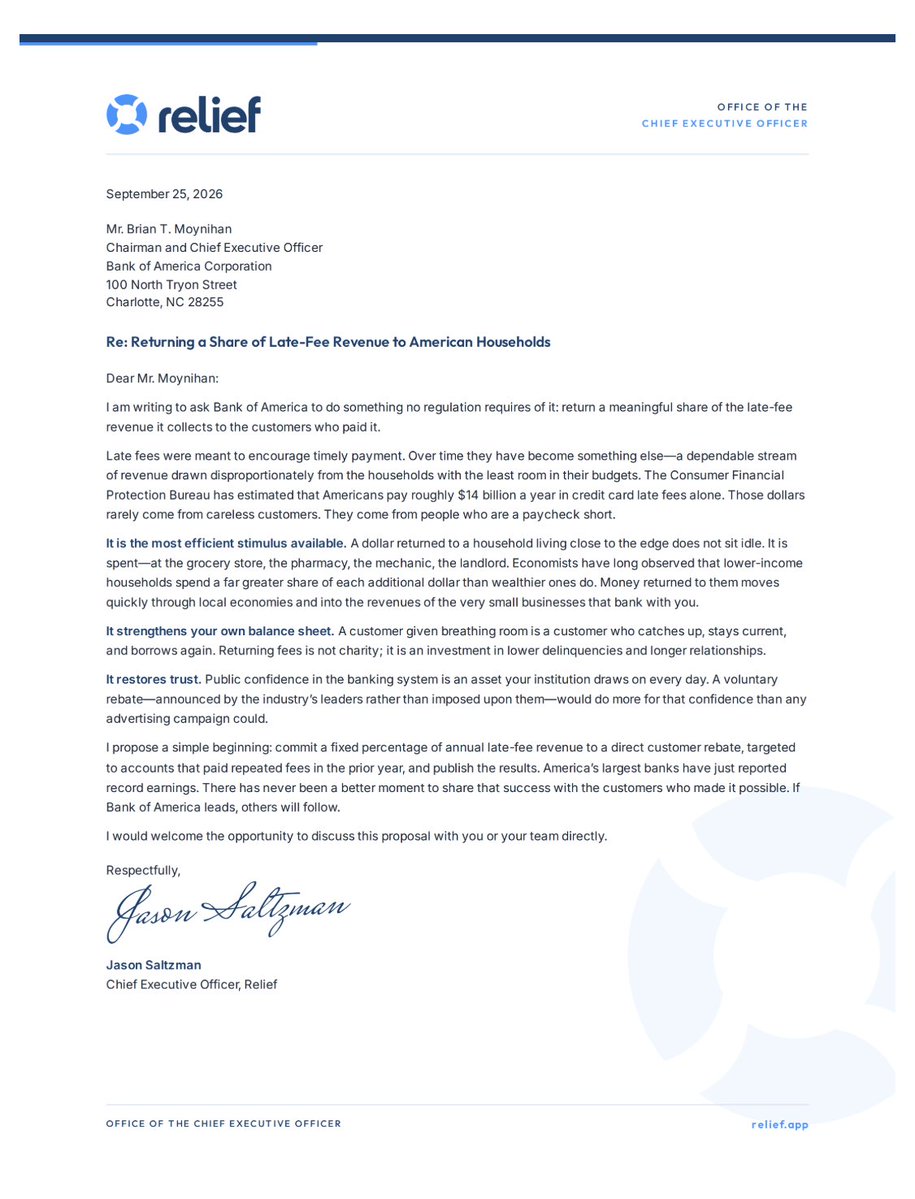
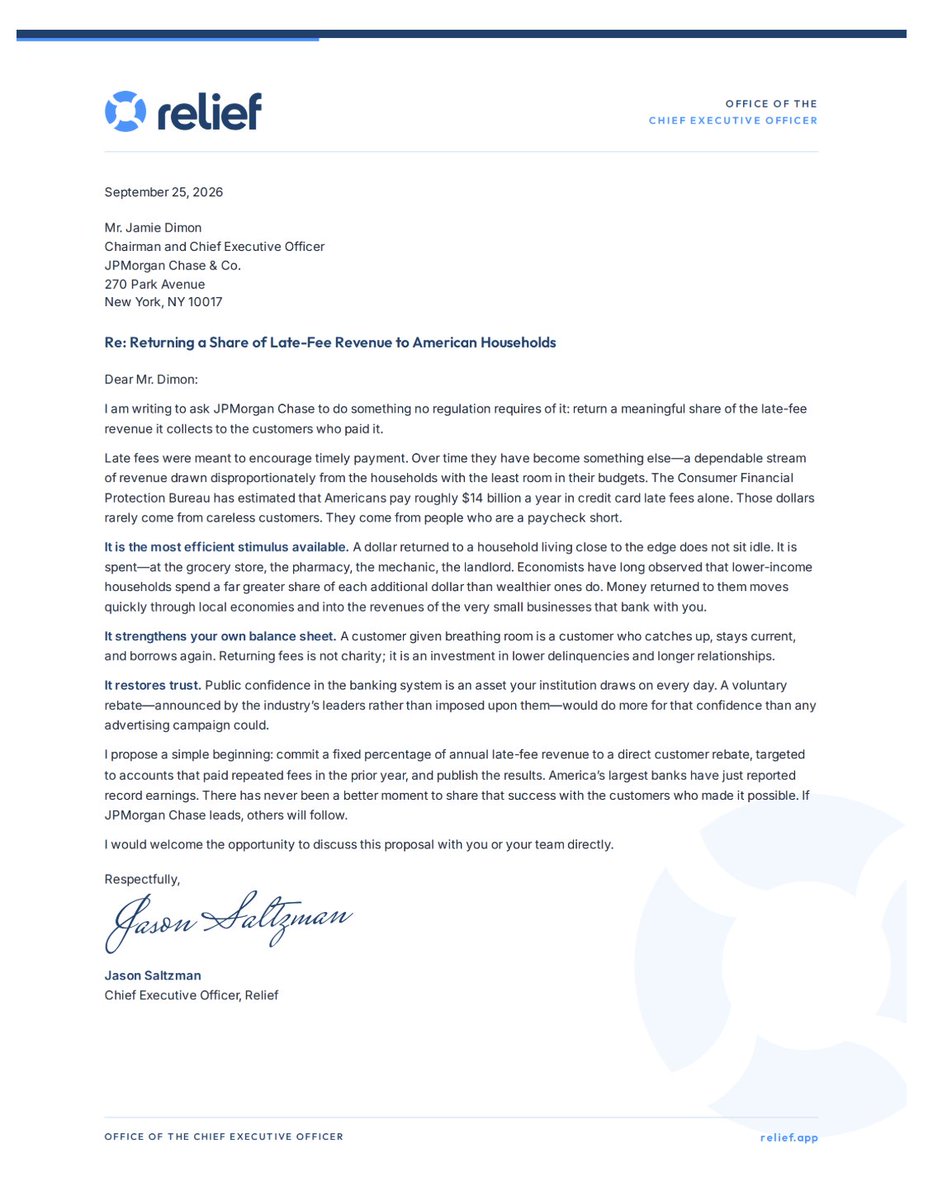
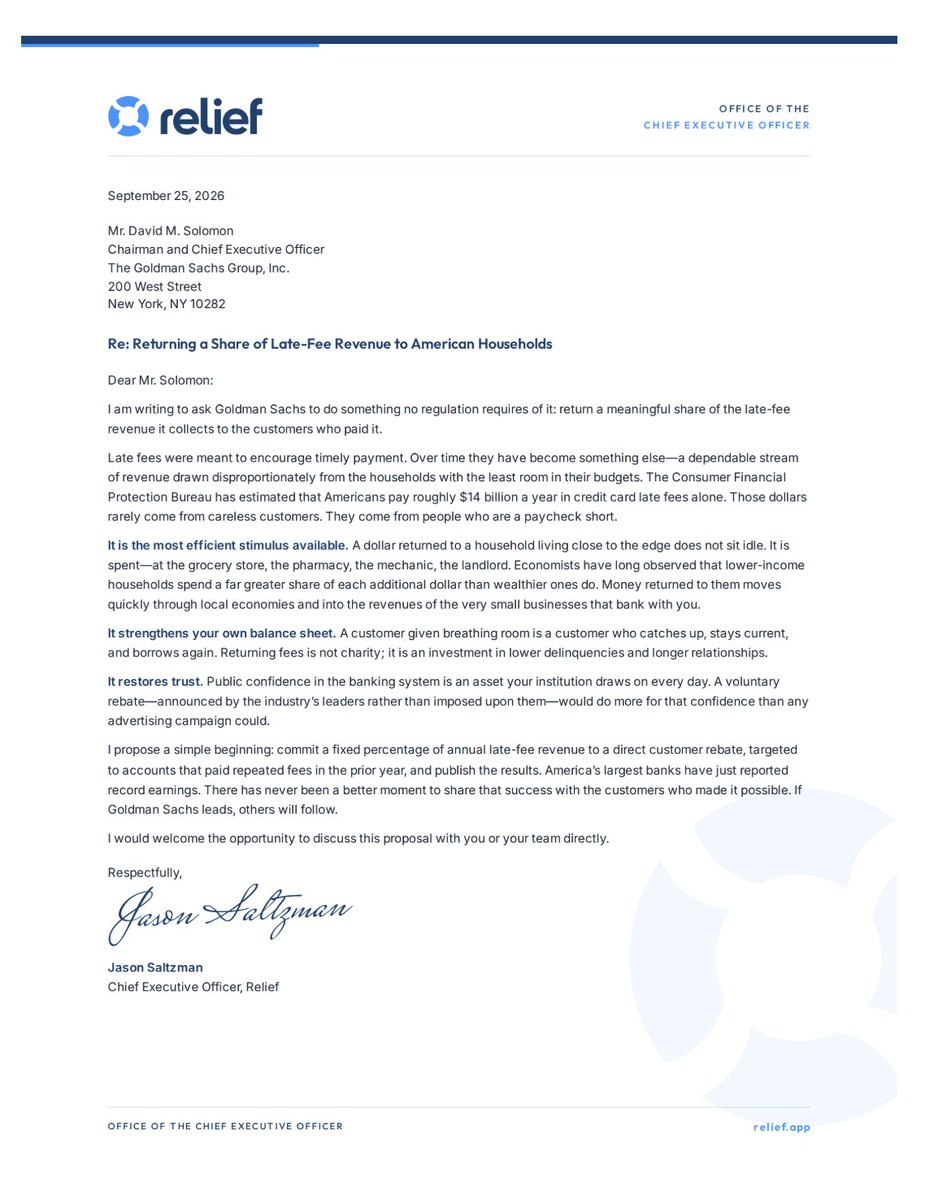
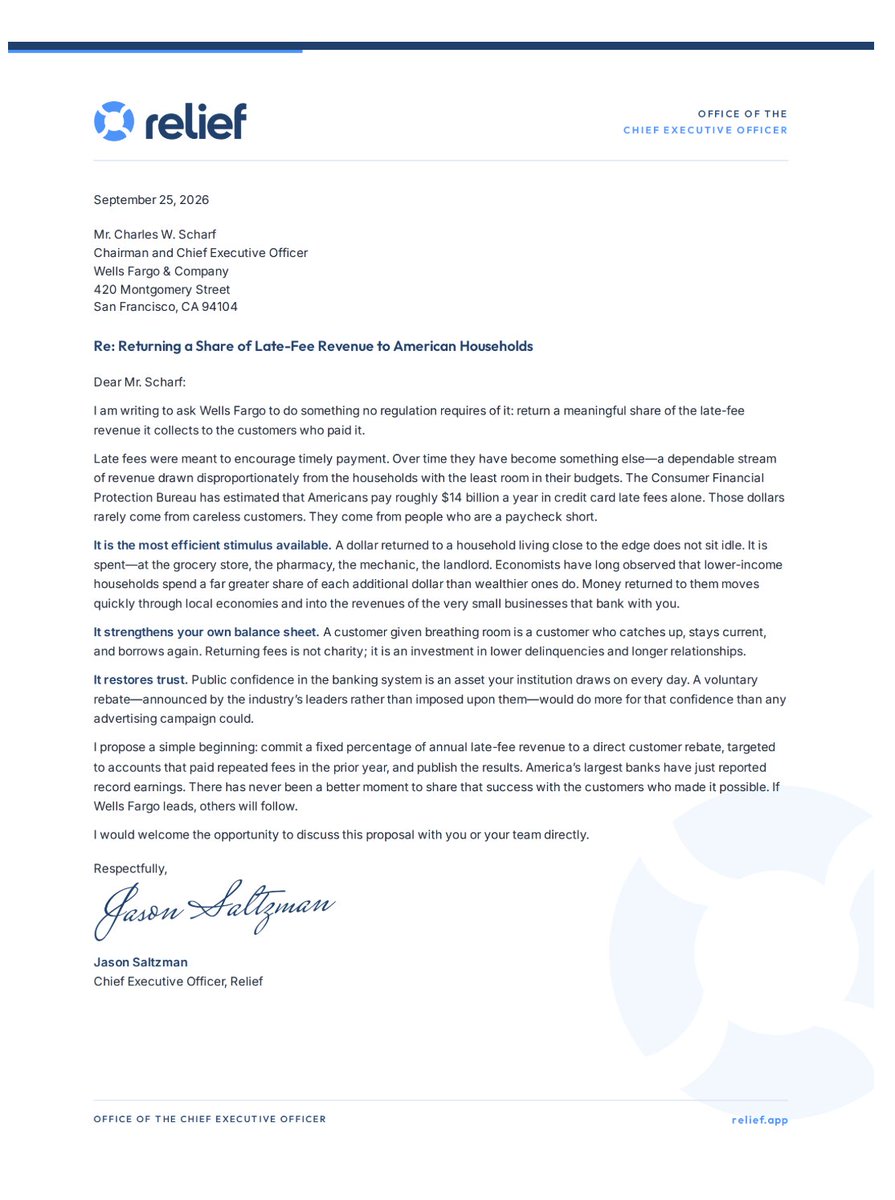
At a time I am heads-down raising our Series B, I did something some people will consider adversarial: I wrote directly to the leaders of America’s biggest banks.
Why?
I was looking through data from the hundreds of thousands of people who have downloaded Relief and engaged with our platform, and what I saw made me sick to my stomach.
Falling behind has become a business model.
Americans have paid billions of dollars a year in credit-card late fees alone. And the people paying those fees are, by definition, often the people already struggling to keep up.
There’s something fundamentally backwards about that.
Relief exists to help people understand their debt, protect themselves, reduce what they owe, and ultimately resolve it. And as we grow, we’re increasingly helping money flow back to creditors that might otherwise have gone uncollected.
So this isn’t an anti-bank letter.
It’s an argument that there is a better model.
Give some of that late-fee economics back to consumers. Give people who are struggling a little breathing room. That money doesn’t disappear. It gets spent on groceries, rent, childcare, transportation, local businesses, and eventually back into the economy.
Banks might make a little less on certain fees in the short term. But healthier consumers are better customers, and a healthier consumer economy is better for everyone.
As Relief becomes larger, I want to make sure we never forget whose side we are supposed to be on.
It’s not always about extracting the maximum dollar.
It’s about treating people like human beings.
And, at the very least, making sure the financial system doesn’t make a difficult moment in someone’s life even harder.
Interesting and spot on. We're so distracted by the polarizing figures of Holmes, her husband, and the story itself that we fail to notice, in real time, that our perception is being spoon-fed to us, shaped by whoever is doing the feeding. Great read.
@polinapompliano ! :)
I saw the Elizabeth Holmes documentary 'You Can See Everything' last night.
Everyone's debating whether she's a liar. That's not the story.
The film is deceiving you in real time & most of you won't notice.
I wrote about it 👇
https://t.co/WmBon6lDUh
“I’m not sure consumer debt is THAT bad of a problem in our country”.
A pretty well-known investor said those exact words to me to start a convo. After about 8 minutes of speaking to me, they were asking to invest.
Why?
One in five American households are behind on payments.
BTW: that’s BEFORE BNPL (buy now pay later) accounts.
Financial recovery will be the largest category of consumer finance ever.
It’s not a luxury it’s a necessity.
https://t.co/M82Gz4fwpS
@JohnCarreyrou@nytimes Great read and great work. I believe that she believes her own bullsh*t. A story as old as time. And she recruits opportunistic insecure people around her to do her bidding. ✌🏼
Its hard, I get it. I don’t know you but I do have my own battles w/ this. What works for me is focusing on purpose. Not in the grand sense of the word, I focus on the small things. Making my wife smile, or calling my mom because it’s amazing I can still do that. Reaching out to a friend and asking how they are or helping a complete stranger. It’s been a life hack for me. All love ❤️. DM me any time.
The Elizabeth Holmes documentary absolutely lives up to the hype.
It’s 4 AM. I literally woke up thinking about it and couldn’t go back to sleep. Not because of the fraud, but because of what it reveals about human psychology.
A few thoughts I need to get out of my head.
First, I actually have some empathy for her.
As an entrepreneur, you’re conditioned to live in the future. You’re encouraged to believe in something that doesn’t exist, articulate it with absolute conviction, and convince others that the impossible is inevitable.
What if Holmes genuinely believed that, given enough time and money, reality would eventually catch up to her vision? What if the deception initially felt like buying time rather than committing fraud?
I understand that psychology. But here’s where my empathy collapses.
I believe she knew exactly what she was doing.
What fascinates me most is the architecture of the people she surrounded herself with. I suspect certain personalities instinctively attract others who share their moral flexibility, ideological rigidity, and appetite for power.
Think about how sophisticated that becomes.
You surround yourself with people willing to intimidate dissenters, suppress uncomfortable truths, and execute morally questionable decisions.
Meanwhile, you remain the visionary.
You’ve effectively created a system of plausible deniability. Not just legally, but psychologically. You can distance yourself from the consequences while maintaining the internal conviction that you’re fundamentally a good person pursuing an extraordinary mission.
And here’s what really kept me awake.
What if she’s both?
What if Elizabeth Holmes was simultaneously a calculated manipulator and someone who genuinely believed her own distorted reality?
We tend to think of deliberate deception and self-delusion as opposites. I think they can coexist, even reinforce each other.
Someone can be extraordinarily sophisticated at manipulating other people’s perceptions while being equally sophisticated at protecting themselves from their own conscience.
An entire organization can become an extension of one person’s psychological defense mechanisms. Loyalty becomes virtue. Skepticism becomes betrayal. Evidence becomes an inconvenience.
To me, that’s almost Machiavellian genius.
Not technological genius, but an extraordinary understanding of human behavior, authority, and the power of collective belief.
And perhaps that’s the most disturbing part. We will probably never know how much she actually believed because the very mechanisms that insulated her from accountability also obscure the distinction between calculated dishonesty and genuine delusion.
Was she an idealist who became a fraud, or a fraud who learned to weaponize idealism?
Maybe both.
As founders, we’re taught to ignore doubters, challenge reality, and maintain irrational conviction. That mentality can create extraordinary things.
But there’s a dangerous inflection point where conviction becomes entitlement, where the importance of your mission becomes justification for abandoning the principles supposedly guiding it.
The difference between a visionary and a fraud isn’t how passionately they believe in the future.
It’s their willingness to remain accountable to the present.
And ultimately, what they’re willing to do to other human beings when reality refuses to cooperate.
That’s what I can’t stop thinking about.
Did Holmes believe her own lies, or was convincing herself the greatest manipulation of all?
This is why our economy is fucked and why debt is wildly out of control.
A +275.2% increase while wages from that same timeline increased 119.5%.
Our parents owned shit, we owe shit.