🇺🇸 Most Americans have never heard of Patriots Day, and almost no one outside the U.S. knows it exists.
Yet it’s one of the most action-packed holidays in the country, and it holds a lot of significance.
Celebrated only in Massachusetts and Maine, it marks the anniversary of the Battles of Lexington and Concord, the opening shots of the American Revolution.
Every year, on the third Monday of April (today), Boston holds its marathon at dawn, the Red Sox play a morning home game at America’s oldest ballpark, and reenactors fire muskets at each other in the suburbs.
In 2013, two bombs were detonated near the finish line, killing 3 people and injuring hundreds more.
The following year, Boston came back with record crowds lining the route, the city's defiance becoming as much a part of the day's identity as the race itself.
The world's oldest annual marathon, a sold-out ballpark, a 250-year-old battle, and the stubborn refusal to be broken, all on the same morning, all in the same city.
Those wheels you’re looking at are 0.75 millimeters thick. That’s half the thickness of a US dime. Each one was carved from a single block of aluminum, and NASA sent six of them to Mars knowing they’d eventually shred.
Curiosity was built for a 2-year mission. It landed in August 2012, and by December that year NASA had already extended the mission indefinitely. Thirteen years and 35.5 kilometers later, the rover is still going, but the wheels started cracking just 14 months in. The damage came faster than anyone at JPL predicted. Sharp embedded rocks were punching straight through the skin between the treads.
So NASA assembled a Wheel Wear Tiger Team (a crisis problem-solving tradition that goes back to Apollo 13) and got to work. In 2017, they uploaded a traction control algorithm from Earth that adjusts each wheel’s speed in real time based on the terrain, reducing force on the front wheels by 20%. They rerouted the rover to softer ground and started driving backward when possible, because pulling wheels over rocks produces less force than pushing them into rocks.
The wildest part: if enough treads snap off, Curiosity is designed to find a sharp rock on Mars and use it to deliberately rip out the damaged inner section of its own wheel. JPL tested this on a replica rover and found Curiosity can keep driving on just the outer third. They predict this won’t be needed until around 2034.
Every 1,000 meters, the rover pulls over and uses the camera on its robotic arm to photograph its own wheels so engineers on Earth can count every crack. Each wheel also has tiny holes that spell “JPL” in Morse code, which Curiosity uses to measure distance by photographing its own tracks in the dirt.
These photos directly changed the next rover. When NASA built Perseverance, engineers 3D-printed about 70 different tread designs before landing on 48 curved treads instead of Curiosity’s 24, with thicker skin. They tested the new wheels over 60 kilometers and got zero damage by Curiosity’s original failure definition. “A boring graph with no data on it,” as one JPL engineer put it.
A $2.5 billion machine doing self-surgery with rocks on another planet because the mission outlasted its design by 6x.
This developer is building a game where you're a plastic army guy on 5 acres of backyard.
- 3rd-person shooter
- Land, air, and sea combat
- Environmental destruction
- Multiplayer
Huge Sarge's Heroes and Small Soldiers vibes!
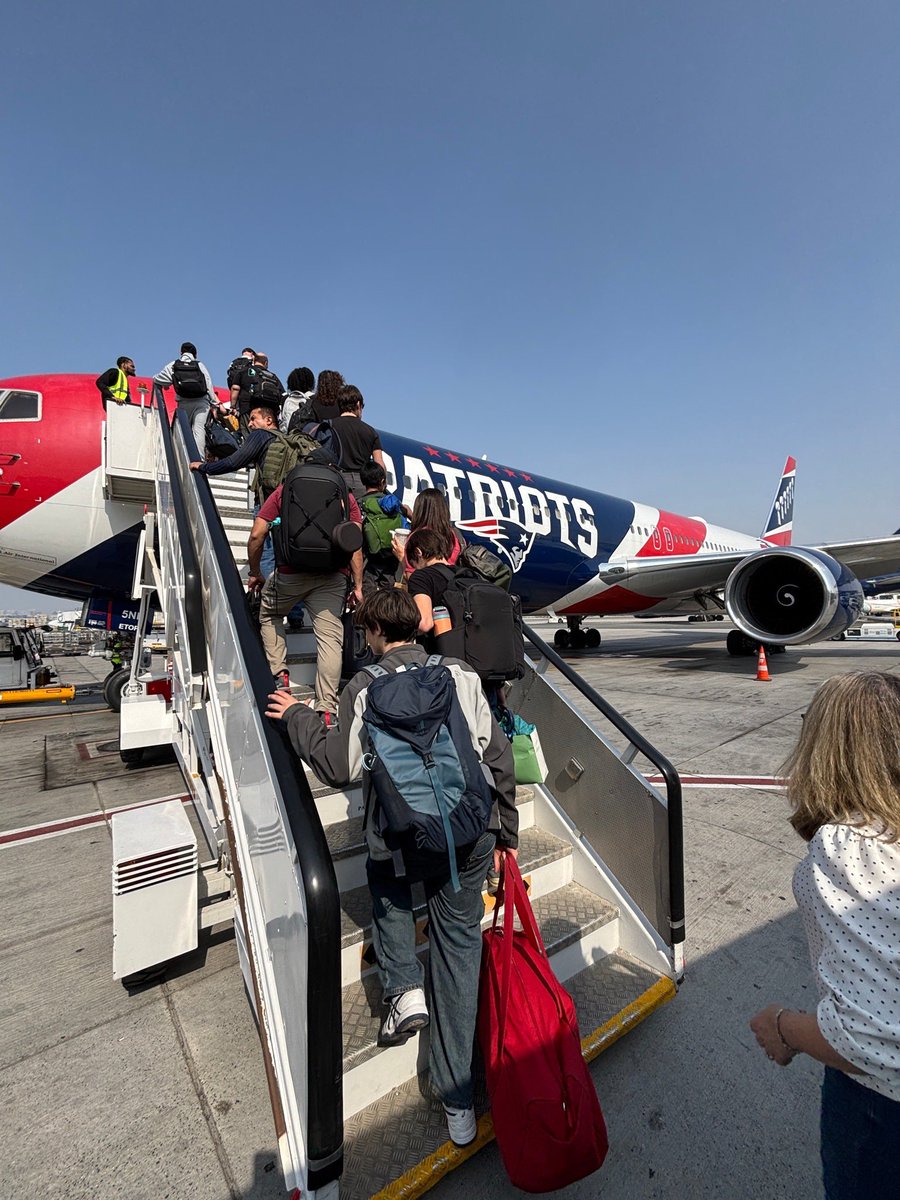
👀 Americans boarding one of the many State Department charter flights leaving the Middle East to the U.S.
This plane landed safely this morning in Washington.
🚨 Someone just built a real-time global intelligence dashboard and open sourced it for free.
It's called World Monitor. Think of it as a CNN war room meets Bloomberg Terminal for geopolitics but anyone can use it.
No paid OSINT tools. No expensive subscriptions. No classified access needed.
Here's what this thing tracks in real-time:
→ Active conflict zones with escalation scoring
→ 220+ military bases from 9 countries
→ Live military aircraft tracking (ADS-B)
→ Naval vessel monitoring including "dark ships" going off radar
→ Nuclear facilities worldwide
→ Undersea cables, oil pipelines, and AI datacenter clusters
→ Protests, sanctions, internet outages, and satellite fire detection
→ Prediction markets as early warning signals
Here's the wildest part:
It has an AI that reads 100+ news sources, classifies threats in real-time, and generates intelligence briefs automatically.
Every country gets a live "Instability Index" score from 0-100 based on military activity, protests, news velocity, and structural risk.
When 3+ signal types spike in the same area, military flights + protests + satellite fires, it triggers a convergence alert.
This is the kind of tool governments pay millions for.
It runs in your browser. One command to install.
100% Open Source. MIT License.
“Over the last 40 years, the United States has been exposed to something that our biology was never intended to handle,” warns former FDA Commissioner David Kessler. https://t.co/6M7186nAdH
Hy-Line Cruises captain Mike Jospeh Lambias captured this image of a seal on an ice flow in Hyannis Harbor Thursday morning on his way to Nantucket.
“Not a sight we see everyday,” he said.
The cold snap is expected to continue this weekend, with low temperatures in the teens🥶
Rome has officially opened its new Colosseum metro station, which also serves as a museum showcasing ancient Roman ruins uncovered during more than a decade of construction.
Right now at 11:31 am January 27th , 2026 on this frigid Maine morning after BILLIONS of dollars spent:
ALL the wind turbines in ALL of New England are contributing only 3.92% of the power to our grid.
Or in other words - only 754 MW of the current system demand of 17,764 MW.
Other contributing resources:
Refuse: 1.20%
Solar: 0.88%
Hydro: 3%
Net imports: 16%
Wood: 1.84%
Landfill gas: 0.16%
Coal is at <1%
Once again, it is OIL at 29%, natural gas at 24% and nuclear at 19% keeping our lights on.
Source: ISO-NE Website