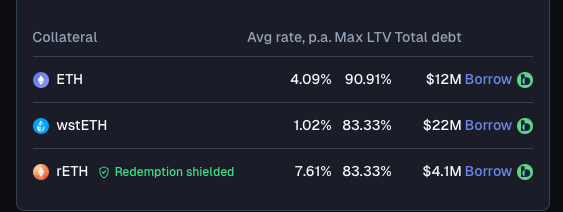
Borrowing BOLD against wstETH on Liquity V2 averages just ~1% right now.
Not set by a utilization curve.
Not set by governance.
Set by borrowers. 🟢
Go long wstETH on immutable contracts 👇
link: https://t.co/5wOnH6gtPJ
hmm the main challenge would be pricing liquidations which IIRC still hasn't been solved, unless there is governance involved. There are some innovative approaches like Frankencoin, but they also come with some tradeoffs eg. governance and slower auction-based liquidations
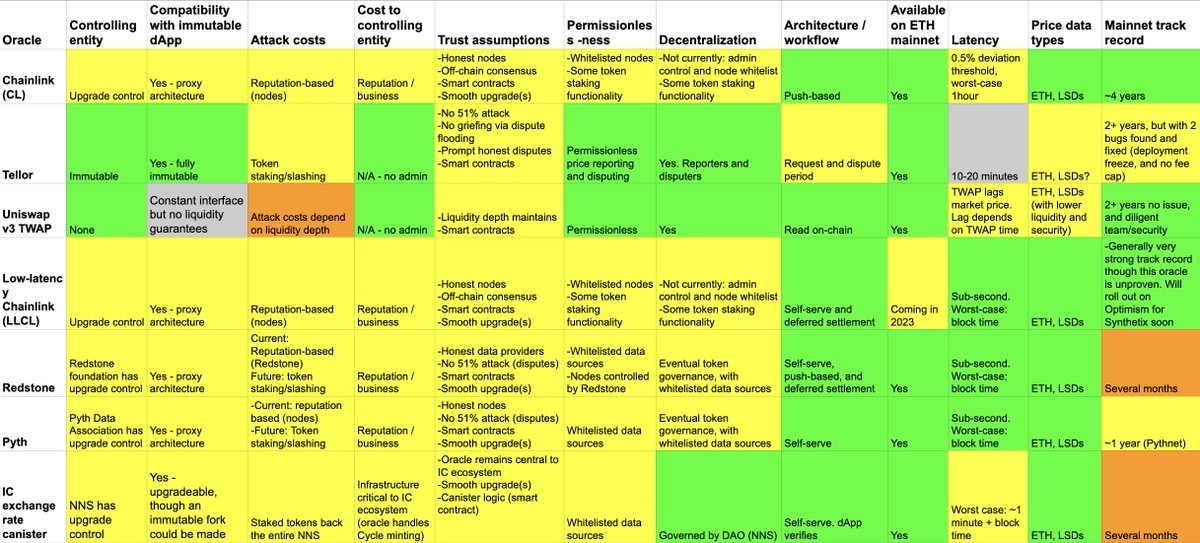
we did a few research pieces back in the day looking for the most decentralized and practical option:
https://t.co/SWeg3V6Rr1
The (updated) oracle conundrum for v2 🔮✨
In our quest to shape the blueprint for oracles and v2, last month we made public some of our extensive research into the oracle landscape. 🔮
The feedback we received from our vibrant community and the different oracle providers was not only enlightening, but very helpful in refining our understanding of oracles. This iterative learning process has been invaluable, and we hope to have the same collaborative spirit for all future topics related to v2!
Thus, we have taken the initiative to re-articulate our learnings, ensuring that the insights we have learnt can help contribute to the understanding of oracles within DeFi in general.
Before we dive in, a couple of reminders: this is internal research that we’re making public, rather than a definitive oracle rating system - and our vision for v2 is to build a protocol that is as immutable as can be.
Here's a recap of our collective insights on the infographic, and an updated look at things:
Admin control / Controlling entity
No changes here - @WeAreTellor and @Uniswap are the only two we looked at that truly have no ‘admin’ control. Admin control in this instance refers to a controlling entity that has the ability to modify or upgrade that particular oracle.
👇
Compatibility with immutable dApps
After speaking with different oracle teams on the matter, we came to a conclusion that fully immutable oracles are the only ones which can be determined as 'green', while oracles that follow a proxy architecture are not the same. Why, you ask? ⬇️
Proxy oracle contracts introduce potential risks due to their upgrade capacity. Most proxy oracle architectures have the ability to completely replace the oracle logic, and could (for example) block specific protocols from accessing vital price feeds based on the identity of the requesting protocol or the type of data request. The mere presence of such control is a concern - hence the change of the color code of any oracles with a proxy architecture to yellow.
👇
Attack costs and “cost to controlling entity”
One great example of a learning from the iterative process taken with the different oracle providers was to split the crypto economic guarantees into two components: a) attack costs, and b) what the controlling entity has at stake. “Attack costs” refers to the economic cost of compromising the oracle’s security, e.g. a malicious actor gaining control over the price feed.
The “cost to controlling entity” column refers to what a governing entity “has to lose” by manipulating, censoring or suddenly deleting the oracle.
For the IC exchange rate canister specifically, we learned that it is now in fact heavily integrated into the core IC ecosystem, and that 'messing' with the oracle would pretty much undermine the ICP network as a whole. On top of that, it is also the only oracle we looked at that has a legitimate decentralized governance mechanism (voting-based).
Despite this, our research still points to the notion that there isn’t any one oracle which combines complete trustlessness with reasonably low latency.
👇
Latency
The only change here is that we learned that the IC exchange rate canister has a worst-case latency of ~1 minute due to historical data granularity - although there is potential for sub-second latency if their outcall functionality were extended to allow for medianization of the latest spot price.
We would also like to clarify our stance on the track record tab of the infographic - our track record criteria specifically refers to the track record of the oracle provider on Mainnet
In closing, this exploration was enriched by the proactive participation and feedback of our community and the various oracle teams. Collectively, these learnings help set the stage for our v2 journey, ensuring that it's founded on a collaborative spirit.
Join our Discord for further discussions on all things oracles and v2: https://t.co/MoQS1ZgSvj
@MMJahanara@donnoh_eth@binji_x Liquity V2 is immutable, so it's not technically possible.
Hence why if an oracle were to fail, the affected branch would shut down
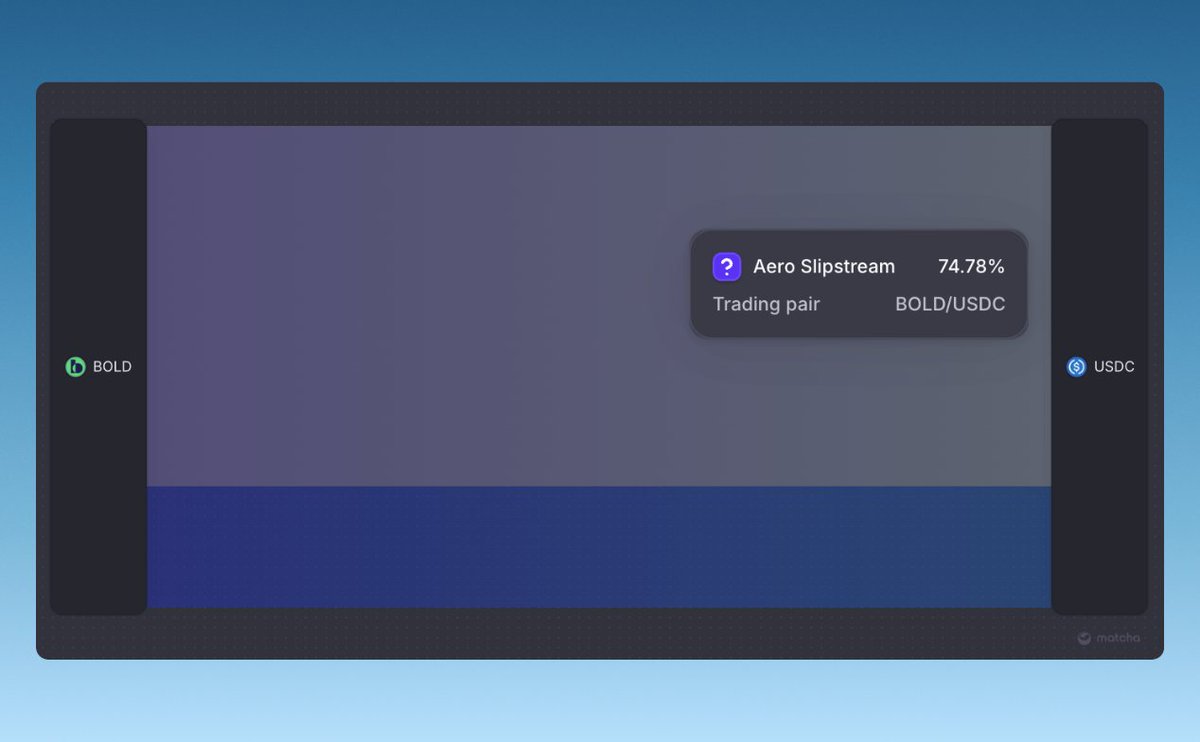
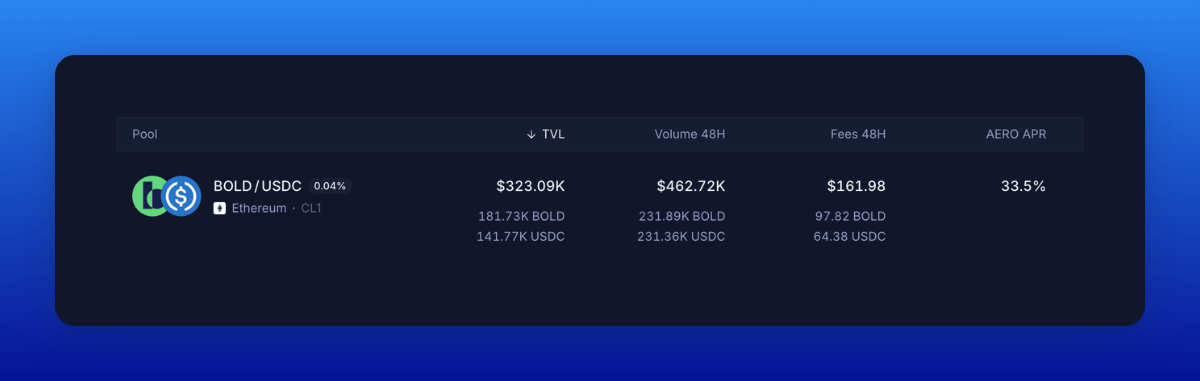
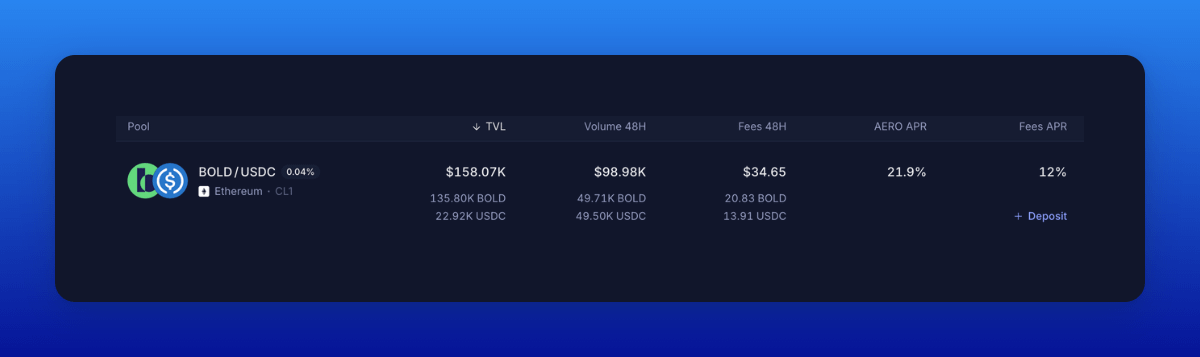
The $BOLD pool on @aeroxyz is printing.
Launched just 2 weeks ago, it already handles 75% of BOLD/USDC swap volume for trades under $100k.
The yield for LPs?
20% APR.
Deposit link below.
Liquity's BOLD is the only significant ETH-backed stablecoin these days
Immutable, simple: collateral is ETH , wstETH and rETH.
Also earns a solid 4.5-5+% in the stability pool, or higher on Curve.
because it's hard to scale an ETH only dollar.
couple of things from experience:
- every BOLD needs ~1.5x in ETH behind it, vs 1:1 for USDC. Weak ETH price = less demand for leverage = no new minters
- people now borrow stables against lots of assets, not just ETH (e.g. HYPE, cbBTC, tokenized stocks)
- users are used to lindy venues like Maker/Aave: utilization-based rates, even with the spikes and the risks that come with them. Setting your own rate is unfamiliar, and most people want hands-off (even though Liquity V2 rates have been the cheapest since launch, and there are rate managers)
- USDC/USDT have on/off ramps everywhere. Hard to beat on convenience, especially for this new cohort of users.
- lack of public support from thought leaders, foundations and treasuries
until ETH becomes a true SoV in a price sense, scaling a ETH only backed stable past a few hundred million will always be a challenge.
regardless, you can still walk the walk
https://t.co/lnrJmcYfGz
fair point, Chainlink is is a trust assumption (like every crypto backed stable)
But it is also the ONLY one: immutable, no random collaterals that can get added, or DAO / admin shenanigans
And if a oracle feed fails, a built-in branch wind-down lets BOLD holders redeem for the underlying ETH
Every ethereum:0x6440f144b7e50d6a8439336510312d2f54beb01d mint = a buyer of ETH.
Think of Liquity V2 and BOLD as an onchain ETH treasury.
- Every BOLD mint locks ~2x its value in ETH.
- More BOLD in circulation means more ETH being bid and held.
BOLD is the dollar that grows Ethereum instead of farming it.
Earn yield with ethereum:0x6440f144b7e50d6a8439336510312d2f54beb01d on a new venue 🟢
BOLD has landed on @aeroxyz on Mainnet✈️
Provide liquidity for the BOLD / USDC pair, and earn 22% APR 👀
link to deposit 👇
https://t.co/mwLlxotViN
Most people jump into bags for what they hope is a quick 10-100x
"In an out" they say, or even "1 win for 9 losses"
But i prefer to take the slow grind.
I prefer $ETH for the majority of my bags.
Do i perp it, a little, but mostly i put it to work.
I LST it in @LidoFinance@Rocket_Pool@fraxfinance@ether_fi
But I also collateralize it, mint USDs, and farm with those.
Many like to borrow on @aave or @Morpho , usually borrowing $USDC to put to work; either lend it, or loop it.
But i prefer stable coin projects like @protocol_fx and @LiquityProtocol . These are part of the @TrustlessForce of truly defi USDs. check @PharosWatch to understand me
Both ethereum:0x085780639cc2cacd35e474e71f4d000e2405d8f6 and ethereum:0x6440f144b7e50d6a8439336510312d2f54beb01d have single sided endogenous yield options. (stake your USD for more USD, use balance - debt = to add to bags or pay for life.
Protocol fx has NO borrow rate but you give up your LST apr
Liquity has electable borrow rate (no aave/morpho hockey stick here), but you get to keep your LST APR - also that borrow rate is paid back to you if you stake ethereum:0x6440f144b7e50d6a8439336510312d2f54beb01d in the stability pool (use @yearnfi or @k3_capital) instead of dumping it.
is this understandable?
another one ❗️
a flavor of Liquity V2 in @FlorinProtocol will be coming to Robinhood Chain 🟢
- borrow against SPY and tokenized stocks
- loop your SPY exposure 👀
- earn with FUSD through the Stability Pool
soon™ 🟩
23% APR on a stablecoin available right now, with your costs locked in.
ysyBOLD on @InverseFinance crossed $1M TVL in 3 days:
🟢 Earns ~5% from Liquity Stability Pools
🟢 Borrow DOLA against it at a fixed rate
🟢 Loop up to get 23% APR in 1 click
https://t.co/0zkMfvboqP
23% APR.
with fixed costs and duration 🔒
loop ysyBOLD on @InverseFinance FiRM:
🟢 borrow DOLA at fixed rates & duration
🟢 a max loop gets you 23% APR on ysyBOLD
$500k of liquidity available now 👀
zap in 1-click here: https://t.co/0zkMfvboqP