AI, trust, deepfakes and epistemic resilience. 'Prepare, Don't Panic' initiative on media manipulation/generative AI. TED speaker deepfakes. Former ED WITNESS.
With @cward1e, talked to @hari for @AmanpourCoPBS deep-dive on how #AI content is impacting elections
Satire to deception to resurrection to dismissing the real....highlighting detection challenges, avoiding blaming ourselves, and pipeline responsibility
https://t.co/y9w6McIn35
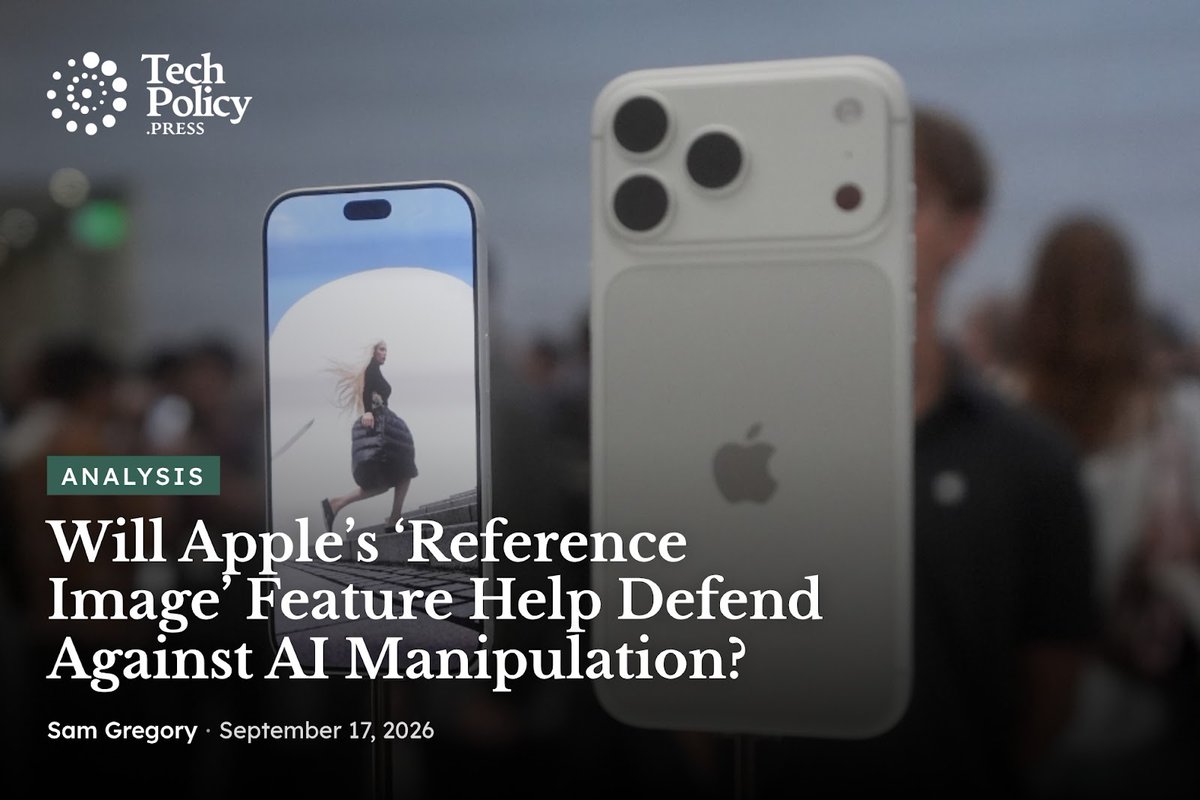
Apple's new authenticity infrastructure, Reference Image, is "a serious piece of engineering, and genuine response to the epistemic crisis of AI", but a start not an end-point. I reflect on lessons from the field, unanswered questions and next-step needs.
https://t.co/18FSdmidMc
Apple enters the defending reality fray with Reference Image, a digital negative to prove a real photo.
I wrote about seeing another major company create the Proof Mode I've wanted for years...what I like, the questions, the concerns.
https://t.co/4ah6p3mpzD
#SunriseandShine
One of the red flags of AI-written text is the heavy use of these odd linguistic constructions called “cataphoric teasers” to create an artificial feeling of suspense. These are easy to spot because they usually take the form of phrases like, “Here’s the part that nobody tells you…” or “Here’s what most people get wrong…” or “Here’s where it gets interesting.” From my experience, text written by Claude is often saturated with these types of phrases. I don't see it as much in ChatGPT (that's anecdotal, though. I might be wrong).
On Al-Jazeera on 3 deepfake threat layers:
*Consumer scams
*Non-consensual sexual images + nudification
*Corrosive ambient uncertainty via political/conflict usage.
Onus can't be on us to spot, report, hide our face but on law + platform responsibility
https://t.co/Dlbz2VsHQc
Callista Gingrich is Callista Gingrich is my conclusion about whether her ambassadorial videos are AI-generated.... no, she just is like this, and is pretty consistent about that. We're in a world where she now looks like a bad corporate HR AI avatar.
https://t.co/ZfYl0q6r78
It's August 2! It's August 2! Why am I so excited (and trepidacious)...
It's the day both California and EU rules on content provenance and AI go into effect. Read on for @witnessorg analysis on where the EU AI Act gets it right, and where we need more.
https://t.co/3nBmzGCfg7
"We take misinformation seriously... [so we decided destroy trust in a key reference point in the epistemology of journalists, fact checkers and researchers]"
Well done, you put Synth ID in it. Now fact-checkers can write an article after it's used to create a viral fake story.
@NewsFromGoogle This was utterly predictable - and would have been indicated by journalists, war crimes investigators and OSINT folks - and on top of that there doesn't seem to be a good reason to trade off trust in Google Earth for jamming in AI on another product https://t.co/fDC3kXVNGs
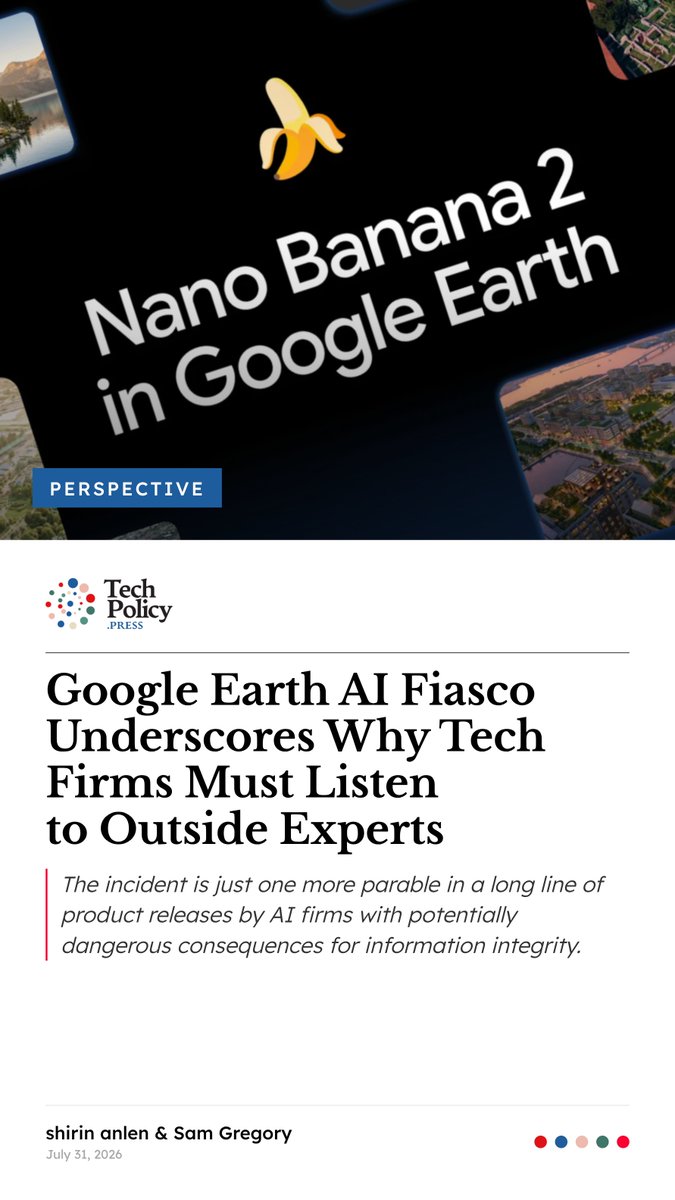
In @techpolicypress shirin anlen and I on a foreseeable fiasco: how Google briefly turned one of the world's most trusted sources of evidence into a generator of plausible fakes, and why tech cos must consult civil society experts before launch, not after
https://t.co/fDC3kXVfQU
Why would Google do this? Because the prioritization of ground truth for journalism, and our shared sense of reality - is less important than "custom images to help you visualize history, create real estate plans, and more." And no, us checking every image is not the answer.
Tonight I typed just one sentence into Google Earth and put refugees near the Mexican border. Then I planted a nuclear plant in Iran. What on earth is Google doing? Check my latest post here: https://t.co/N0h6CVECqS
🎥 Deepfakes: Can you trust anything you see online anymore?
New @TBIJ series 𝑴𝒊𝒔𝒂𝒍𝒊𝒈𝒏𝒆𝒅: 𝑾𝒉𝒆𝒏 𝑨𝑰 𝑮𝒐𝒆𝒔 𝑾𝒓𝒐𝒏𝒈 out now! The reasons we need to worry, why we need to act, and winners/losers in the deepfakes fight (spoiler: not us)
https://t.co/uq8FvuR0IG
How can journalists navigate the rising threat of deepfakes and synthetic media?
@SamGregory introduces the Deepfakes Rapid Response Force, a project from @witnessorg that connects reporters with forensic experts to verify suspicious content and protect reporting integrity.
Watch the full Lightning Talk from #MediaParty 2025 now available here👇
https://t.co/sblclGZZmh
Great conversation with Tai Nalon and Felix Simon at #ijf26 on "When seeing is no longer believing: perils and possibilities in a world of synthetic media" with our differing viewpoints on scope, societal implications, and what to do
https://t.co/AY1t6Qcd5T
OpenAI is shutting down Sora. But the damage is done: normalized AI slop, eroded trust in what's real, detection inadequate, provenance tools still MIA without senior company leadership, shameful normalization of likeness theft. Thanks, but no thanks, Sam
https://t.co/mGGzQwNKSA
Iran is the worst-case scenario for everything we’ve been warning about: AI fakes, civilian footage dismissed as fabricated, and underneath it all, a regime that has engineered the doubt itself.
“The problem is curated access. The regime controls who gets to document and what gets documented.”
I spoke to @morganmeaker for Bloomberg Weekend on the information war in the Iran war. https://t.co/alLEJTYEON
Hyper-realistic AI both to create fantasy images that illustrate people's hopes, and where the wish that something is fake finds a ready-made access point via poor forensic analysis: Talked with @chowarchis@boomlive_in about is it/isn't it Netanyahu vids
https://t.co/3AH4rjsmmV
New piece with shirin anlen based on our work at @witnessorg on how 'forensic cosplay' (h/t @CraigSilverman) is being used to discredit authentic photos of civilian casualties in the Iran war.
The fake heatmap and "ELA" case spread through my own networks. People I know concluded the photos were fake, primed by justified distrust of state sources. That distrust is legitimate. But it can lead to dangerous denialism.
With references to @Shayan86 and @talhagin who have been working on the deluge of AI cases during this war and insights from forensics specialists.