My first day on campus, the graduate school coordinator looked at me and warned me about bribery.
Because I am Nigerian.
I passed my PhD qualifying exams in my first semester. The department turned around and offered two more scholarships to Nigerian students.
Five years after graduation, they invited me back to speak.
That speech became the book.
The people who doubt you first are often the first to celebrate you. Let them. But never forget the doubt. It is fuel.
I vowed never to do my Masters in Nigeria.
Got a lot of UK offers between 2010-2012 but no funding.
Big kudos to my Dad (of blessed memory). He stayed on my neck till I got the Unilag entrance form.
Completed my MSc Structural Engineering in 24months while working full time. It was a hectic schedule.
3 years later, I got Ph.D admission in the U.S and my F1 visa was approved on first attempt.
That "no go area" may eventually become your stepping stone to achieving your ultimate goal.
Today, the rest is history.
Even if he is not the Chairman, even if he is the janitor, "sense" should tell you to address him with some respect.
"Tony" 🙄 she even first said, "Toyin."
One of the most common questions I get is: I have a 2:2, can I secure a fully funded scholarship?
Or, I study Arts, can I get a funded Masters or PhD program?
I think the issue here is that people have fallen into the danger of making one story THE definitive story.
Applying to grad school is not like that. (Nothing in life is.)
There are several factors that play into whether you get a fully funded graduate school admission or not.
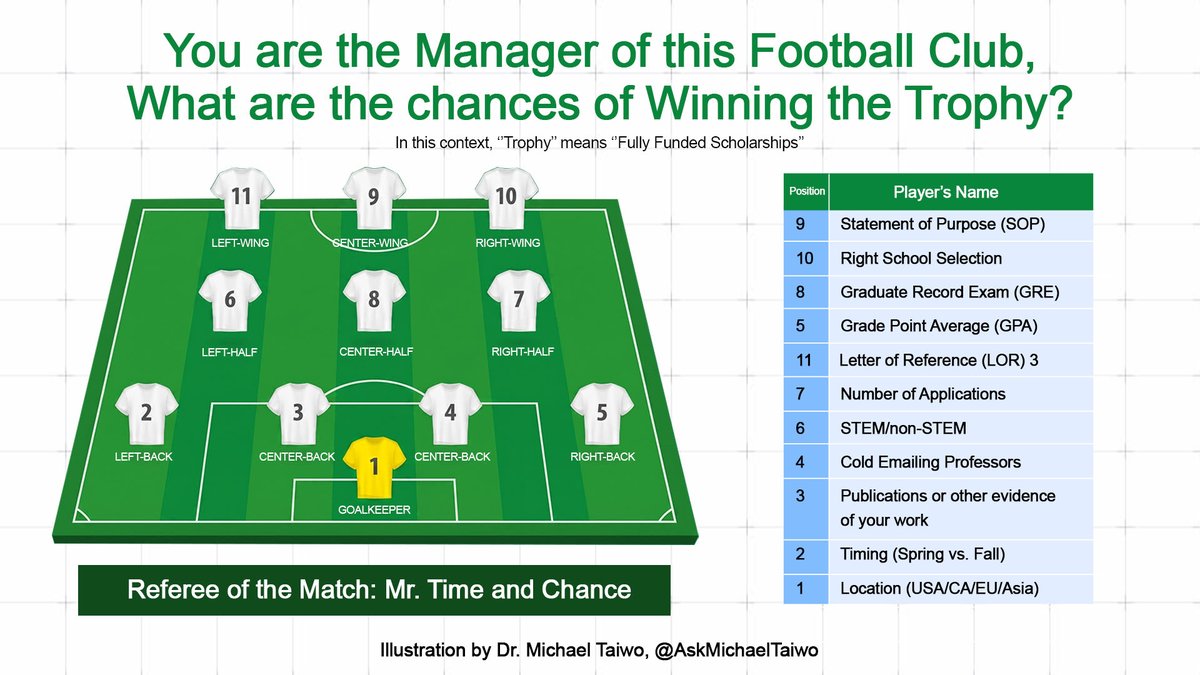
Think of your pursuit as a system, for instance, a football club, where different players are responsible for different parts.
Ideally, you want to be strong in all areas. But that rarely happens. You play the hand you are dealt.
The fact that you are weak in one arena (e.g. GPA) doesn't mean you can't still assemble a winning team/application.
In grad school application, as in life, you won't have all the things you want but if you want it badly enough, you will find a way.
Two Nigerians just closed Africa's largest seed round.
$52 million.
Not fintech. Not crypto. Defense technology.
Nathan Nwachuku and Maxwell Maduka founded Terra Industries in 2024. They build autonomous drones, sentry towers, and unmanned ground vehicles from a 15,000 sq ft factory in Abuja.
Two years in. On track to book $100 million in contracts by year-end.
A second factory in Ghana opens Q4 2026. 34,000 square feet. When fully operational, it will be the largest drone factory on the African continent. Capacity: 50,000 units per year by 2028.
Not an isolated story either.
Nigerian startups raised $214 million in equity in the first half of 2026 alone. More than Egypt. More than any other country on the continent. The strongest equity showing since 2022.
People will tell you Africa cannot build hard tech. That the continent is only good for mobile apps and consumer fintech.
Terra is manufacturing autonomous systems in Abuja and opening offices in London and San Francisco.
The narrative that Africans only consume technology is dying. Slowly, expensively, and loudly.
When a seed round from Nigeria is bigger than most Series B rounds in Europe, the conversation has already shifted.
You just have not been listening.
This new hospital in Ogun is very impressive. I've always maintained we need state of the art hospitals like this around the country. We can never have enough good hospitals.
Flr the good of all of us, I hope they maintain the standard because we have a maintenance problem in this country.
Gsm- before you make phone calls you will have to go to a Business Center. Phone is now general
Internet- before you can check your mails and Surf internet. You will need to visit a business center. Now everyone has access
Water- Was scarce but now. Everyone has borehole
OPay just dropped crazy numbers.
2024: $51 million loss
2025: $72.5 million profit
Revenue jumped 161% to $536 million
Transactions more than doubled to $358 billion
Monthly active users now at 39.3 million
One of the cleanest turnarounds I’ve seen in Nigerian fintech. From burning cash to printing money in a single year, and they’re already eyeing IPO.
Half of Nigeria is under 18.
The median age sits around 18 years, one of the youngest on earth. Over 230 million people, and most of them are still deciding what to do with their lives. For context, Japan's median age is 49. America's is 38. Nigeria's is younger than a university freshman.
Economists call this a demographic dividend. The theory is simple: a massive young workforce enters the economy, productivity jumps, savings grow, and the country booms. South Korea did it. China did it. India is riding it now.
But the dividend is not automatic. It only works when the young people are educated, skilled, and employed. Without that, the same population bulge becomes a liability.
Right now, youth unemployment in Nigeria sits above 40 percent. Four out of ten young Nigerians who want to work cannot find it. Meanwhile GDP growth has picked up to 4.4 percent, the strongest in over a decade, and inflation has dropped from 34 to around 15 percent.
The macro numbers are moving. But the clock is louder than the progress.
Every year without enough schools, training, and jobs, that dividend window narrows. Other countries rode the wave for 20 or 30 years. Nigeria's wave is already here.
The question is not whether the youth exist. It is whether the system will meet them before the window shuts.
You can't follow trend it's dangerous
You can only flow with trends
Staying out of trend equals to staying outdated.
The best thing is to create the trend
A little over two years ago, I came to the U.S. from Nigeria at 14 with a suitcase and an obsession with ML.
Today, I'm 16 and working on Computer Vision + Robotics at @Apple
Recap:
→ Competed in Math & Physics Olympiads from 11y/o
→ Won Rubik’s Cube competitions at my boarding school, with a personal best of 18 seconds
→ Lost my grandma to an undiagnosed illness: one of the reasons I became very interested in AI
→ Graduated high school and started college at 15
→ Researched diffusion models for crystal generation, inspired by drug discovery
→ Prototyped robotic wheelchairs for people with disabilities
→ Worked on an EdTech startup, OpenClaw for Students
→ Joined @Apple this may on the ESCI org!
→ Went to @ycombinator startup and met of the brightest and most ambitious minds
My dream is to build companies that expand what humanity can do with AI
I'll be sharing my journey here! Physical AI, agentic systems, and everything I'm learning along the way.
For fun, I decided to calculate this Software Engineer's "net" i.e. how much are they actually taking home?
Federal income tax, remove $66,159
California income tax, remove $24,259
Social security tax, remove $11,439
Medicare taxes, remove $5,403
California SDI payroll tax, remove $3,985
Total money removed = $111,245
In short, the government will take over one-third of his pay.
If he wants to live in a very normal one-bedroom apartment, he will need to shell out about $4K/month. If he prefers something nicer or in a safer part of town, then expect around $6K/month.
So, between taxes and housing, about $200K out of the $300K is gone.
Leaving him with only $100K
Still a respectable sum but just a third of what he is being paid.
Welcome to America.
CBN cancelled the planned N700 billion treasury bills auction for 5 August amid a sharp tightening of liquidity after it mopped up N4.7 trillion from 🇳🇬 banking system