🇧🇷🚨Roberto Carlos on Neymar Jr. crying after the final whistle:
🗣️ “I felt so bad seeing Neymar Jr. cry after the final whistle. He’s the type of player who would’ve given absolutely everything for Brazil. Maybe the coach didn’t fully believe in him, but when he came on, he still showed his composure and quality.”
🗣️ “I’ve always admired Neymar and everything he’s has achieved in football. The level he’s reached is something very few players will ever experience.”
🗣️ “Winning the World Cup is special, but it doesn’t define a player’s entire career. Some of the greatest players in history never lifted it.”
🗣️ “Trust me, generations will still remember Neymar as one of the greatest footballers to ever wear the Brazil shirt. His legacy was built a long time ago, not today.”
🗣️ “For me, he’s a legend, no matter what. Nothing that happened today will ever change that.”
A little correction: Even though elephants can be sad as a result of missing a loved one to the point of crying, not eating sometimes starving to death, it's usually more about children and other female members of the herd, not mates.
Elephants live Ina matriarchal system. The herd (which comprises of several closely related females and their calves) is lewd by a female. Adult males don't live in the herd. They only move close to the herd during mating season and once they've mated, they're off again. So, they don't develop such strong bond that will require extensive mourning, from a mate.
Elephants have been widely documented standing vigil, shedding tears, and refusing to eat. Surviving family members will gather around a deceased companion, gently touch the body with their trunks, and even cover it with branches and dirt. In fact, herds frequently revisit the bones of deceased family members or mates, pausing to caress the remains years after the death.
A grieving elephant will often become socially withdrawn, refuse to eat, and lag behind the herd, which in severe cases can lead to fatal starvation or a weakened state.
Thank you
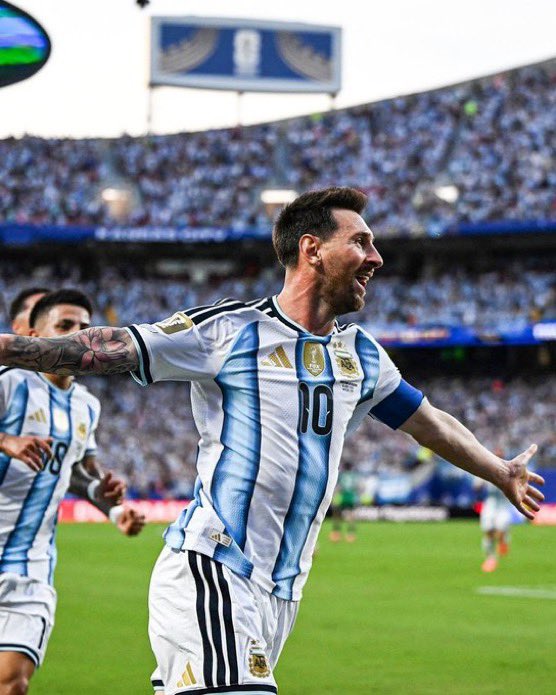
If they tell you Messi will become the World Cup’s highest goal scorer in 2010, you will argue it just doesn’t make sense. At that time, it genuinely looked like the tournament was not built for him, Whatever he does, it simply just doesn’t work. Tight marking, chaos in Argentina’s structure, and a version of Messi that just seems lost with tournament.
But from 2014 onwards, it started to feel like something shifted.
Gradually, like the tournament itself began to open up to him. He stopped being just a creator stuck between lines and became the central force Argentina built everything around. The burden got heavier, but so did his influence. Every World Cup cycle after that felt less like Messi trying to fit into the tournament, and more like the tournament adapting to his presence.
2014 was the first real signal. Even without the trophy, he carried Argentina to the final almost by sheer gravity. By 2018, even in a chaotic team environment, he was still producing moments that kept them alive. Then 2022 arrived, and it wasn’t just brilliance anymore, it was inevitability. The goals, the assists, the leadership, the control of entire matches… it felt like every narrative thread was being pulled toward one conclusion. Messi Time.
Because when you zoom out, it doesn’t just look like he adapted to the World Cup, it starts to feel like the World Cup adapted to him. The spaces appear when he needs them. The moments slow down when he demands control. Even in games where Argentina struggle, there’s always that one passage where he flips the entire rhythm of the match.
From he might struggle here in 2010…
to he’s deciding this entire tournament by 2022…
It’s one of the most extreme evolutions any player has had on this stage.
Enzo Fernández on how the Argentina squad respects Lionel Messi on and off the pitch:
🗣️ “Playing with Lionel Messi is something you truly cannot explain until you live it every day in training and in matches. He is not just our captain… he is our leader, our reference point, and the player who silently carries the responsibility of the entire nation every time he steps onto the pitch.”
“the respect the entire squad has for Messi is absolute and emotional. On the pitch, we would literally run through walls for him. You feel it in your chest every time he touches the ball like you owe him everything, like you must give everything in return because he is leading us into battle.”
“When he receives the ball, we don’t just expect something to happen… we believe something magical will happen. That belief changes your whole mindset as a player. You run harder, you defend deeper, you push your limits because you don’t want to waste a single second of playing alongside him.”
“But off the pitch, it is even more powerful and emotional. The way he treats every single player young or experienced is with complete humility, respect, and calmness. He doesn’t need to speak loudly. His presence alone brings unity. He supports everyone, he listens, and he makes every player feel important in this team.”
“There are moments in training where you just stop, look around, and realise you are sharing the pitch with the greatest player of all time. And instead of pressure or fear, he gives us peace, confidence, and belief that we are part of something bigger than ourselves.”
“We are not just teammates with him… we are people who want to protect him, fight for him, and give everything in every single match so he can shine the way he deserves for Argentina.”
“That is why this team feels different, why it feels emotional every time we step on the pitch. Because when Messi is with us, it doesn’t feel like normal football anymore… it feels like we are living inside history, moment by moment, together as one family.”
🚨Pep Guardiola on Lionel Messi becoming the FIFA World Cup’s all-time leading goalscorer with 17 goals after scoring Argentina first goal against Austria:
🗣️ “Seventeen goals at the FIFA World Cup… people need to really stop and understand what that means. This is not normal football. This is the highest stage in the game, where every action is under pressure and every mistake can define a nation’s history.”
“When you watch Lionel Messi over the years, you realize you are not just seeing a player who scores goals, but someone who continuously reshapes what football at the elite level looks like. The World Cup is where legends are tested, and he has not only passed that test — he has rewritten it.”
“What makes it incredible is not only the number, but the repetition of greatness. Across different tournaments, different teammates, different tactical eras, he has remained the one constant force Argentina could rely on when everything becomes difficult.”
“In football, you can prepare for many things. You can study systems, movements, patterns. But some players operate beyond that level of preparation. Even when you know exactly what Messi wants to do, stopping it is another matter entirely.”
“Seventeen moments where he found a way through the strongest defensive structures in international football. Seventeen moments where tension, expectation, and history all met at the same point — and he still delivered.”
“And it’s important to understand the context of those goals at the FIFA World Cup. These are not casual goals. These are goals that come in decisive matches, in knockout pressure, in moments where everything slows down except his decision-making.”
“What he has done is not just extend a record. He has changed the standard of what people will now expect from greatness on this stage. Future generations will not just aim to be good at the World Cup — they will be measured against this level.”
“Some players win trophies, some define eras at club level, but very few redefine what is possible at international level. Lionel Messi has done that on the biggest stage of all — the FIFA World Cup.”
{@sports}
🚨 Jorge Valdano on Argentina’s obsession with helping Lionel Messi score:
“At this point, Messi scoring doesn’t even feel surprising anymore. He scored a hat-trick against Algeria. Today he misses a penalty against Austria and still finds a way to score. The scary part isn’t even the goals. It’s how inevitable they feel.
Watch the second goal again. Messi starts deep. The counter begins. Medina plays the ball across. Almada could easily take it himself, but he opens his legs and lets it run through because Messi is in the better position. Goal.
That’s when it hit me. This Argentina team isn’t just playing football. They’re playing football with Messi in mind. Every run, every pass and every decision feels like it’s being made with one question: ‘Where is Leo?’
And the funny thing is that Messi makes it easy for them. He drops deep to start moves, then somehow arrives in the box at exactly the right moment to finish them. It’s like he writes the script and acts in it at the same time.
I’ve watched a lot of great teams. But this might be the first one where it genuinely feels like an entire nation has decided: ‘We’re winning this World Cup and we’re making sure Messi shines while doing it.’”
No, it’s different. The way Argentina use Messi now compared to 2022 is completely different.
In 2022, Messi was the focal point of almost everything Argentina did in attack. Most of their creativity, progression, and final-third decisions went through him. If Messi wasn’t influencing the game, Argentina often struggled to create clear chances.
Now, Argentina are much more structured collectively. Players like Alvarez, A Mac Allister, Enzo, and Almada carry far more responsibility in possession and chance creation. Messi is still the best player and the one who decides games, but the team no longer depends on him to control every phase of attack.
What has changed is that Argentina now use Messi more as the final touch rather than the entire system. They manage his minutes, let others do more of the running and ball progression, and then rely on Messi’s quality in key moments. That’s not greater dependence, if anything, it’s a sign that Argentina have become less reliant on him than they were in 2022. He’s just there to finish the moves.
🚨🎙️ ZLATAN IBRAHIMOVIĆ ON LIONEL MESSI'S INFLUENCE ON ARGENTINA AFTER THEIR WIN OVER AUSTRIA:
“I'm obsessed with watching Messi.
Not because he's my friend.
Not because of nostalgia.
Because after all these years, I'm still trying to understand how one player can control a football match without touching the ball every minute.
I watched Argentina today and the first thing I noticed wasn't the scoreline.
It was the way Austria reacted whenever Messi moved.
One step to the left, defenders follow.
One drop into midfield, the entire shape changes.
One glance over his shoulder panic.
That's not football.
That's psychological warfare.
And that's why I laugh when people reduce him to goals and assists.
They don't understand what they're watching.
Messi isn't just Argentina's best player.
He's Argentina's system.
He's their confidence.
He's their belief.
He's the reason every teammate walks onto the pitch thinking the impossible is possible.
People ask me about the GOAT debate.
What debate?
Seriously.
What debate?
For me, there isn't one.
The debate exists because television needs content and social media needs arguments.
When I watch football, I don't see a debate.
I see Messi.
Then I see everybody else.
That doesn't mean other legends weren't incredible.
It means I've never seen another player influence a match, a team and an entire generation of football the way Messi has.
And today was another reminder.
He didn't need a hat-trick.
He didn't need to score from 40 yards.
He just needed to be Lionel Messi.
And suddenly Argentina looked like a completely different team.
That's greatness.
Not when everything depends on you.
When everybody becomes better because you're there.
I've played against great players.
I've played with great players.
But Messi is the only player I've ever watched and genuinely thought:
'This isn't normal.'
The scary thing?
Opponents know exactly what he's going to do.
And they still can't stop it.
That's why I don't waste my time with comparisons anymore.
Some players become legends.
Some players become icons.
Messi became a category of his own.
And after today's performance, if you're still asking me who the greatest footballer of all time is...
You're asking the wrong question.
The right question is:
Will football ever produce another one like him?”
Brazil had not lost a football match at home in 39 years. Then they hosted a World Cup semifinal against Germany, and inside six minutes the Germans scored four goals. By the half-hour it was 5-0. People in the stands had started to cry.
Brazil is the most successful football nation on earth, a five-time world champion. They had gone 62 home games without a single defeat across nearly four decades, the last one a loss to Peru back in 1975. They were missing two big players that night: their star Neymar, who had broken a bone in his back in the previous round, and their captain, Thiago Silva, who was banned for the game. Even so, almost everyone expected a close match.
It started in the 11th minute, when Thomas Müller scored. Then everything fell apart. Miroslav Klose made it 2-0, and that goal made him the top scorer in the history of the World Cup, beating a record held by Brazil's own Ronaldo. Toni Kroos scored twice within two minutes. Then Sami Khedira added a fifth, all of it before the 30th minute. Brazil did not force a single save out of the German goalkeeper in the whole first half, and by the break thousands of fans had given up and gone home.
Germany scored two more after half-time. Brazil pulled one back right at the end to make it 7-1. It matched the worst defeat in Brazil's entire history, level with a 6-0 loss to Uruguay all the way back in 1920. No host country had ever lost this badly at a World Cup, and it was the most one-sided semifinal the tournament had ever seen. Germany went on to win the whole thing.
The whole world watched it live. The game became the most talked-about sporting event in the history of Twitter at the time, with 35.6 million posts during the 90 minutes. When Germany scored that fifth goal, people sent more than 580,000 posts in a single minute, more than any moment in any match before it, and bigger than the Super Bowl.
In Brazil, the score never went away. People turned "7-1" into everyday shorthand for any disaster, from a building project that never gets finished to a bad day at work. When something goes badly wrong, Brazilians still say "7-1 wasn't enough." A football result became the national word for catastrophe.