“God whispers to us in our pleasures, speaks to us in our conscience, but shouts in our pains; it is his megaphone to rouse a deaf world.” - C.S. Lewis
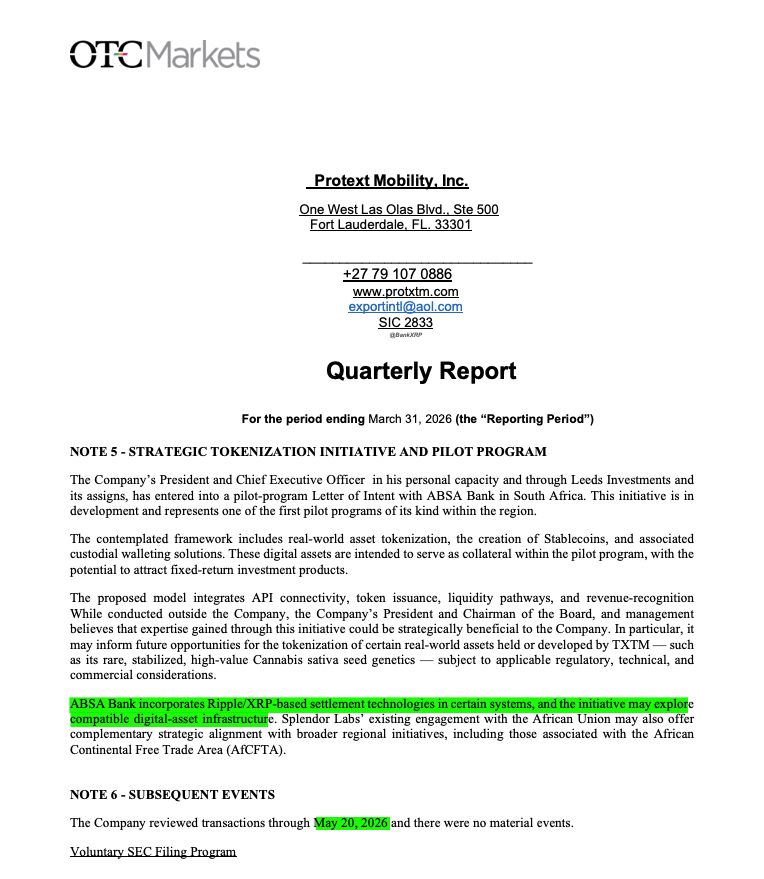
$XRP Adoption Signal in Africa
ABSA Bank is actively incorporating @Ripple/XRP-based settlement technologies across key systems and exploring full digital asset infrastructure.
$TXTM just released its Q1 2026 Quarterly Report, while Splendor Labs’ strategic engagement with the African Union and alignment with AfCFTA position the XRPL perfectly for seamless cross-border trade and tokenization across the continent.
Full report: https://t.co/kkif3sGMTf
Winston Churchill fought his depression with bricks. He'd lay them for hours at his country home in Kent. He joined the bricklayers' union. And in 1921 he wrote about why it worked. It took psychology another 75 years to catch up.
He called his depression the "Black Dog." It followed him for decades. His method for fighting it back was as basic as it sounds: laying brick after brick, hour after hour.
Churchill spelled out his theory in a long essay for The Strand Magazine. People who think for a living, he wrote, can't fix a tired brain just by resting it. They have to use a different part of themselves. The part that moves the eyes and the hands. Woodworking, chemistry, bookbinding, bricklaying, painting. Anything that drags the body into a problem the mind can't solve by itself.
Modern psychology now calls this behavioral activation. It's one of the most-studied depression treatments out there. Depression sets a behavior trap. You feel bad, so you stop doing things, and doing less means less to feel good about. Feeling worse makes you do even less. The loop tightens until you can't breathe inside it.
Behavioral activation breaks the loop from the action side. You schedule the activity first, even when every part of you doesn't want to. Doing it produces small rewards: a wall gets straighter, a painting fills in, a messy room gets clean. Those small rewards slowly rewire the brain. Action comes first, and the feeling follows.
Researchers at the University of Washington put this to the test in 2006. They studied 241 adults with major depression and compared three treatments: behavioral activation, regular talk therapy, and antidepressants. For the people who were most severely depressed, behavioral activation matched the drugs. It beat the talk therapy. A 2014 review of more than 1,500 patients across 26 trials backed up the result.
Physical work like bricklaying does something extra on top of this. It crowds out rumination, the looping bad thoughts that grind people down during the worst stretches of depression. Bricklaying needs both hands and gives feedback brick by brick: each one is straight or crooked. After an hour you can see exactly how much wall you built. No room left for the mental chewing.
The line George Mack used in his post, "depression hates a moving target," is good poetry. The science behind it is sharper. Depression hates a brain that has somewhere else to be.
The Bible has more to say about money than almost any other topic.
Don't bury your talent. Don't sell what you should hold. Don't spend the seed.
Build wealth so you can be generous. Hold the position so your kids start where you ended. Use the rules wisely so the harvest stays in your family.
“God has infinite attention to spare for each one of us. You are as much alone with him as if you were the only being he had ever created.” - C.S. Lewis
“If you spend your time chasing butterflies, they will fly away.
But if you spend your time making a beautiful garden, the butterflies will come.
Do not chase, attract.”
Amazon just got caught running a secret price manipulation operation with Levi's, Home Depot, Walmart, and many more.
Every time you "comparison shopped" online, you were looking at prices that were already rigged.
Here's what happened:
Amazon would monitor prices on Walmart, Target, Best Buy, Home Depot, and Chewy in real time. The second a competitor listed a product cheaper than Amazon, they'd contact the brand directly and tell them to "fix it."
And the exact emails are now PUBLIC.
Amazon sent Levi's links to two Walmart listings with the subject line "styles of concern." They basically said the prices on Walmart are too low and we have a problem.
The next day, Levi's responded: "I talked to Walmart and they have partnered with us to take Easy Khaki Classic fit back up to ladder SPP price, $29.99 immediately."
Levi's literally called Walmart and told them to raise the price. Because Amazon told Levi's to make the call.
Walmart complied. Then Amazon matched the HIGHER price.
Both retailers ended up charging more. The customer paid extra. Nobody competed.
Same playbook with Hanes:
Amazon sent them links showing Target and Walmart prices were lower. Hanes confirmed they "reached out to Target and Walmart to have the prices increased."
Target increased the prices. Walmart increased the prices. Amazon kept their margins.
But it gets even worse...
Amazon told Allergan (the company that makes eye drops) that their product was "suppressed" on Amazon because it was cheaper on another site.
Allergan responded: "Walmart got their price back up to $16.99." Amazon then unsuppressed the listing.
They did this with pet treats on Chewy. Furniture on Home Depot. Products across dozens of categories spanning YEARS.
The mechanism is simple but terrifying:
If you're a brand and you sell cheaper on Walmart than on Amazon, Amazon suppresses your product, removes you from the Buy Box, buries you in search results, and effectively makes you invisible to 300 million customers.
Brands can't afford that. So they call Walmart and Target and say "raise your prices or we'll lose our Amazon listings."
Walmart and Target comply because they need the brand's products.
Amazon captures 40 cents of every dollar spent online in America. That gives them the leverage to set prices across THE ENTIRE internet. Not just their own platform.
So turns out, you were never comparison shopping.
You were looking at a coordinated price floor set by Amazon through backroom phone calls between brands and their competitors.
"Amazon is working to make your life more unaffordable."
3 separate antitrust trials are now scheduled for 2027. The FTC has its own case. 18 states plus the DOJ are piling on.
This is literally happening during the WORST affordability crisis in a generation. Groceries up 25% since 2020. Housing unaffordable. Wages flat.
And the largest ecommerce company on Earth has been secretly coordinating with brands to make sure you can't find a cheaper price ANYWHERE.
"Competition" in retail is just a fantasy.
Your microwave heats food with waves 12.2 centimeters long, about the length of your palm. A fruit fly is 2.5 millimeters. Its entire body fits inside 1/50th of a single wave.
I looked into why, and the physics is clean. Things absorb microwave energy best when the wavelength roughly matches their size. For a fruit fly, that would require frequencies about 24 times higher than what your kitchen microwave puts out. A 2018 study in Scientific Reports tested four insect species and found that at the frequencies home microwaves use, the waves basically sailed right through them. When they cranked the frequency high enough for the wavelength to match insect bodies, absorption jumped by 3 to 370%.
The inside of your microwave is also a patchwork. Waves bounce off the metal walls and form a fixed pattern of hot zones and dead zones, spaced about 6 centimeters apart. The turntable exists to drag your food through the hot spots so it heats evenly. A fruit fly is small enough to sit entirely inside a dead zone and never get touched.
Weight matters too. A fruit fly comes in at about 0.8 milligrams, roughly the same as a grain of salt. The heat it absorbs depends on its volume. The heat it sheds depends on its surface area. Smaller bodies lose heat faster than they gain it, so even the small amount of energy the fly picks up bleeds away almost instantly. Researchers at Kyoto University put fruit flies directly into microwaves in 2020 and confirmed the flies were simply too small to convert the energy into heat.
The air inside the oven stays at room temperature the whole time. Microwaves work by flipping water molecules back and forth billions of times per second, which creates friction and heat inside the food. Air has almost no water in it, so it absorbs nothing. The fly is just cruising through room-temperature air, dodging hot spots 6 centimeters apart when its whole body spans 2.5 millimeters.
I love that the same animal that shrugs off your kitchen microwave was the first animal ever launched into space. February 20, 1947. A batch of fruit flies rode a captured German V-2 rocket to 109 kilometers above New Mexico, then parachuted back alive. 75% of human disease genes have counterparts in fruit fly DNA, and six Nobel Prizes have come from research using them. The creature that ruins your bananas has contributed more to modern medicine than most lab equipment.
Your body replaces 98% of its atoms every year. Within five years, every single one is swapped out. The you from 2021 is physically gone. Not "mostly gone." Gone. The atoms that used to be your face are now part of the air, the ocean, somebody else's lunch.
Oak Ridge National Laboratory proved this in 1953. Your skin right now is about a month old. Your liver, six weeks. Your stomach lining regrows every five days. Your skeleton is completely different from ten years ago. A few atoms do stick around for life, buried in some brain cells, in parts of your heart, and in your tooth enamel. Scientists at the Karolinska Institute in Sweden tracked them using leftover radiation from 1950s nuclear bomb tests. The oldest surviving piece of "you" lives in your brain, your heart, and your teeth.
Your brain is also erasing you. On purpose. A neuroscientist named Ron Davis at Scripps Research found that the brain has cells that release dopamine, the same chemical you feel after a good meal or a win, and use it to dissolve memories. When his team shut these cells off in test animals, they remembered twice as much. The chemical behind your best feelings is the same one shredding your past, and it never stops running.
Ebbinghaus proved this back in 1885. You lose about half of everything you learn within one hour. A 2020 study from Baycrest's Rotman Research Institute had people live through a real experience and then checked how much they kept. At best, about a quarter. 75% of the details of your own life are being actively wiped by the organ that is supposed to be keeping track of it all.
The universe is 13.8 billion years old. Squeeze all of it into one calendar year, with the Big Bang on January 1st, and humans show up at 11:52 PM on New Year's Eve. Your whole life, every birthday and breakup and boring Tuesday, lasts 0.17 seconds on that calendar. Not even long enough to blink.
Stars will keep burning for about a hundred trillion more years, then the fuel runs out and the lights go off everywhere. The last things left will be black holes, places where gravity is so strong not even light can escape. Even those slowly leak away over a number of years so large you would need a hundred zeros to write it. After the last one is gone, nothing is left. No light, no warmth, nothing bumping into anything else, ever again. The universe reaches total stillness and stays there. Forever.
Brian Cox once described the window where life can even exist as one-thousandth of a billion billion billionth, billion billion billionth, billion billion billionth of a percent of the universe's total run time. You are in that window right now. Built from borrowed atoms, running on a brain shredding its own records, here for a fifth of a second on a cosmic calendar that ends in permanent silence. Anyway, hope your Tuesday is going alright.
84 months is 7 years. For every one of those years, that cheese sat as part of a full wheel in a dark cave where someone washed it in salt water, flipped it over, and scraped bad mold off by hand. It had a full-time babysitter.
The cave sat at about 55°F in thick, damp air around 90% humidity. Your fridge runs at 38°F with dry air around 65%. The cave is warm enough for good bacteria to slowly break down the cheese from inside, which is where all the sharp, deep flavor comes from. Your fridge was built to suck moisture out of the air. Good for keeping your milk fresh. Terrible for cheese.
The skin on that wheel (called a rind) was alive. It was covered in bacteria and mold that were actually helping it, working like a living armor that fought off the bad stuff the same way your immune system fights a cold. And those good bacteria had been winning that fight for 7 straight years.
Then someone cut the wheel open, sliced off a small wedge, wrapped it in plastic, and shipped it to your grocery store. Now the cheese is exposed on two or three sides with zero protection. Bacteria from all over your fridge, the open yogurt, the leftover curry from Tuesday, whatever else is in there, can land right on it. The small piece dries out fast because almost all of it is touching air. And the plastic wrap traps moisture against the cut surface, which is exactly what bad mold needs to grow.
Fort Saint Antoine in eastern France is an old military bunker carved into a mountain. Inside, 100,000 wheels of Comte (a hard French cheese) age on wooden shelves while workers walk through and care for each one on a set schedule. Your wedge went from that level of treatment to sitting between a jar of pickles and some week-old pasta.
That cheese was fragile the entire time. It spent 7 years in a fortress with a security team. Now it is in your fridge with nothing but plastic wrap between it and a slow death.
Judas ate with God for three years and never flinched.
Sat at the fire. Said the prayers. Watched blind men see. Watched dead men stand up. Watched lepers get clean skin back. Saw all of it. Touched all of it.
And it did nothing to him.
That should make you sick.
Because you know men like that. You’ve sat next to them in church. They sing the hymns. They say amen. They put the money in the plate. And they go home and do things in the dark that would get them killed in any century but this one.
Jesus called him a devil. Not after the betrayal. Before it. John 6:70. He looked at twelve men and said one of you is a devil. And then He let the devil stay.
He let him hold the money. Let him sit at the table. Let him hear every parable. Let him watch Lazarus walk out of a tomb.
And Judas saw resurrection with his own eyes and thought, what’s that worth in silver?
That’s not weakness. That’s not a man who lost his way. That’s a creature wearing human skin at the table of God, calculating the price of the blood on his plate.
Jesus washed his feet.
Read that again.
God kneeled in front of the thing that was about to murder Him and washed the dirt off its feet.
Not because Judas deserved it. Because the eleven men watching needed to see what love looks like when it’s aimed at something that will never love you back.
That’s the sermon your pastor won’t preach.
That Jesus didn’t die confused. He didn’t die betrayed. He sat across from a devil, broke bread, and said what thou doest, do quickly.
He gave evil permission to finish.
Because the cross was never Plan B.
And the son of perdition was never a surprise.
He was a prop in a story written before the foundation of the world. A creature who thought he was the predator and turned out to be the instrument.
The tomb didn’t stay shut.
But the field Judas bought with his thirty pieces? His guts are still in the dirt.
A SHORT HISTORY OF MEDICINE...
"Doctor, I have an earache."
2000 B.C. - "Here, eat this root."
1000 B.C. - "That root is heathen, say this prayer."
1850 A.D. - "That prayer is superstition, drink this potion."
1940 A.D. - "That potion is snake oil, swallow this pill."
1985 A.D. - "That pill is ineffective; take this antibiotic."
2026 A.D. - "That antibiotic is artificial. Here, eat this root!"
It's not a "discount", that's the actual price. They charge the insurance more, much more, and the ins pays it. Ins just adds the costs to everyone's deductible.
American is a healthy 28 year old, he decided to skip paying for health insurance this year because the cheapest plan was $900 per month with a high deductible
He had to spend 2 nights in the ER without insurance, he breaks down the bill
“This is my receipt from spending 2 days in the hospital:
- It totaled about $24,000
- My CT scan alone was $8,300
- Laboratory, 6,000
- IV therapy, $1,020, $4,000 in total
And while $24,000 seems like a lot of money, let me show you something. This is what I'm actually paying, $2,478
because when you don't have insurance, these hospitals give you a discount. They discounted $22,000 off of this bill”
“But if I had insurance, I wouldn't have gotten that discount. So it would've been a $24,000 bill billed to my insurance, and then my insurance would've said, ‘Hey, you have a $5,000 deductible. You need to pay $5,000 for this last emergency room visit.’
Then you tack on the $900 a month that I'd be paying for that insurance. I'd be paying $20K this year for healthcare.
So the craziest part about this is even if I have another hospital visit, by the end of this year, I'm still gonna be paying less than I would if I had insurance. At minimum, my cost for healthcare this year would've been $20,000 with insurance. Right now I'm at $2,400.”
US Health Insurance is a scam
🔥 Protext Mobility Update: The Moment we’ve all been Waiting for is Almost here—Our Real-World Assets (RWAs) Testing is Nearly Complete, and the Results are in: Zero Faults Found! 📊