Every time the human race has cared about a food enough to paint it, steal it or go to war over it, the food was an animal.
Nobody ever painted a salad on a cave wall. Lascaux has around 900 animals and no side dishes.
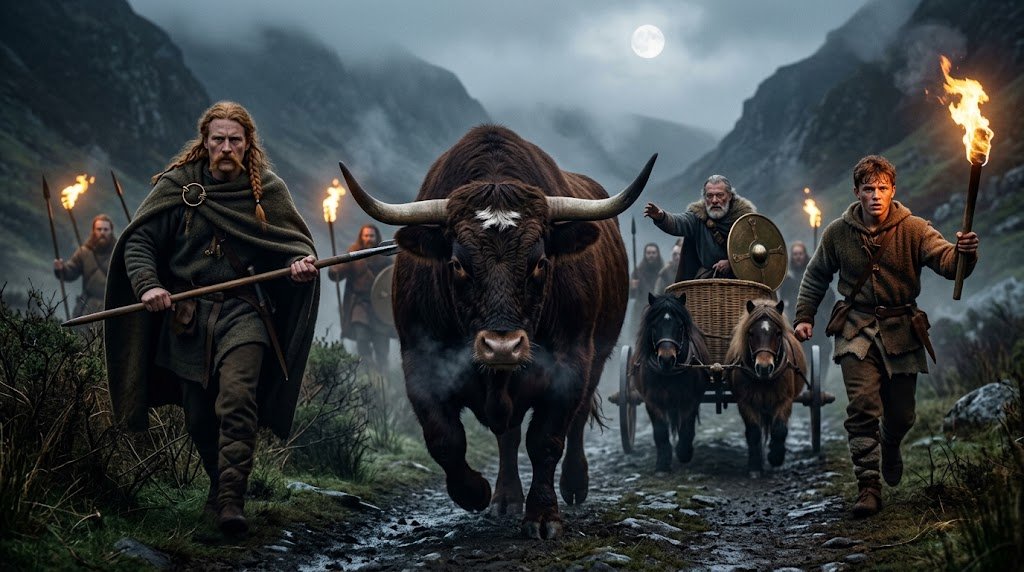
Nobody ever rode out at midnight to steal a neighbour's lentils. Ireland's national epic is a war over one bull.
Nobody ever paid a bride price in celery.
Nobody ever branded a carrot. The word itself means the mark you burn into a hide.
Nobody ever dug a ditch round a park to keep the peasants off the kale.
Nobody ever hanged a man for taking the king's cabbage.
Nobody ever read the future in the entrails of a leek.
Nobody ever killed the fatted turnip for a son come home.
Nobody ever named a star sign after a bean. There is a bull, a ram and a goat up there, and they got in first.
Nobody ever followed a migrating herd of spinach across a land bridge into America.
For 2.6 million years the species was in no doubt about which part of dinner was the dinner.
It took a committee and a pyramid diagram to make it a matter of opinion.
Your body keeps two months of fat in storage and less than one day of carbohydrate, which tells you what it was expecting to run on.
Your entire bloodstream holds about one teaspoon of sugar. Any more and an alarm goes off.
Your liver and muscles hold perhaps 2,000 calories of carbohydrate. A day, if you sit still.
A lean adult carries around 100,000 calories of fat. Six weeks and more, with no further instructions.
You store vitamin B12 for three to five years.
You store vitamin A for months, in the liver, like every other hunter.
You store vitamin D in your own fat, to see you through a winter.
You store almost no vitamin C. Scurvy takes about a month.
Look at what gets a warehouse. Fat, and the nutrients that come in an animal.
Those arrive in gluts. A kill, a feast, then nothing for a week. So the body built somewhere to keep them.
Carbohydrate gets a shelf. If none turns up, the liver simply makes its own, and has done every night of your life.
There are essential fats. There are essential proteins. The textbook requirement for carbohydrate is zero, and it says so.
No engineer builds a 100,000 calorie tank for the reserve fuel and a one day tank for the main one.
The plate they drew for you is two thirds the fuel you were never built to store.
@ShadowOfAnAlien And pigs have the wonderful advantage of being able to turn all sorts of scraps and leftovers into meat. The medieval equivalent of a recycling plant, except the finished product was bacon.
For 800 years the poor of Europe were periodically poisoned by their own bread, and the cure, when it came, was pork.
The disease was called St Anthony's fire. It began with a burning in the hands and feet. Then came visions and convulsions. In the worst cases the fingers, toes and whole limbs turned black, dried out and dropped off without bleeding. One outbreak in France in 944 is said to have killed tens of thousands.
Nobody knew the cause. It was a fungus that grows on rye in a wet summer and bakes into the loaf unseen. Rye was the bread of the poor. The rich ate wheat and meat, and the fire passed them by, which everyone took as a judgment.
Around 1095 a religious order was founded to nurse the victims. The brothers of St Anthony ran hundreds of hospitals. Their treatment was simple. They took the sufferer in, fed him wheat bread and pork, and rubbed the limbs with lard. Many recovered.
They recovered because they had stopped eating the rye. The monks did not know that. They only knew that their food worked.
To supply the hospitals, the order was granted a unique privilege. Its pigs could roam free through any town in Europe, wearing a little bell, fed by whoever they passed.
So picture a medieval street. Among the crowd wanders a pig with a bell on, untouchable, being fattened by the public to treat people the grain had crippled.
The cause was not identified until the 1670s. For the whole of the Middle Ages, the staple food of the poor was maiming them, and the answer was walking about in the road.
@aki_korhonen I can almost see the label. Holy Hog Water. Blessed by St Anthony, approved by the monks, and best consumed with a large helping of bacon.
@oelschlaeg2 Imagine telling a medieval peasant that the safest way to consume his rye was to turn it into whisky. I suspect he'd have embraced that medical advice enthusiastically.
The barbell is the most overrated muscle-building tool in the gym, and the proof is in what ends each set.
A barbell squat ends when your lower back has had enough. A leg press ends when your quads have.
A barbell bench ends when the bar starts to wobble. A Smith machine press ends when your chest gives out.
A barbell row ends when you can no longer hold the bend. A chest-supported row ends when your upper back gives out.
A barbell curl ends when you start swinging it. A preacher curl ends when your biceps give out.
A barbell overhead press ends when your midriff folds. A seated machine press ends when your shoulders give out.
A Romanian deadlift ends when your grip opens. A hamstring curl ends when your hamstrings give out.
Six barbell lifts, and in every one the set was called off by something other than the muscle you came to train.
A muscle grows when it is made to work against a load heavy enough to recruit all of it, right up to the point it cannot move that load again. Whatever stops the set early is deciding how much growth you leave on the floor.
On a barbell that decision gets made by your balance, your grip and your lower back. On a machine the frame holds you still, so the only thing left to fail is the target.
The barbell teaches you to be good at the barbell, which is a perfectly decent hobby. The machine was built to take one muscle to its limit, which is the job you walked in for.
Somewhere tonight a man in a lifting belt will tell a woman on the leg press that she is cheating, and her quads will have outgrown his by spring.
In the 1970s half of Britain dreamed of packing in the job and living off the land. The man who wrote the manual had one rule above all the others, and it was to get a cow.
You will remember the sitcom. Tom and Barbara digging up the lawn in Surbiton, the goat called Geraldine, the pigs, the cockerel, and Margo next door in her kaftan. It ran from 1975 and the whole country watched it.
The real thing was a man called John Seymour. He had farmed, soldiered and wandered across Africa, and in the 1950s he and his wife took 5 acres in Suffolk with no electricity and worked out how to feed a family from it. In 1976 he put it all into one large illustrated book. It sold over a million copies and was on the shelf of everyone who ever owned a pair of wellingtons.
Look at his plan for a single acre. Half of it is grass.
On that half lives a cow. She gives milk, butter, cheese and cream for the house. Her skimmed milk and whey feed the pig. Her dung feeds the vegetable plot. Her calf is next year's meat. Take the cow away, he wrote, and the whole thing stops working.
Then the pig, to eat the scraps and plough the ground. Then hens. The vegetables come last and need the animals to grow at all.
Seymour moved to a hill farm in west Wales and later to Ireland, and died in 2004 at 90.
A generation remembers The Good Life as a programme about growing your own vegetables. The man who invented it said self-sufficiency begins with an animal, and without one you are just gardening.
Two jumpers. One came off a hill, one came out of a refinery.
Polyester:
- Made from oil
- The same plastic as a drinks bottle
- Traps sweat and stinks by lunchtime
- Crackles with static
- Sheds 500,000 fibres every wash
- Found in human blood, lungs, placentas and brains
- Melts onto the skin in a fire
- Worn out in two winters
- In the ground for centuries
- Sold to you as performance fabric
Wool:
- Made from grass
- The same protein as your own hair
- Soaks up a third of its weight in sweat and stays dry
- No static
- Sheds nothing a river can't digest
- Found in nobody's bloodstream
- Chars and goes out by itself
- Handed down to your son
- Fertiliser within a year
- Sold for less than it costs to shear
One of these has had 10,000 years of testing on every hillside from Shetland to Mongolia. The other has had 80, on you.
@LeeAArcher What's fascinating is that you've spent decades gardening outdoors, yet noticed a difference only after changing your diet. That makes the observation worth exploring.
University debate. The motion: "There is no such thing as a safe tan."
Dermatologist: "Ultraviolet light is a proven carcinogen. Every tan is damage. The only responsible advice is shade, clothing and factor 50, all year round."
Anthropologist: "When did humans lose their fur?"
Dermatologist: "I'm not sure that's relevant."
Anthropologist: "At least 1.2 million years ago. In equatorial Africa. Naked, outdoors, all day, under the strongest sun on the planet. How did the species cope without a pharmacy?"
Dermatologist: "Dark skin. Melanin."
Anthropologist: "A built-in defence, then. And when people walked north into weak sunlight, what happened to it?"
Dermatologist: "The skin got paler."
Anthropologist: "Why?"
Dermatologist: "...To let more ultraviolet in. For vitamin D."
Anthropologist: "Most of that in the last 8,000 years. Evolution stripped the pigment out of an entire continent because the people who got more sun on their skin left more children. You've stood up tonight and called that a design fault."
Dermatologist: "They didn't live long enough to get skin cancer."
Anthropologist: "Who gets more melanoma today? The roofer or the accountant?"
Dermatologist: "It's complicated."
Anthropologist: "It's the accountant. The people outdoors all year get less of it than the people who see the sun for a fortnight in Spain. And melanoma in Britain has more than doubled since the early nineties, across the best-creamed decades in human history."
Dermatologist: "That's better diagnosis."
Anthropologist: "It's a remarkable defence of a product. The more we use, the more cancer we find, and the answer is a higher factor."
Moderator: "We're out of time. It's a lovely evening, there's a terrace."
[The dermatologist is already putting on a hat.]
@stwors That's a perfect example of the distinction between regular sun exposure and suddenly spending hours under intense Hawaiian sunshine. Your skin simply wasn't prepared for that dose.
@catpurrsarenice Ha! Between the Wisconsin winters and the amount of clothing required to survive them, I suspect your skin spends much of the year wondering whether the sun still exists.
@DrRandyWhite That's a considerably better opening line than mine. Although I suspect the dermatologist would insist on putting factor 50 on the serpent.
@White_RhinoCap Skin cancer certainly occurs in people with dark skin, and it can be particularly dangerous when diagnosed late. But the rates aren't remotely equal. Melanin provides real UV protection, though it certainly isn't immunity.
@Iz77491 The skin is an extraordinary organ, and sunlight does far more than give us a tan. Vitamin D synthesis, nitric oxide release and local immune responses are all part of the picture. We've made the conversation far too one-dimensional.
@RaymondYu4 Exactly. Biology rarely operates in absolutes. Sunlight has genuine benefits, excessive UV exposure has genuine risks, and pretending one cancels out the other makes for terrible health advice.
@Joe1031572T You don't need to destroy a herd to make farming disappear. Make the economics impossible, drive producers out of business, and eventually the animals go too.
In the winter of 1069 William the Conqueror put down a rebellion in the north of England by killing the animals. The people died afterwards, on their own.
Three years after Hastings, Yorkshire rose against him with Danish help. William marched north, bought off the Danes, and then decided the region would never trouble him again.
He did not need a battle. He split his army into small bands and sent them through every valley between the Humber and the Tees. Their orders were to destroy what kept people alive. They slaughtered the cattle, the sheep and the plough oxen. They burned the stored grain and the seed corn. They broke the ploughs.
Then they left, in midwinter.
A monk who wrote the history of those years, and who admired William, could not excuse it. He recorded that the survivors ate horses, dogs and cats, and then each other. Some sold themselves into slavery for a meal. He put the dead at 100,000. The corpses lay unburied on the roads, because there was no one left with the strength to dig.
Sixteen years later the King's surveyors rode through the same country compiling Domesday Book. Against village after village in Yorkshire they wrote one word. Waste.
William is said to have confessed it on his deathbed as the sin that weighed on him most.
It became the standard method. Sherman used it in Georgia. The United States Army used it on the Plains, against the bison.
Every commander who has wanted to break a people for good has understood the same thing. You do not have to fight them. You only have to get to the herd first.
@LakeLadyJane Very much so. The uncomfortable lesson is that food security isn't merely an agricultural issue. It's national security. And we've become remarkably casual about how dependent we are on systems we don't control.
@5weekwonder And that's the warning history gives us. A population doesn't have to be attacked directly to become vulnerable. Undermine its food production and water security, and you've already weakened its independence.
@SparksintheDale That's an extraordinary amount of labour, much of it done by hand. An entire country's worth of stone boundaries built largely to manage grazing animals. Our agricultural history is quite literally written across the landscape.
Gerald, the man on Clarkson's Farm whom nobody can understand, has spent more than 50 years repairing something that an arable farm has no use for at all.
He is a dry stone waller. The Cotswolds have about 4,000 miles of those walls, which is roughly the length of the Great Wall of China. They are the reason the place looks the way it does. Tourists fly in from America and Japan to photograph them.
Every yard was built for one purpose, which was to keep sheep in.
For 500 years the Cotswolds was the greatest wool country in Europe. The limestone was lying in the fields, so the shepherds stacked it into walls, without mortar, to divide the grazing. A wall holds a flock where a ditch will not. It gives the lambs shelter from the wind. A well built one lasts 150 years.
Wheat does not need holding. A combine harvester would rather the walls were not there. On a pure arable farm they are an obstacle that costs money, and across the east of England their cousins, the hedges, were torn out by the mile for exactly that reason.
So when you watch Gerald setting a stone, you are watching a man maintain the fencing of a livestock system that has mostly gone, on behalf of a landscape that would not exist without it.
The honey coloured villages, the wool churches, the walls and the little green fields were all paid for by an animal eating grass.
Gerald understands that perfectly well. He has just never managed to say it in a way the rest of us could follow.







![SamaHoole's tweet photo. University debate. The motion: "There is no such thing as a safe tan."
Dermatologist: "Ultraviolet light is a proven carcinogen. Every tan is damage. The only responsible advice is shade, clothing and factor 50, all year round."
Anthropologist: "When did humans lose their fur?"
Dermatologist: "I'm not sure that's relevant."
Anthropologist: "At least 1.2 million years ago. In equatorial Africa. Naked, outdoors, all day, under the strongest sun on the planet. How did the species cope without a pharmacy?"
Dermatologist: "Dark skin. Melanin."
Anthropologist: "A built-in defence, then. And when people walked north into weak sunlight, what happened to it?"
Dermatologist: "The skin got paler."
Anthropologist: "Why?"
Dermatologist: "...To let more ultraviolet in. For vitamin D."
Anthropologist: "Most of that in the last 8,000 years. Evolution stripped the pigment out of an entire continent because the people who got more sun on their skin left more children. You've stood up tonight and called that a design fault."
Dermatologist: "They didn't live long enough to get skin cancer."
Anthropologist: "Who gets more melanoma today? The roofer or the accountant?"
Dermatologist: "It's complicated."
Anthropologist: "It's the accountant. The people outdoors all year get less of it than the people who see the sun for a fortnight in Spain. And melanoma in Britain has more than doubled since the early nineties, across the best-creamed decades in human history."
Dermatologist: "That's better diagnosis."
Anthropologist: "It's a remarkable defence of a product. The more we use, the more cancer we find, and the answer is a higher factor."
Moderator: "We're out of time. It's a lovely evening, there's a terrace."
[The dermatologist is already putting on a hat.]](https://pbs.twimg.com/media/HUVL6zgWMAEsRlv.jpg)


