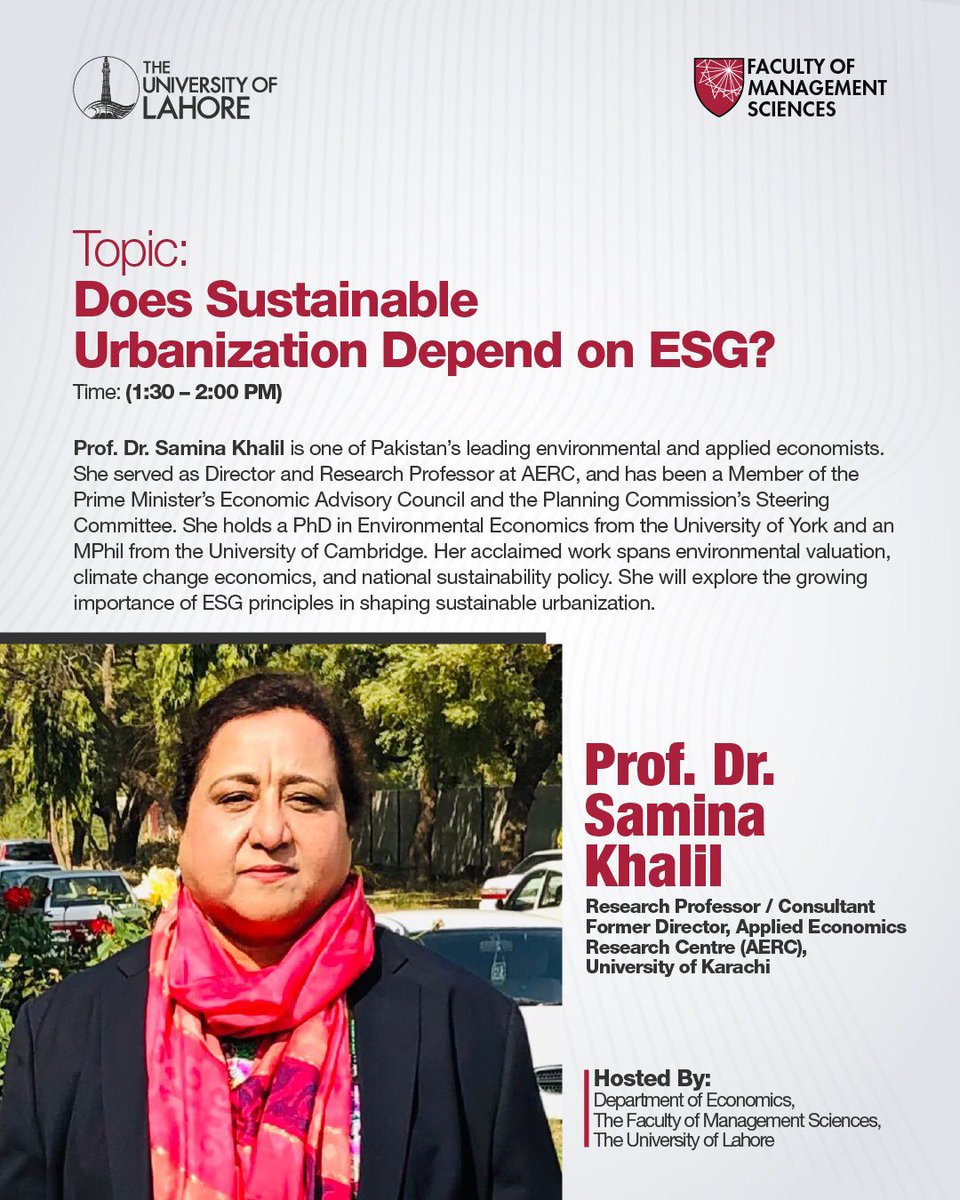
Former Research Professor / Director PhD York University, MPhil Cambridge University UK, Deve Economics, Envir & Climate Change, Institutional Econ. Gender issu
In my opinion Strategies for Labour Empowerment include autonomy & decision making
that is giving workers the authority to solve problems and share leadership visions:
Establishing transparent feedback mechanisms and whistleblower protections.
Women labour Empowerment requires tangible resources and continuous support across both rural and urban areas:
Market-Oriented Training: Vocational training, entrepreneurship development, and financial literacy programs—led by organizations like UN Women Pakistan—are helping marginalized and rural women build sustainable livelihoods.
Home-Based Workers' Rights: Initiatives and unions are forming to integrate home-based workers into the formal economy, ensuring social security and fair access to supply chains.
Financial Inclusion: Expanding access to microfinance and digital banking is a critical step in providing women with the autonomy to make household and professional decisions.
Mohenjo Daro was one of the largest cities of the Indus Civilization, but archaeologists still debate who held power there and whether a ruling elite existed at all. Now, a new study suggests the society behind the city may have been the most egalitarian in the ancient world.
https://t.co/dp6QKzNx9r
Germany’s decision to slash public transit fares by 90% as a response to high gas prices represents a bold step toward addressing both economic and environmental challenges. Holmes would be interested in the logic behind this drastic policy change. The move encourages people to leave their cars behind, which could reduce traffic congestion and pollution. This action, motivated by the pressing need for a shift in energy usage, requires careful analysis of its effectiveness and long-term consequences.
Public transportation systems have always been crucial to managing urban congestion, but offering such a steep discount raises important questions. How will this affect the economy, the environment, and the behavior of the general public? Holmes, with his keen eye for detail, would analyze data to see if this dramatic change actually leads to a sustainable reduction in car use, or if it is simply a temporary solution to a deeper systemic issue.
By reducing the financial barrier to public transit, Germany is signaling a shift in how society views mobility. Holmes would not only look at the immediate effects of this policy but also at the broader social changes that it could spur. Will other nations follow suit, or will this experiment prove to be too costly to maintain? 🛤️🚆
Did we in Pakistan also get any sane advice from anyone in Davos? At least we could also seriously address similar concerns and challenges that Ms. Gita Gopinath has mentioned for India regarding per capita income and pollution.
👇
Gita Gopinath, the deputy MD of International Monetary Fund (IMF), has said three things about India during the Davos Meeting this year.
1. First, a very happy one: India will soon be world number three in GDP, overtaking Japan and Germany. The first is the USA with $30.62 trillion, and the second is China with $19.40 trill. She has further said that, if you looked at the growth rate, India should become the third-largest economy soon. At present, the DGP of India is $4.13 trillion, Germany has 5.01 trillion, and Japan has $4.28 trillion. But looking at the growth rate, India will soon overtake Japan and Germany, the latest by 2028; that can happen even earlier.
But.
There are two much more #important #challenges India has to worry about.
2. India needs not be complacent about the possibility of becoming the third largest economy in the World; it should worry much more about the #per_capita_Income.
The country with the highest per capita income is, Monaco with $256,000; The largest economy, USA, comes only at the 11th position with $89,000, and the second largest economy, China, at the 99th position with $13,000/-, the third largest economy Germany comes at the 24th position with $59,925, and fourth economy Japan comes at the 52nd position with $34,713;
And India, which is going to be the third-largest economy soon, comes only at the 166th position with just $2,828 per capita income. This is a very sad thing and a big challenge for India.
And this is what Gita Gopinath said India has to worry about. The biggest challenge for India is to drastically increase the per capita income of its citizens through structural reforms, and try to come near China at least at the 100th position.
3. And the second important challenge for India is #pollution. It may sound strange. But pollution is eating into our GDP and into the lives of our people. According to the studies of World Bank in 2022 at least 1.7 million people die annually due to pollution; but the recent studies estimate that at least 2 million people die due to pollution, that is, 5500 persons every day. The deaths due to pollution makes 18% of all deaths in India. Pollution is a great challenge, and the government and people have to put in serious efforts to bring it down to tolerable levels. Pollution will adversely affect the travellers to India; the international investors who might wish to come to India will have to think twice before coming to India, if the environment is not right.
Artificial intelligence (AI) is transforming the retail and B2B e-commerce sectors by enabling hyper-personalization, streamlining operations, and enhancing customer communication through advanced data analysis and networking technologies.
With the rapid growth of business-to-business or B2B eCommerce and the influence of consumer expectations on the B2B buying experience, there has been a huge growth in the use of artificial intelligence (AI). Today, AI is not just a cool feature, it’s opening up transformative opportunities for B2B eCommerce developers, marketers, business owners and also B2B buyers
A must watch interview of Prof Mahmood Mamdani who is an academic, anthropologist and political commentator. Prof Mamdani's amazing grasp of the political reality and social equation, the clarity of his well grounded views unlike our pseudo liberals and champagne socialists.
In Pakistan our modern op-ed so called liberals and pseudo intellectuals and political economics writers know everything, and listen to nothing. Applause inside the echo chamber is mistaken for relevance outside it.
Realpolitik is only practical when anchored in real time, not marooned in the past or chasing ambitious futures detached from present reality.
Realpolitik works only in real time. Once it becomes hostage to the past or seduced by grand visions of the future, it ceases to be politics of reality and turns into ideology.
https://t.co/JmGxkgsm0t
𝟒𝐭𝐡 𝐌𝐞𝐞𝐭𝐢𝐧𝐠 𝐨𝐟 𝐭𝐡𝐞 𝐒𝐞𝐧𝐚𝐭𝐞 𝐨𝐟 Begum Nusrat Bhutto Women University (BNBWU) 𝐚𝐭 𝐒𝐮𝐤𝐤𝐮𝐫.
The 4th Meeting of the Senate of BNBWU Sukkur was held on November 24, 2025, marking a significant milestone in strengthening institutional governance and advancing academic excellence. The session was chaired by Mr. Muhammad Ismail Rahoo, Minister for Universities & Boards, Government of Sindh, and co-chaired by Prof. Dr. Tehmina Nangraj, Vice Chancellor, BNBWU.
I as one the Senate Members attended the meeting and was immensely impressed by the dedication and visionary leadership of the VC Prof. Dr. Tehmina Nangraj and her team who are able to take the women university to next higher levels in the shortest possible time. The increase in the enrolment of new students is remarkable as women in higher education reflects the growing awareness of importance of higher education and learning, specially among young women of Sindh.
The Honorable Minister and members highly appreciated the University’s ongoing progress, academic strengthening, administrative discipline, and developmental reforms under the present leadership.
During his remarks, Mr. Muhammad Ismail Rahoo stated:
“We regularly receive reports on the University’s progress, but witnessing the development firsthand, whether in infrastructure, academic expansion, quality education, or women empowerment, is truly impressive. Achieving this level of transformation in such a short span of time, in just two years, reflects extraordinary leadership. The role of the Vice Chancellor is exemplary; her vision, dedication, and drive have transformed this institution into an emerging model university for Sindh.”
Distinguished members, appreciated the tireless efforts and dynamic leadership of the worthy Vice Chancellor, acknowledging her unwavering commitment, institutional discipline, and strategic vision that have accelerated BNBWU’s remarkable growth. They noted that, as members of various statutory bodies of the University, they have personally witnessed the continued development and transformation taking place across all academic and administrative domains.
During the discussion, I highlighted the growing national recognition of BNBWU. I shared that Dr. Intekhab Ulfat of the Department of Physics from the University of Karachi has recently authored an article praising the transformative development of BNBWU within just two years, acknowledging the University as a symbol of progress, empowerment, and quality higher education.
The meeting concluded with a vote of thanks by the Chair, appreciating the collective contributions, active participation, and dedicated support of all members in steering BNBWU toward new horizons of excellence.
A Thought Provoking and timely book by Peter Fleming.
Fleming’s analysis is sharp, witty, and unflinching. He argues that the university has become a "zombie institution," outwardly maintaining the rituals of academia while its internal life has been hollowed out by market logic. He details how the language of "excellence," "impact," and "brand" has created a environment of performative busyness where genuine intellectual curiosity is a liability. The chapter on "communal cynicism"—where everyone knows the game is rigged but feels compelled to play along—was a mirror held up to my entire department. This book offers no easy solutions, and that is its strength. It is not a self-help guide for surviving the academy; it is a diagnosis of a terminal condition. It gave me the vocabulary to understand my burnout not as a personal failing, but as a logical response to a broken system. It was the push I needed to look beyond the university walls for a meaningful life and career.
10 Lessons and Insights from "Dark Academia":
1. The University is a "Zombie Institution": It walks and talks like a place of learning, but its core has been consumed by corporate managerialism, leaving a hollow shell that mimics its former self.
2. "Toxic Professionalism" is the Prevailing Culture: A performative ethos of overwork, competitiveness, and feigned passion masks a system of exploitation, creating an environment where burnout is the norm, not the exception.
3. Your Value is Reduced to Metricized Output: Your worth as an academic is not your teaching or intellectual contribution, but your ability to generate measurable "products"—publications, grants, and citations.
4. The "Publish or Perish" Imperative is Structurally Sadistic: The system is designed to create a permanent state of anxiety and job insecurity, especially for early-career researchers, forcing them into a cycle of endless production.
5. Administration is the New Core Activity: The real growth in universities is in managerial and administrative roles, which impose auditing and compliance regimes that strangle actual teaching and research.
6. The "Impact" Agenda is Often a Farce: The pressure to demonstrate the societal "impact" of research often leads to contrived, box-ticking exercises that distort genuine intellectual inquiry.
7. Precarity is a Feature, Not a Bug: The reliance on a vast, underpaid army of adjuncts and fixed-term contract researchers is essential to the business model, ensuring a disposable workforce with little power or job security.
8. Cynicism is the Collective Coping Mechanism: Most academics are privately cynical about the system's demands, but this cynicism is passive. It allows the game to continue because everyone is too afraid to stop playing.
9. The "Brand" is Everything: The university's primary concern is its market brand and position in league tables. Education and research are merely marketing tools to attract customers (students) and investment.
10. Escape is a Legitimate and Often Sanity-Saving Choice: Fleming legitimizes the desire to leave academia. Recognizing that the system is dysfunctional, rather than internalizing its failure as your own, is the first step toward liberation and a healthier professional life.
Like father like son (in the making)
🌹
That is why USA is a great country as it accommodates all free thinkers and writers to express their intellectual bounties irrespective of their origin or background.
https://t.co/QleZUmWpRD
China is placing large data centers under the ocean. Cold seawater naturally cools computer servers. This reduces the need for air conditioning systems inside traditional land-based facilities. Cooling is one of the highest energy costs in data centers.
Researchers and engineers involved in the project say these underwater centers can cut power use by up to 30 percent. They also save land area and reduce noise. The ocean environment helps maintain stable temperatures around the clock. Several prototypes have already been tested, and more units are being deployed off coastal regions.
These facilities are sealed and monitored remotely. Maintenance involves retrieving individual modules from the water when needed. Companies and governments are exploring this approach to improve energy efficiency and support growing data demands.