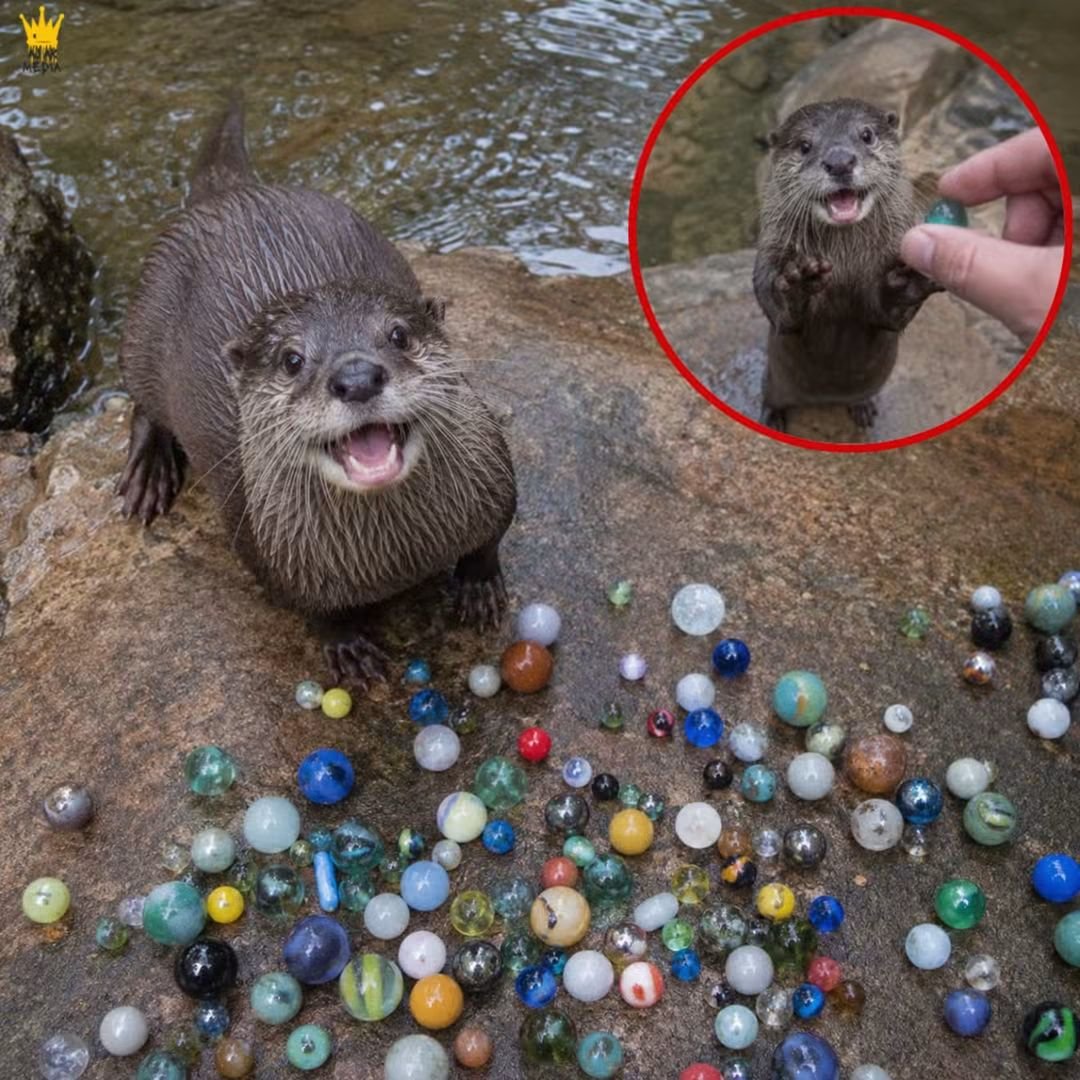
Otter at a local zoo is going viral after showing zookeepers her favorite marble collection.
At a local zoo, staff noticed one otter had a habit that was different from the rest.
Otters are known for using rocks to crack open shellfish, and some even keep their favorite stones because they work better than others. But this otter wasn’t saving rocks. She was saving marbles.
Zookeepers first noticed her hiding one shiny marble in the corner of her enclosure. Then another appeared. Then another.
Soon, staff realized she wasn’t just collecting them by accident. She was carefully keeping each one like it meant something.
The zookeepers thought it was so sweet that one by one, staff members started bringing her a different marble as a gift. Every time she received one, she would take it gently, inspect it, and add it to her little collection.
Now, whenever certain keepers visit, she gathers the marbles together as if she’s showing them off. Visitors say it looks like she knows exactly which marble came from which person.
This is absolutely insane and beautiful. 2500 drones putting on a jaw dropping show over North Richland Hills Texas for America 250. Bald eagle, rocket, Uncle Sam saying I Want USA, George Washington, astronauts on the moon, and more.
Texas knows how to celebrate freedom. This is next level patriotism.
Happy 4th of July yall! God bless America!
🔥🇺🇸
The Red Arrows of the Royal Air Force celebrating the 250th Birthday of the USA. Happy 4th of July to everyone celebrating with us back home in Northern Ireland, from this American Ulsterman. 🇬🇧🤝🇺🇸
Statue of Liberty, skyscrapers and a flotilla of ships - the Red Arrows over New York in a huge international flypast this morning, celebrating the Fourth of July with the American people on the 250th anniversary of independence.
#RedArrows | #RAF | #NewYork | #America250
A 33-year-old woman at MIT wrote the code that ran inside the Apollo 11 lunar lander, and 20 seconds before Neil Armstrong touched the moon, her program made a decision the astronauts didn't know was happening that was the only reason the mission didn't crash.
Her name was Margaret Hamilton.
She led the team writing every line of code that would fly humans to the moon and back. The part almost nobody knows is that she had to fight to be allowed to do the work at all.
Code in 1965 was not treated as real work.
Rockets were serious. Circuits were serious. Writing code was something the men at NASA thought secretaries could do on the side. Hamilton was told this to her face more than once.
So she started calling what her team did "software engineering."
She used the phrase on purpose. In meetings. In memos. To force people to treat it as a discipline instead of a chore. Colleagues laughed at her the first few times she said it out loud.
That phrase is now the name of the biggest engineering profession on earth.
The story of what her code did on July 20, 1969 is the one every kid should be taught.
Neil Armstrong and Buzz Aldrin were 3 minutes from touching down when the computer inside the lunar module started flashing an alarm.
1202.
Then again. Then 1201. Five alarms in four minutes. The computer was telling the astronauts it could not finish everything it had been asked to do.
The computer they were flying with had less memory than a modern microwave.
Someone on the checklist had left a switch in the wrong position, and a radar the astronauts did not even need right then was flooding the computer with data. It was eating around 13% of the machine's brain at the exact moment every second mattered.
In almost any other system, that overload would have frozen the machine.
A frozen machine 30,000 feet above the moon means a crash. It means two dead astronauts and a third one orbiting alone above them, waiting for a signal that would never come.
Hamilton's code did something else.
She had built the software with a rule almost nobody in her field was using at the time. When the machine ran out of room, it would not treat every task as equally important. It would look at the list of jobs it had been asked to do, throw out the ones that could wait, and keep running only the ones keeping the crew alive.
The radar was the low priority job.
The landing was the highest.
So the computer did what she had told it to do. It dumped the radar. It kept flying. The alarm was not a failure. It was the machine reporting that it was handling the overload exactly the way she had designed it to.
Down in Houston, a 24-year-old engineer named Jack Garman recognized the alarm from a test his team had run months earlier. He shouted "Go" to the flight controller. The controller shouted it up to the crew. The landing kept going.
Armstrong touched the surface with 25 seconds of fuel left.
The part that gets lost in every retelling is why Hamilton had built that safety net in the first place.
NASA had not asked for it.
She had added it on her own, years earlier, because her 4-year-old daughter Lauren had once crashed the simulator by pressing a button during a test. The button was one the astronauts had been told they would never press.
Hamilton wanted the code to survive that button press anyway.
Her bosses told her it was a waste of time. Astronauts do not make mistakes.
She insisted. The safety net went in.
Two years later, on the way to the moon, an astronaut left a switch in the wrong position. The exact class of mistake she had been told would never happen.
There is a photograph of her from that period.
She is standing next to a stack of paper as tall as she is. Every page in that stack is the code her team wrote for the mission. She is smiling at the camera like she knows something the rest of the aerospace industry has not figured out yet.
In 2016, Barack Obama put the Presidential Medal of Freedom around her neck and said the astronauts did not have much time, but thankfully, they had Margaret Hamilton.
Every autopilot in every plane you have ever flown on uses a version of what she invented. Every pacemaker. Every self driving car. Every satellite in orbit.
The idea that a machine should know which job matters most and drop the rest when it runs out of room is now the foundation of almost every safety system on the planet.
She wrote it because a 4 year old crashed a simulator and nobody else thought it was worth fixing.
The men in the room laughed at her for calling it engineering.
Then her code was the only thing in the sky that did not fail.
It’s the man, the legend and ungovernable Neal the seal. At this point just put up road crossings signs and do a gofundme to cover the repairs in town. Neal is everywhere it the ocean 🦭 🌊 😂
Neil the Seal, the internet's favorite 5-year-old southern elephant seal, is back.
He has spent his vacation growing into a massive 1,000-kilogram (one-tonne) subadult and he is currently treating Tasmanian infrastructure like his personal playground.