1. And yet, you didn’t cite any of those multiple sources. If you want people to take you and your arguments seriously, you need to actually present your sources. Even then, not every source is automatically reliable or sufficient.
2. What exactly is wrong with the logic that lolis are not actual children? If you are trying to argue that lolis should be treated or seen the same as real kids, that is just as delusional as treating/seeing video game violence as real-life murder.
all these mfs can keep talking to a wall
either 1: they're telling me the info i got from MULTIPLE SOURCES is incorrect but won't tell me what's actually correct
2: they're keep mentioning legality as if legality has ever been 100% morally correct
3: "they're not actual kids"
This post relies heavily on unrealistic worst-case scenarios that only complicate things. A simple rule to follow is that if the art does not present anything resembling actual child anatomy or proportions, then nothing of that caliber was referenced.
This is misleading because anatomical and proportional traits exclusive to actual children are not present in loli designs. So here’s my question: if those traits are being referenced, why aren’t they present in the designs?
Pose references are a weak point, since they don’t depend on how something actually looks and can be applied to almost anything. While it’s true that artists reference something, what’s being referenced in stylized designs like loli is an abstract idea of what a human looks like. That only accounts for body parts and their placement, not how they appear in a real-world sense, nor does it account for realistic anatomy or proportions.
This would only be concerning if what’s shown were visually photorealistic in relation to actual children, or indistinguishable from them. This does not apply to lolis, as their stylization makes them visually far removed from how real children look. Your concern is best directed at content that is indistinguishable from real children.
@redhatbonnie @Osint251113@Nekofetichista1@aquafacesit@SydusArts2@edpwatch_ And pedophilia isn’t something you can just “develop”; it’s not like an illness or something that simply arises on its own. I should also add that there is no substantial evidence supporting the claim that lolicon influences someone to commit CSA crimes.
1. This tendency only appears in individuals who are already offenders; what you posted does not show whether anything is actually developed or if new offenders are created
2.Lolicon content isn’t even mentioned here, so you don’t have clear evidence that it was included or relevant.
@kamiskilled @redhatbonnie @SydusArts2@edpwatch_ It should also be clarified that pedophilia, as defined in the DSM, is target-based, not trait-based, so traits like being short, small, or flat-chested cannot be used to reliably define pedophilia.
Can you provide evidence that this is truly human nature? You can’t expect to be right without support. Pedophilia, as defined in the DSM-5, strictly concerns attraction to actual children, so fictional concepts like lolis do not qualify. Additionally, traits like being flat-chested or short are common amongst adults, so they cannot be used as indicators of pedophilia, nor are those traits exclusive to children.
@redhatbonnie @SydusArts2@edpwatch_ So he’s mentally deranged for liking stylized fictional designs? Your standards for what counts as "deranged" are extremely low. No rule says bigger breasts, hips, or butts are "better," and even then, those traits can be present in lolis as well 🤷🏾♂️.
@yusatifo1244927@MugenBeastSFW That’s not a debunk. Who Parlo is as an individual has no bearing on whether the document is telling the truth. If you want to debunk something, you need to address it directly. Saying “this was made by X person, so it’s automatically false” isn’t valid.
Then you don’t understand basic psychology. The brain is capable of distinguishing fiction from reality; by your logic, anyone who enjoys violent video games would have violent tendencies in real life.
It’s not logical to claim that lolis are modeled after actual children when, visually (due to stylization) and generally behaviorally, they are not comparable to real children. As a whole, lolis and actual children are far removed from each other, and it takes delusion to link the two together.
This is where you need to support your claim: what is the actual correlation between predators and lolicon content? If that correlation is low, then your argument doesn’t hold, because you can’t use outliers to make a general claim, and it’s not logical to assign “victims” to something that doesn’t exist.
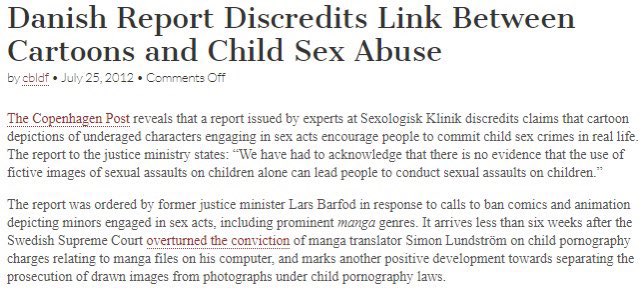
Dismissing court findings and psychological studies without engagement doesn’t make your position correct, and the morality you’re appealing to is artificial. Moral judgments should be grounded in the presence of real-world harm.
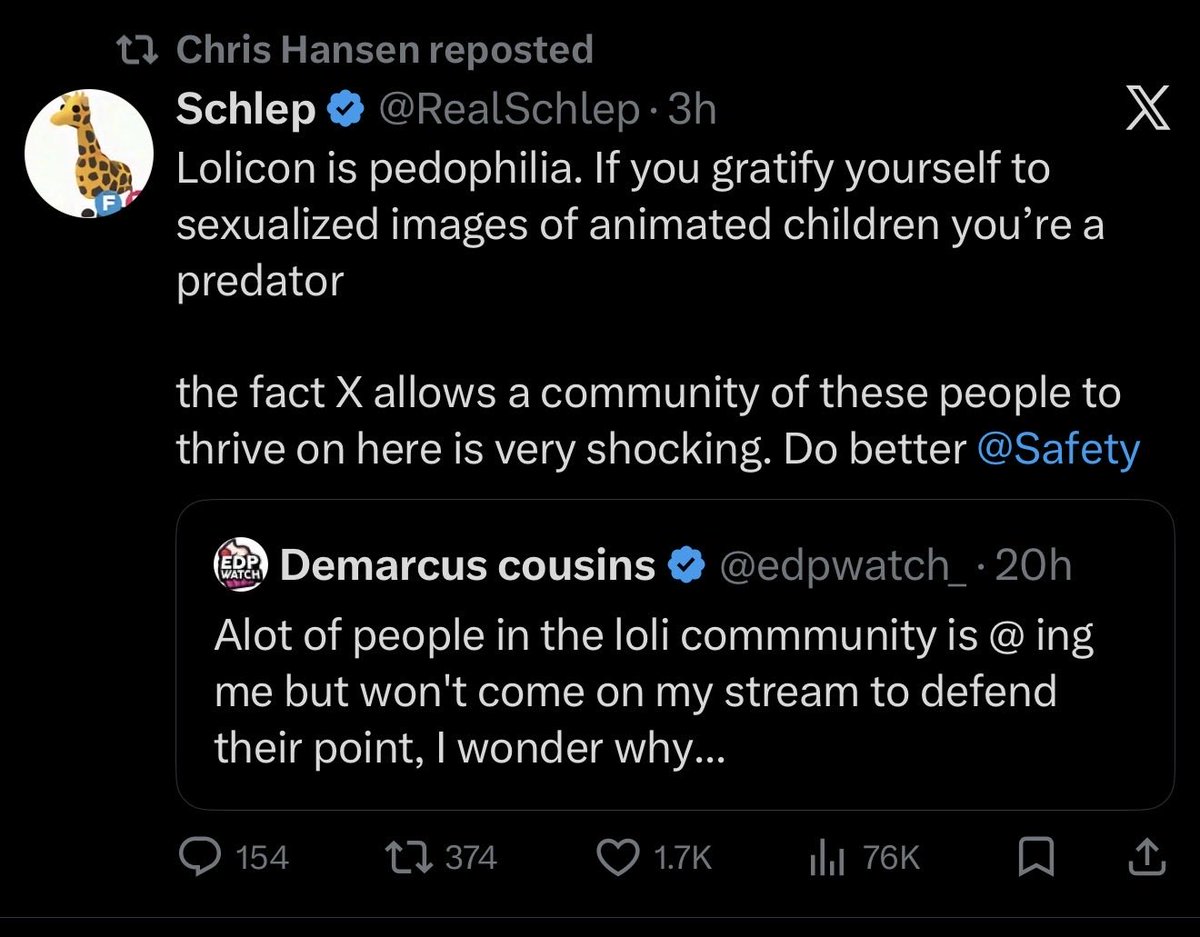
Dude, everything you’re saying about this is just rooted in pure emotion. There’s no logic or regard for what’s actually true. Psychology and the law both tear apart your claim that lolicon is pedophilia, so I don’t understand why you’re trying so hard to push something that simply isn’t true. Getting banned from Roblox shouldn’t just be some automatic pivot to worrying about trivial shit.
Grooming is a direct action that can only be carried out against real human beings. Simply liking a fictional character cannot constitute grooming. Age in fiction is merely a narrative label and does not carry the biological or legal weight that age has in the real world. Therefore, using a fictional character’s stated age to argue that lolicons are pedophiles does not hold. Additionally, loli characters are not bound to a fixed age range, as they can be assigned virtually any age.