Excited to share MolCryst-MLIPs — an open database of fine-tuned MLIPs for molecular crystals 🔬
9 validated potentials + full DFT datasets. More systems coming soon!
📄 https://t.co/CDGfH3ev1T
🗄️ https://t.co/CHAqRvXHZC
#CompChem#MLIP#MachineLearning
💡 New preprint out!
Scaling gas–surface simulations from AIMD to 100k+ trajectories with MLIP.
Efficient sampling + active learning → compact datasets, near ab initio accuracy, detailed scattering physics (energy transfer, rotation, scattering regimes)
https://t.co/xBnrga23pQ
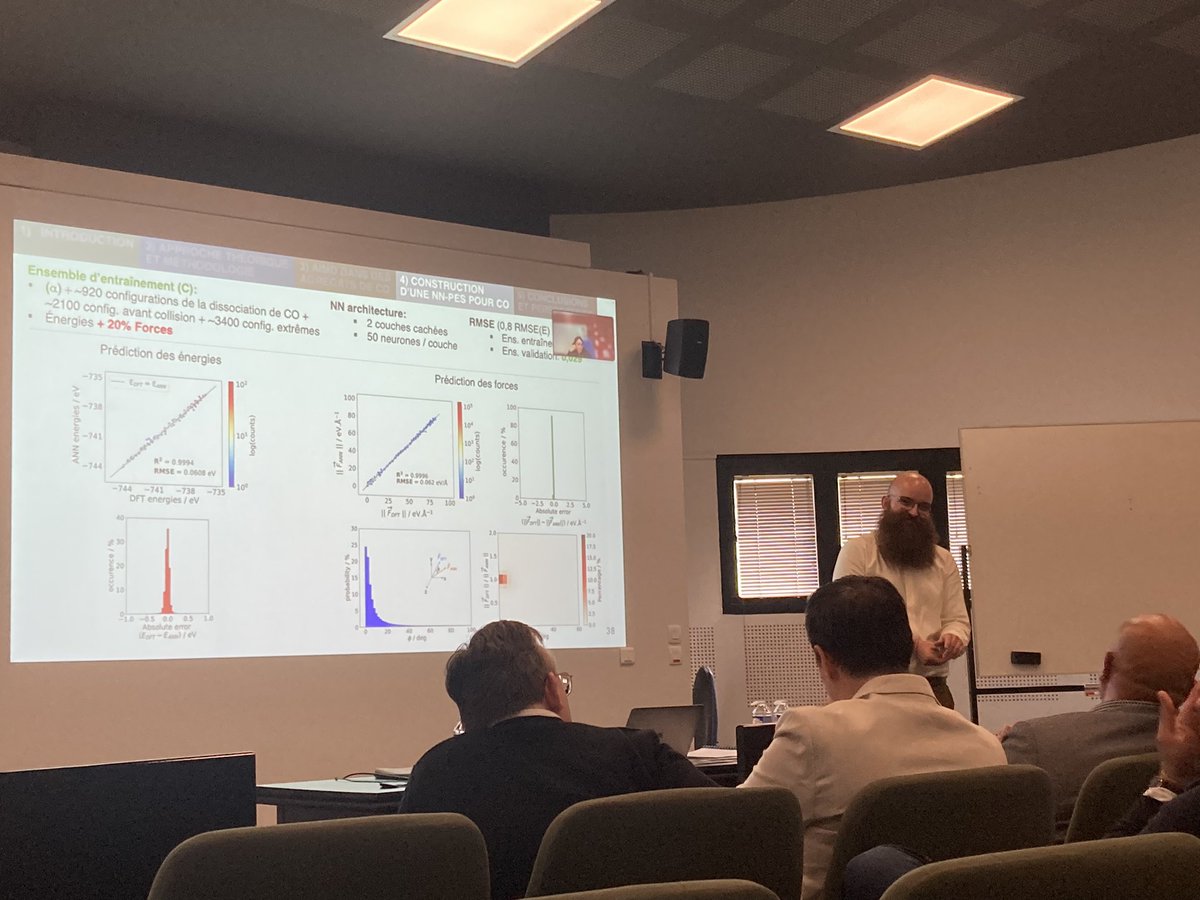
Presented my work at Institut Chevreul on how machine and deep learning advance molecular simulations — from interstellar ices to irradiated metals, from photon-induced desorption to defect detection, bridging astrochemistry and materials science.
#AI#MachineLearning#compchem
🎉📣 New paper out! We present a deep-potential ML model enabling large-scale, faster molecular dynamics of CO ice to probe photodesorption and energy transfer (rotation/translation/vibration).
https://t.co/5Rwa8hJGJX
#MolecularDynamics#Astrochemistry
🔭🌌 Check out our new paper on the experimental and theoretical analysis of the rotational and translational energy distributions of photodesorbed CO from CO ice 👉🏻 https://t.co/0DrSwoRTG6
Excited to launch our first machine learning workshop at @nyuniversity with @PhilippHoellmer!
We’re introducing the fundamentals of to students across departments.
The first session has just begun!
#compchem
#Budget2025 Universités en danger ✊
Beaucoup de monde sur le perron du siège de l’université pour la conférence de presse organisée par le président Régis Bordet en cette journée de fermeture exceptionnelle.
🤝 @lillefrance
A DEROULER 👇
Happy to share my first scientific article in @JPhysChem, providing new insights into the catalytic oxidation of NO to NO2 at ambient temperatures on oxygen-functionalized graphite! Check it out here 👉 https://t.co/6cCYDQxojX @Phlam_Labo @labexcappa@CNRS_HdF @univ_lille@ED_SMRE
BREAKING NEWS
The Royal Swedish Academy of Sciences has decided to award the 2024 #NobelPrize in Physics to John J. Hopfield and Geoffrey E. Hinton “for foundational discoveries and inventions that enable machine learning with artificial neural networks.”