Geopolitics and Strategic Affairs | Civilizational Perspectives and Research | Publications, Briefs, Academic Engagement, and Nurturing Emerging Scholars
#SharpScope April 2026 | India’s Oil Dependence and the Anatomy of Energy Vulnerability
India imports nearly 90% of its crude oil. Around half of it passes through the Strait of Hormuz. Strategic reserves remain critically limited.
In this Sharp Scope, data analyst Divyanka Tandon analysis examines:
* Oil import dependence
* Russia vs Gulf supply risks
* Hormuz chokepoint exposure
* Strategic reserve gaps
* Conflict shock scenarios
* India’s energy vulnerability outlook
A serious data-driven study on one of India’s biggest strategic risks.
Read more: https://t.co/YpUrSuoTdy.
#DataAnalysis #India #OilCrisis #StraitofHormuz
Myanmar’s Civil War and India’s Northeast: A Regional Crisis Unfolds
by @KumarSheni
• The crisis is now not seen only as a humanitarian problem, but as a strategic, demographic and security problem that impacts federal politics, border management and regional peace.
• The lack of a uniform refugee regime, as such, has therefore made the crisis a challenge to the federal structure and administrative coordination of India.
• The refugee situation has also exacerbated ethnic and political tensions in the North-East of India.
• The borderlands have become something of a strategic frontier, where humanitarian, security and geopolitical interests converge in the conflict.
Read more:
https://t.co/Pg8fL3hZGP
#CivilWar #Myanmar
Representation versus Recognition: Madhesi Identity in Nepal’s Emerging Political Order
By @KumarSheni
In Nepal, the question of Madhesis’ demands in the new political order remains stuck in a paradox, which is the difference between representation and recognition.
Balen Shah’s triumph was a symbolic success as it showed that a Madhesi-origin leader can win capital city support. But there needs to be greater shifts in state attitudes and public awareness.
The citizenship rights of citizens have long been problematic in Nepal, especially for women who are married across the India-Nepal border, and their children.
At the end, the future of Madhesis in the new political order of Nepal will rely on the state’s ability to overcome symbolic diversity to substantive inclusion.
Read more: https://t.co/osD3mdq2qF
#India #MadhesiIdentity #Nepal
UAE bids farewell to OPEC: A “Crude” necessity or a “Refined” move?
By Abhishek Kumar Singh @_sheksaab_
The UAE’s shift likely reflects a broader objective of maximising returns from its hydrocarbon reserves before global fossil fuel demand begins to decline more sharply.
Rather than remaining bound by Saudi-dominated OPEC arrangements that constrain its production and revenues, Abu Dhabi appears to be opting for greater strategic autonomy.
Jorge León, a former OPEC official, has argued that the cartel would become “structurally weaker” without the UAE, particularly given the concentration of spare production capacity among a small number of members.
From once playing a role akin to a central bank for the global oil market to now striving to maintain internal cohesion, OPEC has traversed a remarkable trajectory.
Read more: https://t.co/LyrOcbwLTR
#OPEC #UAE
India and Vietnam Are Closer Than Ever -The Timing Is No Accident
By @AayushPal55
India and Vietnam have agreed to elevate their relationship to an Enhanced Comprehensive Strategic Partnership, marking an important milestone, with cooperation expanding in trade, critical minerals, etc.
Defence and security cooperation has emerged as a new pillar of the relationship, while one of the biggest common concerns between India and Vietnam has been China.
For India, strengthening relations with Vietnam is part of boosting engagement with Southeast Asia under the Act East Policy, while for Vietnam, engagement with India is strategically advantageous as India is emerging as one of the next major forces in the global economy.
Read more: https://t.co/ms6i6EpUmC
#India #Vietnam
Coal, Power, and Pollution: Why India’s Energy Choices Still Choke Its Cities
By @AnusreetaDutta4
Indian cities are suffering because the country’s power grid relies too much on coal.
Urban India needs a steady supply of electricity, but the electricity that comes in often makes life in cities worse.
India needs to close down its dirtiest power plants faster, keep a closer eye on emissions, enforce the rules more strictly, and make a real push for renewable energy along with storage, grid reform, and demand management.
The real choice is between a future with less sickness and one with cleaner, more reliable energy. India needs to stop linking progress with coal dependence if it wants its cities to breathe.
Read more: https://t.co/CGKstbuvZM
#GreenEnergy #India #Pollution
From Minerals to Microchips: India’s Multi-Sectoral Strategy in Post-Conflict Sudan
By Hridbina Chatterjee
The 9th Foreign Office Consultations (FOC) between India and Sudan, which took place in Port Sudan on May 4, 2026, were an important step in strengthening the relaunch of diplomatic relations between both countries after a period of hiatus.
In 2026, one of the major talking points during consultations was the growing bilateral cooperation regarding the extractive industries and energy sectors.
The addition of Digital Public Infrastructure (DPI) in the 9th FOC reflects the contemporary development of relations between India and Sudan.
The Port Sudan meeting encompasses more than just bilateral trade; it also encompasses broader geopolitical factors surrounding the Red Sea region’s balance of power.
Read more: https://t.co/8iRceTRRXr
#FOC #India #Sudan
From Trudeau’s Allegations to Carney’s Reset: How Canada Is Rethinking Khalistan
By @AayushPal55
Canada’s intelligence agency has identified Khalistani terrorism as a national security threat within Canada.
Bilateral relations deteriorated sharply in 2023 when Trudeau accused the Indian government of involvement in the killing of Hardeep Singh Nijjar. India firmly rejected these allegations.
Since 2024, with the arrival of the new Canadian Prime Minister Mark Carney, relations between India and Canada have entered a phase of reset. The new leadership has demonstrated a more pragmatic approach.
The recent report by Canada’s intelligence agency is a positive signal. It reflects a shift toward realism and an acknowledgement of security concerns that India has consistently highlighted.
Read more: https://t.co/PC2lu5lE4i
#Canada #India #Khalistan #KhalistaniMovement
The Indian Diaspora and Australia’s Indo-Pacific Turn
By @AnjSinghg
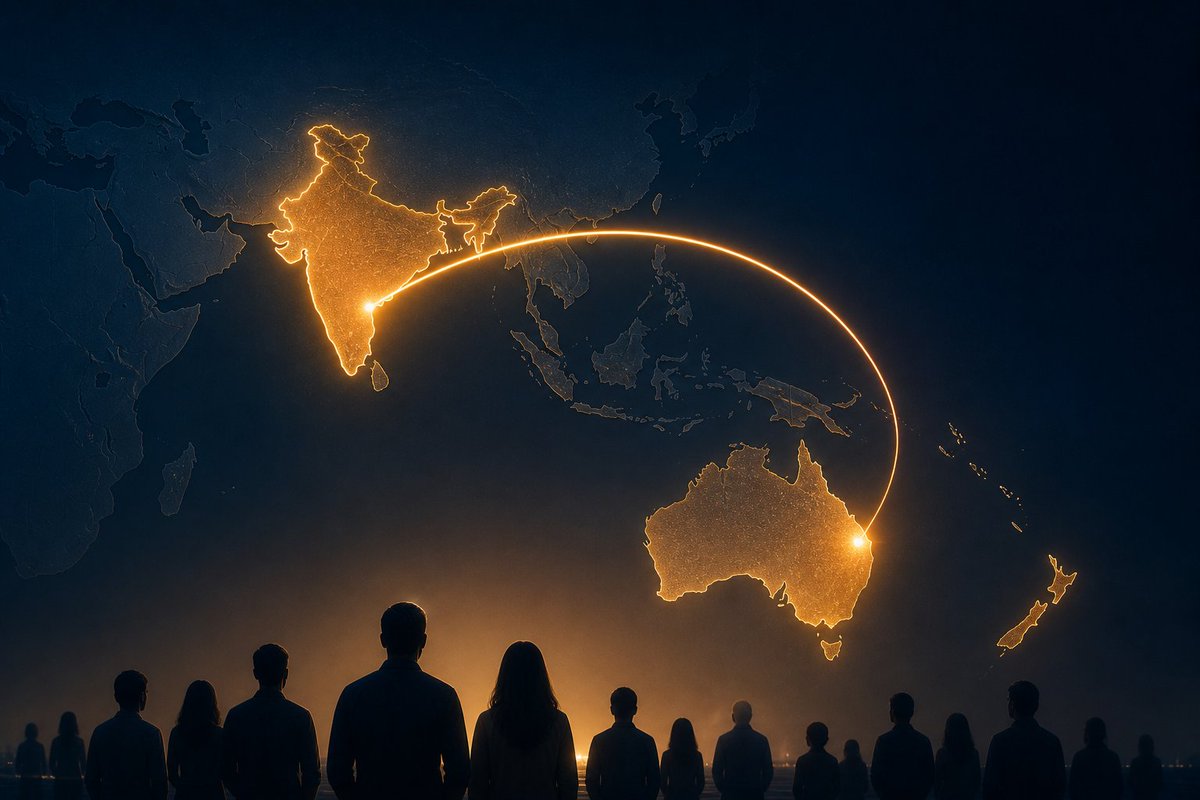
India-born citizens are now Australia’s largest immigrant population, which represents a historic demographic change with important ramifications for regional geopolitics, internal politics, and international relations.
Migrants from England, who had dominated the population since colonial times, have been surpassed for the first time in more than a century, signifying Australia’s shift from a Eurocentric identity to a more Indo-Pacific orientation.
Skilled migration from India improves human capital and increases economic interdependence between Australia and India, especially in industries like IT, healthcare, and education.
Read more: https://t.co/ryLqAlfAXT
#Australia #India #Migration
Bharatiya Cinema and the Responsibility of Influence
By @AnandaMathews
Cinema in Bharat has long held a unique and far-reaching influence, extending well beyond entertainment into the cultural identity of millions.
At its core, cinema does more than tell stories—it shapes perception.
Those who create and contribute to Bharatiya Cinema are not merely producing entertainment—they are participating in a global cultural dialogue, one that shapes how individuals understand identity, purpose, and coexistence.
Read more: https://t.co/1rZPswtfno
#BharatiyaCinema #Cinema #India
Wellington’s Wager: Why New Zealand Chose India in an Age of Uncertainty
By @AayushPal55
In a landmark bilateral development, India and New Zealand have agreed on a Free Trade Agreement allowing 100 per cent duty-free access to Indian products in New Zealand.
New Zealand has also agreed to invest 20 billion dollars in India over the next 15 years.
India has taken a cautious and pragmatic approach by excluding the dairy sector.
Read more: https://t.co/KOWcEMT8Sz
#FreeTradeAgreement #India #NewZealand
QUAD: A Concert Without Conductors
By @AayushPal55
The Indo-Pacific accounts for nearly two-thirds of global GDP, roughly 60 per cent of global maritime trade, and close to 70 per cent of seaborne energy flows. More than 80 per cent of the world’s goods transported by ships move through Indo-Pacific sea lanes and chokepoints.
This growing assertiveness was closely observed by India, the United States, Japan, and Australia. Another important factor was the leadership alignment among these countries after 2016.
However, post-pandemic, significant changes took place within the Quad countries due to leadership transitions. These leadership changes impacted the functioning of the Quad.
Despite these challenges, the potential of the Quad remains intact. However, the current phase reflects strategic uncertainty and reduced cohesion.
Read more: https://t.co/oE9RQsEG4l
#Australia #India #Japan #QUAD #USA
Middle Powers Reshaping Global Order: UAE, Turkey, Indonesia, and India
By @AnusreetaDutta4
Countries like the UAE, Turkey, and Indonesia are no longer just “ in the middle”; rather, they are becoming major players in business, banking, logistics, and culture.
The number of intermediate powers has roughly doubled since 1991, and together they now have more material power than the great powers.
This is a structural change, not a temporary change, and it shows that the system is moving toward a more scattered, multipolar one.
India’s geopolitical strategy is way more adaptable. It is still a major player in BRICS and the G20, and it is expanding its role in the Quad.
Read more: https://t.co/InSRTNuTTe
#India #Indonesia #MiddlePowers #Turkey #UAE
The Silicon Siege: How the West Asian Crisis Rebuilt the Military-Industrial Complex
By @Paraggilada
With the inclusion of venture-backed tech giants, or the “Silicon Insurgents”, the triangle has changed into a diamond. Companies that were once in the business of social media algorithms are now designing and building the “algorithms” of the “algorithmic kill chain,
West Asia has now become a live-fire laboratory of experimental technology that is undergoing “battle-testing” for future international applications.
For the first time, artificial intelligence (AI) & machine learning platforms such as Maven are processing satellite imagery, signals intelligence, and real-time data in order to identify ground-based military targets over the Iranian plateau with minimal human involvement.
The military-industrial complex has emerged from the shadows into full view as a “supplier of war” and will no longer remain a silent partner in foreign policy.
Read more: https://t.co/nAQUq9OS8R
#MIC #WestAsia
Zero- Sum Security: How Washington’s Gulf Pivot Could Leave Ukraine Defenseless
By Shivendra Shukla
The U.S. Department of Defense reportedly diverted nearly $750 million from the Prioritised Ukraine Requirement List (PURL) to replenish rapidly depleting American weapons stockpiles.
Intensive military operations in the Gulf after Operation Epic Fury have consumed large numbers of Patriot and THAAD interceptors, exposing a serious strain on U.S. ammunition reserves.
America’s defense industry is struggling to replace advanced weapons fast enough, creating a widening gap between production capacity and battlefield consumption.
A prolonged U.S. strategic shift toward the Gulf could weaken Ukraine’s access to critical advanced air defense systems, increasing its vulnerability against Russian missile and air attacks.
Read more:https://t.co/adrD2q3v6v
#PURL #USStateDepartment #USA
Zombie Multilateralism: Why the United Nations Must Change or Fade Away
By Abhishek Kumar Singh (@_sheksaab_ )
The UN’s inability to address the prevalent issues shows that it is no longer a “universal” body but a bystander to this new era.
Simply put, the UN of today cannot and should not be represented by the UNSC of yesterday.
A single veto-wielding power can stop international response dead in its tracks and totally frustrate the will of the overwhelming majority of the international community.
The idea that the UN still moves and talks, but has no soul or actual life-force left is akin to Zombie Multilateralism.
Read more: https://t.co/NYi9srPYa9
#UnitedNations #ZombieMultilateralism
India’s Economic Statecraft in the Maldives: Strategy, Stability and Influence
By Anjali Singh (@AnjSinghg)
Under the SAARC Currency Swap Framework, India approved the first ₹30 billion withdrawal for the Maldives, indicating ongoing financial support and bolstering its strategic position in the area.
From the perspective of international relations, the action represents India’s use of economic statecraft, which is the use of financial instruments to further geopolitical objectives.
Further, the development is in line with India’s “Neighbourhood First” strategy and Vision MAHASAGAR, which place a high priority on regional connectivity and stability in the Indian Ocean Region.
Ultimately, India’s approval of the ₹30 billion withdrawal is a deliberate intervention that combines geopolitical intent with economic help, rather than just a financial transaction.
Read more: https://t.co/QLmzpjKbNn
#CurrencySwap #India #Maldives #NeighbourhoodFirstPolicy #SAARC
#SWGeoFrames Cyber Warfare Between China and India: A 30-Year Geopolitical and Data-Driven Analysis
1/ Cyber-attacks are not isolated incidents but part of broader geopolitical strategies designed to undermine adversaries without confrontation.
2/ With the emergence of quantum computing, AI-powered attacks, and more sophisticated APT groups, the cyber warfare landscape will become increasingly complex.
#AI #APT #China #Cyberattacks #Cybersecurity #Cyberwarfare #DataAnalysis #India
#SWGeoFrames Cyber Warfare Between China and India: A 30-Year Geopolitical and Data-Driven Analysis
1/ Cyber warfare has emerged not only as a tool for espionage but also as a means to exert economic pressure, disrupt social stability, and influence geopolitical narratives.
2/ The cyber domain has effectively become the new frontier of Indo-China rivalry, where borders are invisible, and the damage can be catastrophic.
#AI #APT #China #Cyberattacks #Cybersecurity #Cyberwarfare #DataAnalysis #India
#SamvadaUpdate India Pushes Trade Diversification at Ontario Roundtable
India’s Consul General @MahavirSinghvii took part in the International Trade Diversification Roundtable hosted by Ontario Premier Doug Ford, alongside Economic Development Minister Victor Fedeli and Parliamentary Assistant Will Bouma, with participation from 16 senior diplomats across Europe, Asia, and South America. @fordnation@VictorFedeli@WillBoumaBrant
Singhvi highlighted the strong economic complementarities between India and Ontario, particularly in AI, advanced manufacturing, aerospace, clean energy, critical minerals, and technology innovation.
He pointed to Ontario’s academic strength and startup ecosystem as key drivers for expanding joint research, co-investment, and innovation partnerships.
Emphasising India’s evolving global role, he noted the country’s shift toward comprehensive economic partnerships—integrating trade, investment, services, and resilient supply chains—positioning India as a central node in global commerce.
@HCI_Ottawa@MEAIndia@DrSJaishankar@IndianDiplomacy@CanadainIndia@ONeconomy@DoC_GoI@investindia@ficci_india@FollowCII@ASSOCHAM4India@investontario
#IndiaCanada #TradeDiversification #IndiaOntario #GlobalTrade #EconomicPartnership #InvestInIndia #SupplyChains #AI #CleanEnergy #CriticalMinerals