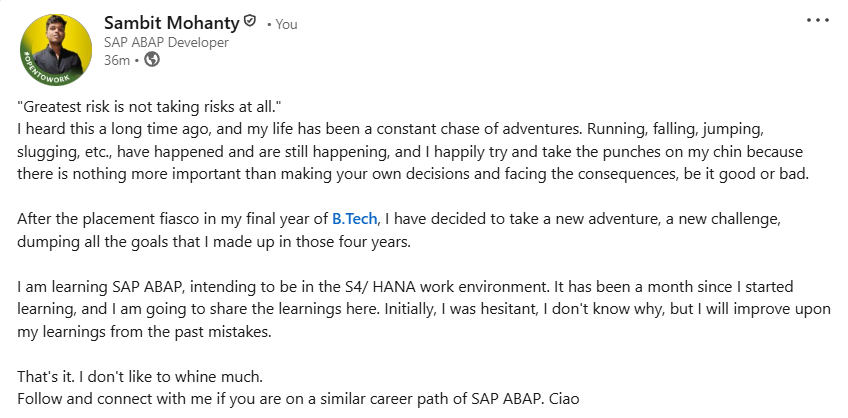
It's been a while since I posted anything serious here. Long story short, after a year of sitting and struggling to get a job, I finally got into TCS. It was so weird, what I was doing. I want to learn as fast and as much as I can, and switch after a year.
So I am starting fresh.
Sarvam Epoch | Chapter 1
Join us for the first edition of Sarvam Epoch, our flagship AI conference, in Bengaluru.
Across the two days, we will share new model updates, launch new products, present our latest research, and host hands-on technical workshops.
Builder Edition, 30 July | Enterprise Edition, 31 July
Register here: https://t.co/WD4z1oovEC
Are you learning SAP ABAP or enthusiastic about it, but don't know where to start ? Ever wondered what the history of SAP is and why it is an integral part of all enterprises ? Then you should give this piece of blog a read.
(link in comments )
@LinkedInHelp, I am trying to log in through Google, and it then verifies through otp. Still, I can't log in to my account. I tried clearing my cache and other browsers. Please look into it.
There's a consumer insight I can't shake: future nostalgia. Not the Dua Lipa kind, but something more fundamental about how generational wants are evolving in India at breakneck speed.
For our parents, there are two distinct kinds of nostalgia that define their consumer memory: pre-liberalization and post-liberalization.
Pre-lib nostalgia is hand-ground masalas, neighborhood kirana stores, joint family Sunday lunches, Ambassador cars, Doordarshan serials, handwritten letters, and local festivals untouched by commercial branding. It's the memory of scarcity that felt like abundance because it was all you knew.
Post-lib nostalgia is early cable TV, the first Maruti cars, initial mall experiences, landline phones, physical music cassettes, and the genuine excitement of "foreign" brands arriving on Indian shores. It's the memory of access feeling revolutionary.
For us millennials, our nostalgic anchor is post-lib, pre-internet: Orkut profiles, text messaging limits, physical video game cartridges, waiting for downloads, MTV and Channel V, early mobile phones as status symbols, internet cafes, and the tactile experience of shopping before everything went online.
But here's where it gets interesting.
The generational cycle is compressing. Gen X to millennial took about 15 years. Millennial to Gen Z took 7-8 years. Gen Z to Gen Alpha is happening even faster.
This isn't just demographic pedantry. The time between generational wants shifting is shrinking because each generation is accessing the internet sooner and faster than the last.
Gen Z's future nostalgia is already forming around the last moments of "effort" and "waiting”: the final generation to remember buffering, to have experienced both physical and digital music, to remember when social media required a computer. Their nostalgia centers on Instagram before Reels, early gaming communities, the brief moment when having an iPhone meant something, and physical books existing alongside Kindles.
Gen Alpha's future nostalgia is the most fascinating. They're the first truly post-scarcity generation in terms of content and entertainment. Their nostalgia might be about things being "harder to get”: remember when you had to physically go places? Remember when content wasn't infinite? Remember when AI couldn't create anything you wanted instantly?
This compression shows up most clearly in how each generation defines meaningful experiences.
Mom's generation: Stapu (physical, local, spontaneous)
• Happened in your gully
• Required nothing but chalk and friends
• Zero adult mediation
• Pure physical joy
Our generation: Shiamak Dawar/Danceworx dance classes (structured, aspirational, skill-building)
• Required enrollment, payment, traveling to a "destination"
• Adult-facilitated but youth-focused
• Building toward something: performance, skill, belonging
• Very city-specific cultural marker
Gen Z: Not concerts (concerts are too millennial, too much planning, too expensive, too "event-ified") Instead: pop-up experiences that appear in their feed, café-hopping with aesthetic documentation, gaming sessions, thrift shopping as social activity, spontaneous group orders where the ordering process itself becomes the hangout, "getting ready" together virtually, micro-adventures triggered by Reels.
Their experiences are ambient social: less structured than dance classes, more digital-native than stapu, but still requiring some physical presence and effort.
The pattern emerges: Physical purity → Structured aspiration → Ambient digital-physical hybrid → ?
What Makes Future Nostalgia?
Not everything becomes nostalgic. There's a crucial difference between what sticks and what doesn't.
I think a solid 1/1 is matcha versus Labubu. Matcha has depth, ritual, learning curve, cultural weight. It's experiential and has room for mastery. Labubu is pure aesthetic consumption without depth. Future nostalgia needs friction, story, some "you had to be there" quality.
The shapers of this nostalgia are shifting too. We've moved from traditional media gatekeepers to algorithm-driven micro-influencers and platform dynamics. TikTok can create a nostalgic feeling for something that happened six months ago.
For brands and businesses, this acceleration means traditional generational marketing is obsolete. By the time you've figured out millennial preferences, Gen Z has moved on. By the time you've cracked Gen Z, Gen Alpha is already forming different wants entirely.
The companies that will win are those that can identify what has the ingredients for future nostalgia: depth, ritual, some degree of effort, cultural resonance, and build around those elements before they become obvious.
The question isn't what Gen Z wants now. It's what they'll miss when it's gone.