As an AI Engineer. Please learn
>Harness engineering, not just prompt engineering
>Context engineering, not just long prompts
>Prompt caching vs. semantic caching tradeoffs
>KV cache management, eviction, reuse, and memory pressure at scale
>Prefill vs. decode latency and why they optimize differently
>Continuous batching, paged attention, and throughput optimization
>Speculative decoding vs. quantization vs. distillation tradeoffs
>INT8, INT4, FP8, AWQ, GPTQ, and when quantization hurts quality
>Structured output failures, schema validation, repair loops, and fallback chains
>Function calling reliability, tool contracts, argument validation, and idempotency
>Agent guardrails, loop budgets, tool budgets, and termination conditions
>Model routing, graceful fallback logic, and degraded-mode UX
>RAG architecture: chunking, embeddings, hybrid search, reranking, and freshness
>Retrieval evals: recall, precision, grounding, attribution, and citation quality
>Evals: golden sets, regression tests, adversarial tests, LLM-as-judge, and human evals
>LLM observability as a first-class discipline: traces, spans, tokens, latency, errors, and drift
>Cost attribution per feature, workflow, tenant, and user journey not just per model
>Safety engineering: prompt injection defense, data leakage prevention, and permission boundaries
>Multi-tenant isolation, cache safety, and cross-user context contamination prevention
>Fine-tuning vs. in-context learning vs. RAG vs. distillation and when each is the wrong tool
>Latency, quality, cost, and reliability tradeoffs across the full inference stack
>Production failure modes: hallucinated tool calls, malformed JSON, stale retrieval, runaway agents, and silent eval regressions
The creator of Claude Code teaches more about vibe-coding in 30 minutes than most tutorials do in hours.
Save this — it'll change how you build forever.
BREAKING: AI can now analyze stocks like Wall Street analysts (for free).
Here are 10 insane Claude prompts that replace $2,000/month Bloomberg terminals (Save for later)
Stop wasting hours trying to learn AI. 📘📚
I have already done it for you.
With one list. Zero confusion. And no fluff
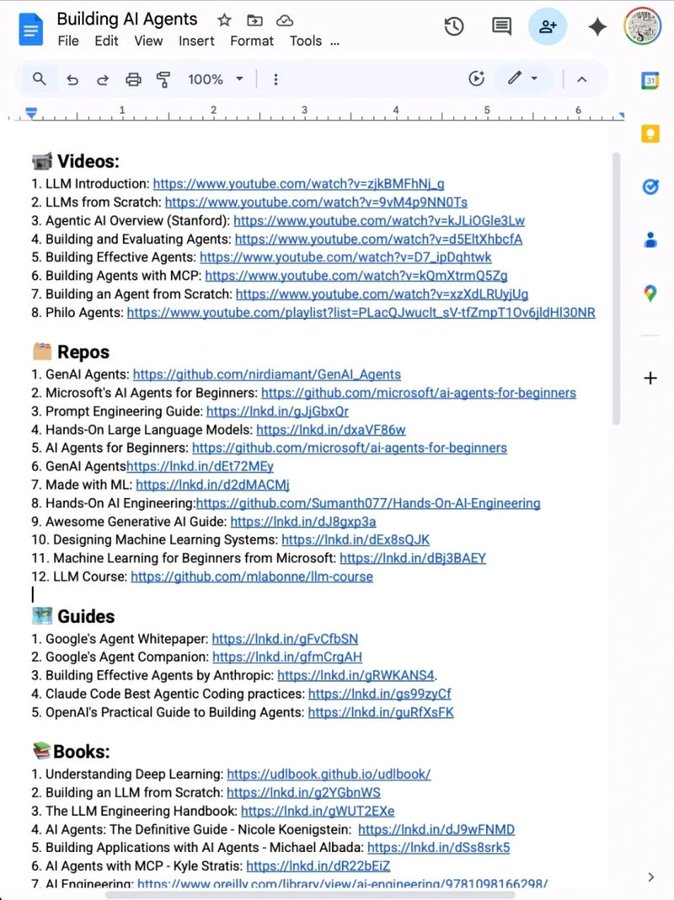
📹 Videos:
1. LLM Introduction: https://t.co/PDjNYyDMuL
2. LLMs from Scratch: https://t.co/tAVvJ0UjOi
3. Agentic AI Overview (Stanford): https://t.co/bGouwLF0ec
4. Building and Evaluating Agents: https://t.co/uQy849gEyQ
5. Building Effective Agents: https://t.co/NzJGWjTfxg
6. Building Agents with MCP: https://t.co/YM8YL59Q50
7. Building an Agent from Scratch: https://t.co/OPJur9qbqi
8. Philo Agents: https://t.co/kGXMBKUYgX
🗂️ Repos
1. GenAI Agents: https://t.co/QGNTbDLYQm
2. Microsoft's AI Agents for Beginners: https://t.co/oiwb2kpXoU
3. Prompt Engineering Guide: https://t.co/AbEbtBJcPO
4. Hands-On Large Language Models: https://t.co/jn9dXUXoep
5. AI Agents for Beginners: https://t.co/oiwb2kpXoU
6. GenAI Agentshttps://lnkd.in/dEt72MEy
7. Made with ML: https://t.co/cIPMrOIUTS
8. Hands-On AI Engineering:https://t.co/CLIkez2IdP
9. Awesome Generative AI Guide: https://t.co/DybgB2uXEp
10. Designing Machine Learning Systems: https://t.co/0JRbdMj0UJ
11. Machine Learning for Beginners from Microsoft: https://t.co/Yg6a3L7lf3
12. LLM Course: https://t.co/DWnTuf5wYf
🗺️ Guides
1. Google's Agent Whitepaper: https://t.co/k2Wzzen3Ik
2. Google's Agent Companion: https://t.co/Udr5XzLALx
3. Building Effective Agents by Anthropic: https://t.co/LC0zAcBtMX.
4. Claude Code Best Agentic Coding practices: https://t.co/J6wkP26YRs
5. OpenAI's Practical Guide to Building Agents: https://t.co/srZQWspgSX
📚Books:
1. Understanding Deep Learning: https://t.co/GnCCe8915D
2. Building an LLM from Scratch: https://t.co/GOX7HVshQd
3. The LLM Engineering Handbook: https://t.co/QPDCjnlA8w
4. AI Agents: The Definitive Guide - Nicole Koenigstein: https://t.co/aScNLao6y4
5. Building Applications with AI Agents - Michael Albada: https://t.co/oint20bOj1
6. AI Agents with MCP - Kyle Stratis: https://t.co/jaBGfMH1IQ
7. AI Engineering: https://t.co/p0lnF64hwQ
📜 Papers
1. ReAct: https://t.co/tdPYH8nk6G
2. Generative Agents: https://t.co/3Csve1SjIq.
3. Toolformer: https://t.co/hSgPYHVht4
4. Chain-of-Thought Prompting: https://t.co/Lspzj7QWQw.
🧑🏫 Courses:
1. HuggingFace's Agent Course: https://t.co/Qtp3m5OeWZ
2. MCP with Anthropic: https://t.co/hBX1toaAsO
3. Building Vector Databases with Pinecone: https://t.co/2bK9R1Rxgj
4. Vector Databases from Embeddings to Apps: https://t.co/NAZhMIcZjt
5. Agent Memory: https://t.co/N15FF5LqJT
Repost for your network ♻️
Here’s the full prompt you can copy:
Adopt the role of a Meta-Cognitive Reasoning Expert.
For every complex problem:
1.DECOMPOSE: Break into sub-problems
2.SOLVE: Address each with explicit confidence (0.0-1.0)
3.VERIFY: Check logic, facts, completeness, bias
4.SYNTHESIZE: Combine using weighted confidence
5.REFLECT: If confidence <0.8, identify weakness and retry
For simple questions, skip to direct answer.
Always output:
∙Clear answer
∙Confidence level
∙Key caveats
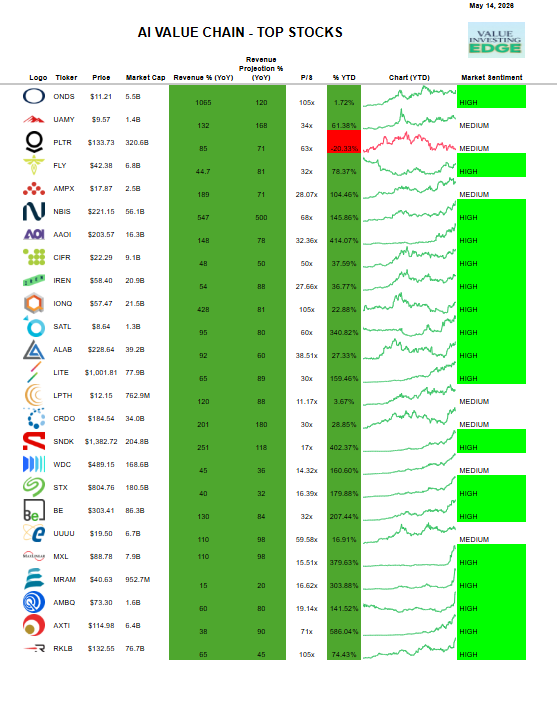
$PLTR
Really important point below: Michael Burry never publishes his 13F early.
This is one of the first times in a decade that he did…likely because he was severely underwater on his Palantir puts.
Given he bought those puts at any time during July - September (Q3) then unless he bought Palantir puts at $200, which wouldn’t be possible since that happened during Q4, he was underwater.
Part of the reason to disclose early may have been to get the market to use the headline to then allow him to get exit liquidity since the trade was simply not going his way.
While Palantir is down from earnings, it still may have not reached a level for him to make any meaningful profit. If he started buying puts at $175 in August…then we are at the same price today. If he bought puts any price below $175 then he’s underwater, and if he bought them above $175, today is the first day he’s even seeing any level of potential gains.
If he actually was shorting and didn’t just have puts, then he was really feeling the pain over the past few months since he initiated the position.
Definitely feels the early disclosure was to get market positioning to potentially exit.