#BOU2024#Sesh3 1/6: Urban Challenges: Urbanization profoundly alters the biotic and abiotic conditions shaping city bird lives. New urban challenges impact their phenotypes. 🏙️🦜
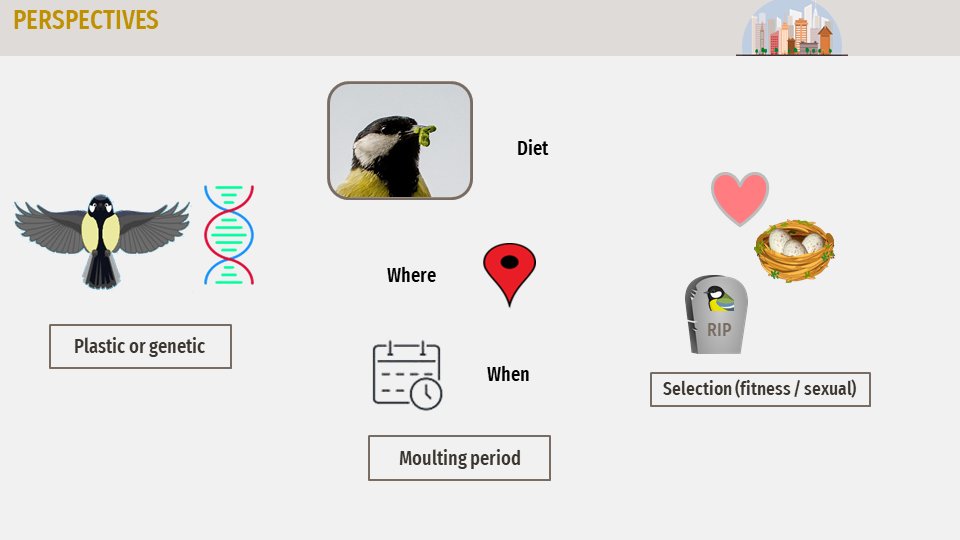
#BOU2024#SESH3 6/6 Understanding whether phenotypic changes stem from plasticity or genetics, assessing natural and sexual selection impact, and delving into conditions experiences during moulting are crucial to fully grasp urbanisation's effects on colouration.
#BOU2024#SESH3 5/6 Urban areas likely impact colouration due to carotenoid resource scarcity and moulting quality and time. Selective may favour more chromatic yearlings in cities or yearlings could be less efficient than older birds in foraging.
#BOU2024#SESH3 4/6 Analyses of the climate-habitat interaction reveal differing temperature sensitivities between habitats but there is no direct effect of temperature on colouration traits within habitats.
#BOU2024#SESH3 3/6 Urban birds appear duller with impacted feather structure compared to their forest counterparts. Notably, only 1-year-old birds seem duller in cities, revealing stronger sexual dichromatism in urban populations.
#BOU2024#SESH3 2/6 Using a 10-year dataset from monitoring of great tits in Montpellier and a forest nearby, we analysed colour variation, with chromatic and structural variables, in great tits between both habitats and its interaction with mean temperature during moulting.
#BOU2024#SESH3 1/6 Urbanisation and climate both create novel environments and shape phenotypes. With the urban heat island, urban areas can provide insights into future climate changes. However, the interaction between urbanisation and climate has not been investigated yet.