Health Promotion Expert: Passionate about promoting healthier lifestyles through physical activity. With degrees in Sport Science, Biokinetics & Public Health
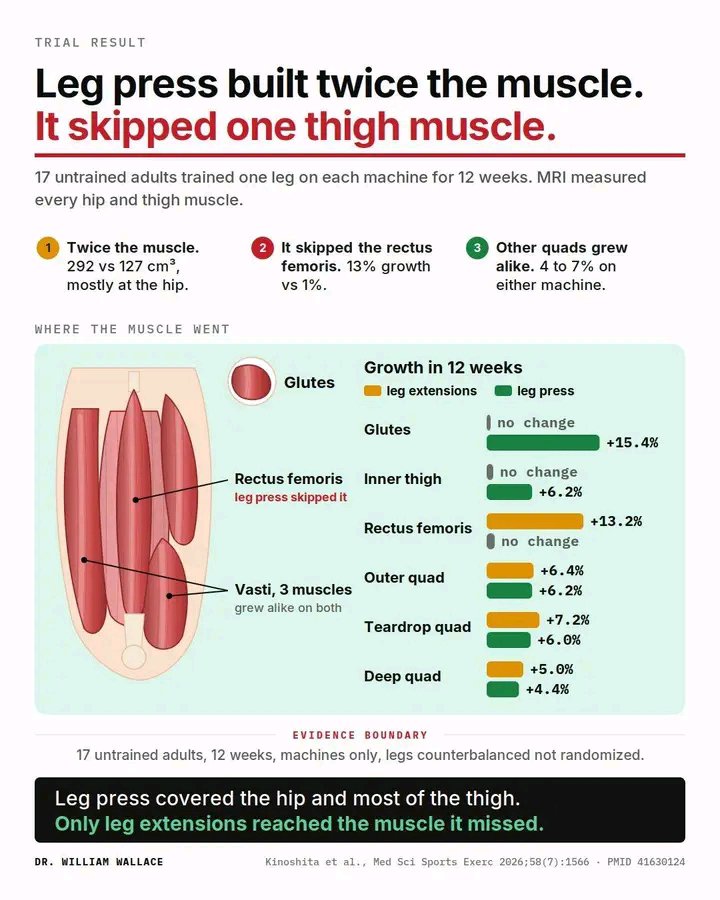
Leg press does not train the whole thigh, and leg extensions do not train the hip. Twelve weeks of MRI scans showed which muscles each machine left out.
Kinoshita and colleagues (Med Sci Sports Exerc 2026) had 17 untrained adults, 11 men and 6 women, train one leg on the leg
press and the other on the leg extension machine, five sets of ten at 70 percent of maximum, twice a week for twelve weeks. Because both legs belonged to the same person, diet, sleep and genetics were identical & MRI measured the volume of 17 hip & thigh muscles before and after
a muscle that matters for sprinting and kicking. A programme built on one machine alone leaves a measurable muscle untrained, and the scans show which one.
The scans describe a division of labour rather than a winner. Leg press covered the hip, the inner thigh and most of the quadriceps in one movement and added more than twice the total muscle, while leg extensions were the only one of the two to reach the rectus femoris,
so the gaps could change in experienced lifters. Both exercises used machines at a fixed seat angle, and a free-weight squat or a different backrest setting changes how far the hip bends and could change what the rectus femoris does.
whole-quadriceps growth of 7.1 percent on leg extensions against 4.9 on leg press was not a significant difference, so the two may or may not differ there. Legs were assigned by dominance rather than at random. Everyone was untrained, and beginners grow from almost any stimulus,
Ten weeks of squats give a similar map: knee extensors up about 5 percent, glutes up, rectus femoris unchanged (Kubo et al., Eur J Appl Physiol 2019).
Seventeen people is a small trial:
and neither moved on leg extensions. The three vasti, the bulk of the quadriceps, grew 5 to 7 percent on either machine. The rectus femoris grew 13 percent on leg extensions and 1 percent on leg press, a change indistinguishable from zero.
Across all 17 muscles, leg press added 292 cubic cm of muscle, a little over a cupful, against 127 for leg extensions, about half a cup. Most of that extra came from the hip: the gluteus maximus grew 15 percent and the adductor magnus on the inner thigh 6 percent on leg press,
Cyclists show the same pattern, with large single-joint thigh muscles and a rectus femoris no bigger than in people who do not train (Ema et al., Scand J Med Sci Sports 2016).
so a muscle that pulls the hip the other way is fighting the movement and the nervous system turns it down, which the study confirmed by recording its electrical activity.
The rectus femoris, the strip of quadriceps running down the centre of the front thigh, is the one quad muscle that also crosses the hip, where it works as a hip flexor. A leg press extends the hip and the knee together,