@Nithin0dha
"AI can make you more disciplined, but not smarter. And if you think about where most trading losses actually come from, that distinction matters more than people realise."
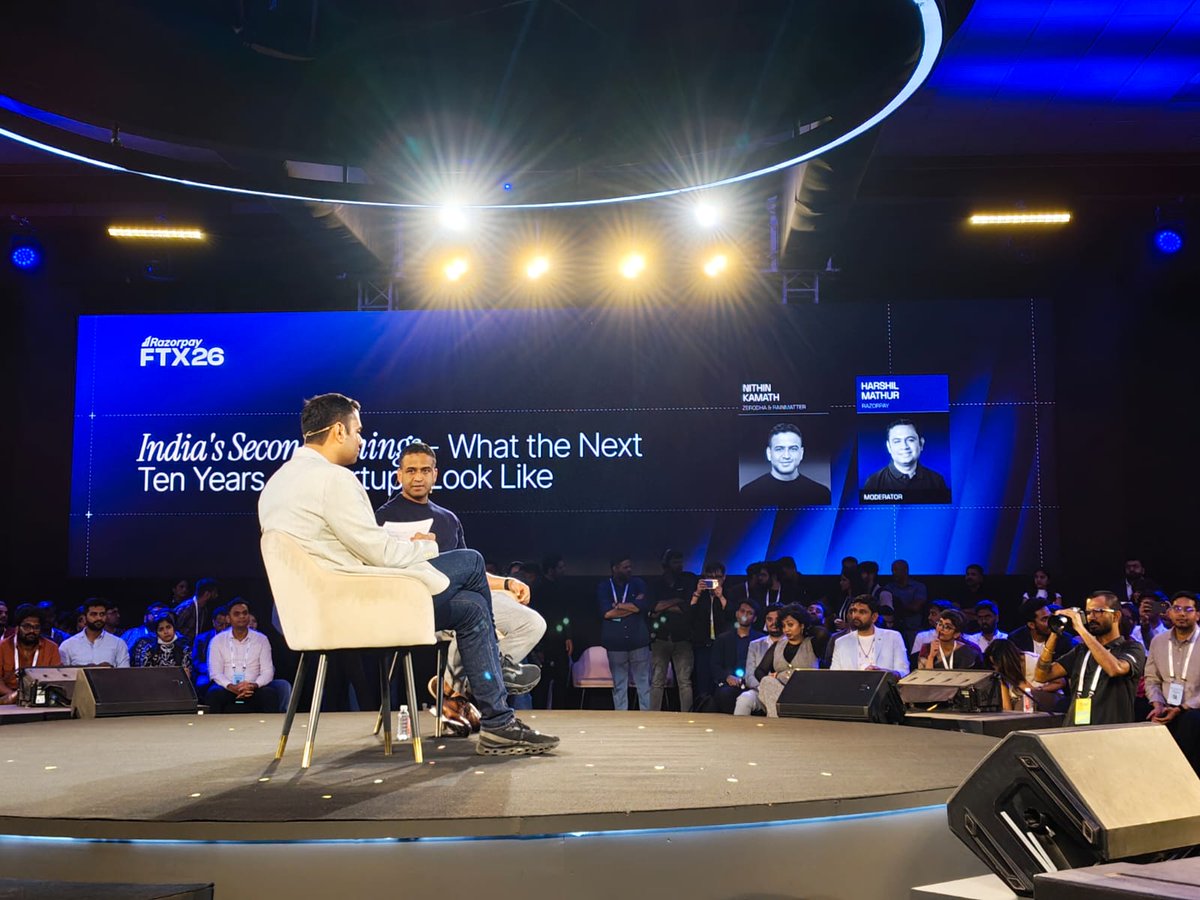
Heard you say this live at FTX '26 also. You ended with — "if you have an answer for controlling trader emotions, please write to me."
That line has lived in my head since.
We're building exactly what you just described at https://t.co/fKBlw4WJDG for more than a year now — An AI that integrates into systems and aims to make traders more disciplined, not smarter. No signals. No alpha promises. Just behavioural intelligence that forces you to confront yourself before, during, and after every trade like a mirror.
91% of F&O traders lose money. The market isn't the problem. Their Behaviour is. AI should help fix that.
Writing to you now. Grateful to you for validating our process. Would genuinely value the chance to show you what we’re building and hear your thoughts.
People keep asking me if AI can help them make money from trading. My honest answer is not really.
As long as there's a human in the loop, you're still dealing with the same creature driven by fear and greed, and that human will keep making the same mistakes. But beyond psychology, there's a bigger problem. There's no real informational edge left in markets. The odds are that everything is priced in. And even when it isn't, operating under that assumption is almost always a good idea.
The people actually making consistent money in markets are high-frequency trading firms, market makers, prop desks etc that have built infrastructural and data moats over years, with significant investment of time and capital. Those are real edges.
So, where does AI actually fit? It's a tool to help you behave better. Not to generate alpha.
What it can do is help you build and test strategies, then execute them systematically, removing emotion from the equation. That means fewer panic sells, less revenge trading, and more consistency. What it can't do is turn a bad strategy into a good one or create a magic money tree.
This is still an edge, just a different kind. AI can make you more disciplined, but not smarter. And if you think about where most trading losses actually come from, that distinction matters more than people realise.
No candles printing today. Study the ones from last week instead: which daily closes actually mattered, and which intraday spikes were noise in hindsight? Hindsight is only wasted if you don't take notes.
Plan the week before the week starts: which setups am I allowed to trade? What's my max daily loss? What's the one mistake from last week I refuse to repeat? Three answers, written down, before the next open.
Closed-market math homework: take your average win and your average loss this month. Divide. If that number is below 1, you need a win rate most traders never sustain. Better to learn that on a quiet day.
Nobody knows what the market does tomorrow. Not analysts, not FIIs, not AI, not this account. TA doesn't predict — it frames risk: where you're wrong, what's normal, what's changed. Anyone selling certainty is selling something else.
VWAP is where the average participant's money sits for the day. Price above it: buyers in control on average. Below: sellers. Intraday traders who ignore VWAP are trading against information institutions watch every minute.
I use general AI every day. But for trading I need three things a blank chat box can't give me: my actual numbers (computed, not guessed), my behavioral patterns over months, and guardrails that block advice I shouldn't take. Journal first, AI second. That's ArthaLearn.
Strategy tagging on ArthaLearn answers an uncomfortable question: which of your strategies actually make money? It's rarely all of them — and often not the one you enjoy most. Trade what works, not what's fun. Link in bio to run the check on your trades.
Revenge trading has a signature: a new trade within minutes of a loss, bigger than your average size, in a setup you'd normally skip. If you journal, you can literally see it. If you don't, you'll call it 'being decisive'.
Traders: what's the one rule you break most often, even though you know better? I'll start: moving my stop 'just this once'. Reply with yours — no judgment, we're all fighting the same wiring.
None of these show up on your chart. All of them show up in your P&L. Add up one month of contract notes once — the number changes how often you trade. (I check mine with ArthaLearn's brokerage comparison — free, link in bio.)
And the seventh, silent one: slippage — the gap between the price you clicked and the price you got. On market orders in fast moves, it's often bigger than all six fees combined.
STT, brokerage, exchange charges, GST, stamp duty, slippage. On small accounts trading frequently, costs quietly consume a huge share of gross profits. Compute your real cost per trade once. It changes behavior.
Step 3: risk per share = entry − stop.
Step 4: quantity = (capital × risk%) ÷ risk per share.
Size comes LAST, after the level. I do this in 10 seconds with ArthaLearn's position size calculator — free, no login. https://t.co/3xY7jFEF7L
Step 1: decide max risk per trade as a % of capital. Common range: 0.5-2%. This is a personal risk decision, not a market one.
Step 2: find your stop from the chart — the price where the setup is invalid.
Market breadth > index level. Nifty flat while the advance/decline ratio runs 3:1 negative tells you more than the index number does. The index is 50 stocks. The market is 2000.