Paid Partnership
Dusk is making privacy practical for financial applications. Its Layer-1 and XSC standard focus on confidential smart contracts while preserving useful on-chain functionality. That balance is what makes @DuskFoundation interesting to me. $DUSK #dusk
Paid Partnership
Dusk is building toward a future where financial applications can combine blockchain transparency with privacy. Its confidential smart contracts and XSC standard make @DuskFoundation worth watching. $DUSK #dusk
Paid Partnership
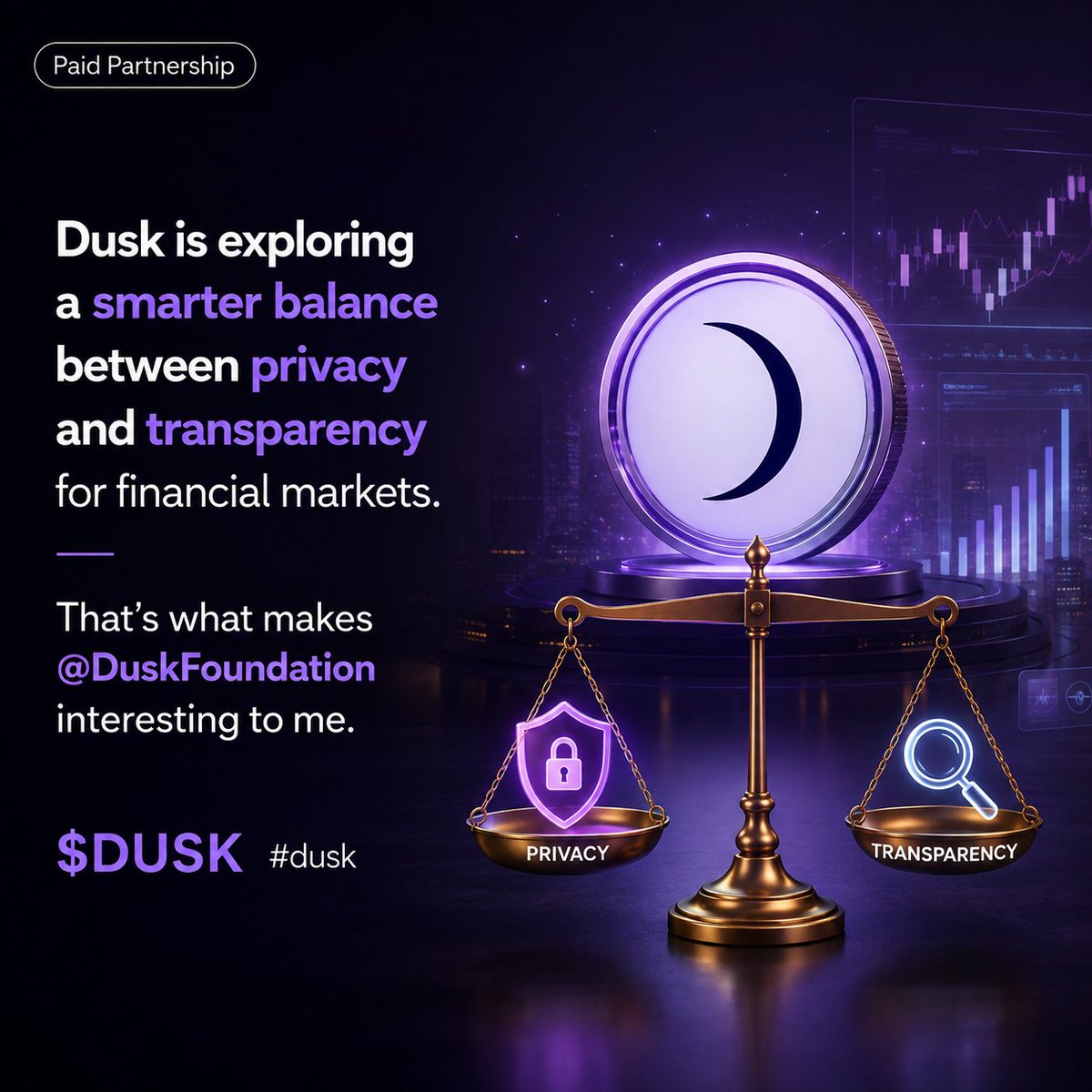
Dusk is exploring a smarter balance between privacy and transparency for financial markets. That’s what makes @DuskFoundation interesting to me. $DUSK #dusk
Paid Partnership
I’m starting to see @DuskFoundation less as a privacy project and more as an experiment in selective transparency—deciding who can see what, and when. That could matter a lot for financial markets.
$DUSK #dusk
Gen Z & Investing: A Different Approach to Money?
I keep noticing how different Gen Z’s relationship with money feels.
It’s not just that younger people are buying crypto or trading stocks. I think the bigger change is that they’ve grown up expecting financial markets to be accessible.
Everything is on the phone.
You can buy Bitcoin at midnight, move money across borders, research a company in minutes, or jump into a new token before most people have even heard about it.
That wasn’t normal for previous generations.
And honestly, I think that has changed the way people think about investing.
The old advice was simple: work hard, save money, buy a house, invest for the long term, and stay patient.
That advice still has value. But the world Gen Z is investing in looks very different.
There’s more opportunity.
There’s also a lot more noise.
I’ve seen traders buy something simply because everyone on their feed was talking about it. The price goes up, they feel like they made the right decision, and suddenly a trade becomes a “conviction.”
Then the market turns.
That’s when you find out whether you had a thesis or were just following momentum.
This is where I think Gen Z has an interesting advantage, but also a real weakness.
They’re comfortable with new financial tools. They’re curious. They’re willing to experiment.
But markets punish impatience.
📊 Price: Easier access means more people can participate, but access alone doesn’t create an edge.
📈 Change: Markets can move incredibly quickly now, especially when a narrative catches fire.
💰 Volume: I pay attention to whether volume actually supports the move or whether traders are simply chasing green candles.
🟢 Buyer pressure: Strong when buyers keep stepping in even after the initial excitement starts fading.
🔴 Seller pressure: Becomes important when early investors start taking profits and new buyers stop chasing.
🎯 Key levels: Support, resistance, and liquidity still matter. No amount of hype changes that.
⚠️ Risk: FOMO, leverage, low-liquidity tokens, and blindly following influencers can hurt badly.
So I don’t think Gen Z is necessarily better at investing.
They’re just playing a different game.
And maybe the biggest lesson is this:
Having access to markets is easy. Learning how not to lose money in them is the hard part.
That part hasn’t changed.. #Binance #BinanceAcademy #LearnWithBinance
Paid Partnership
Privacy and transparency don’t have to conflict. @DuskFoundation is exploring how confidential smart contracts can protect sensitive financial data while keeping rules verifiable. $DUSK #dusk