@ishmohit1@soicfinance Many congratulations to the entire team. @SOIC have been instrumental in making investing sensible and simpler for retail investors. Best wishes for the coming decades💐🥳
Respected @nsitharaman ji and @FinMinIndia ,
Suggestion 1 of 3 for strengthening India's capital markets:
Long-term capital gains tax on listed equities should be abolished.
A long-term shareholder is not a speculator but a provider of patient risk capital. By investing in and holding businesses, investors help companies expand, create jobs, innovate and contribute to India's economic growth.
India requires enormous amounts of long-term capital to build world class enterprises, infrastructure and global champions. Tax policy should encourage households to move savings from passive assets, including imported stores of value such as gold, into productive businesses that create jobs, generate tax revenues and build national wealth.
The appreciation in a company's value is not created in isolation. During its growth journey, the government already collects corporate tax, GST, income tax from employees, customs duties, stamp duties and numerous other levies. Long-term capital gains are often the final outcome of economic activity that has already generated substantial tax revenues.
Most importantly, tax policy should clearly distinguish between investment and speculation. A long term shareholder is a partner in wealth creation, not merely a participant in market transactions. Tax policy should reward long-term ownership of productive businesses and distinguish it from short-term speculation.
India needs more patient capital, more entrepreneurship and more long term investing. Abolishing long-term capital gains tax on listed equities would be a powerful step in that direction.
Respectfully submitted.
@LuckyInvest_ARK discovered @styleunion_in in Surat today, went in to explore. Felt the differentiation that one observes at Dmart compared to its competition. Neat, optimal use of the space, good staff behavior, smaller things taken care of to provide unique shopping experience
@adigitalblogger@WealthSolitaire Have seen this "den of wealth" 's messages in few whatsapp groups, frequent and promising multibaggers. And people are gullible to these fraudulent promises.
@1FinanceHQ thank you for sending over the 10th issue of the magazine. Really good coverage on how retirement ready is India. @BahlKanan and team is putting in real hard work behind each section. Kudos👏🏽
Rajeev Thakkar of PPFAS on future of Indian IT services industry.
“People are saying AI will replace developers, but if 5 out of 10 developers go away, overall costs will reduce.”
“Decreased costs in IT will have same effect as Discount brokers and Internet had in India.”
Gold isn't just an ornament; it’s a strategic asset. But the way we interact with it has remained largely "analog"—until now. The launch of Electronic Gold Receipts (EGRs) on the NSE isn't just another product launch; it’s a structural intervention.
https://t.co/GpfwLi9Jsk
Visited HDFC Bank and IDFC First Bank to open an SSY account.
Had to return empty handed because both the banks were trying to sell their ULIP plan.
Told my alignment towards SSY and they started showing cashflow projection.
I told them how much is the CAGR to which they conveniently told 8%.
I told them to show me 8% on calculator. The guy didn’t know anything how to calculate it.
Since I cleared my CFA Level 2, I taught him how to calculate IRR with financial calculator and shown him it’s 6% not even beating inflation.
He said there is insurance cover which one can claim after the death, and I told them I am not betting on my death here.
SSY gives 8% v/s their plan giving 6%.
Both the banks didn’t process my SSY application too.
I usually avoid responding to such posts that pop up from time to time. But when the comment comes from a well known handle like @abidsensibull , who himself runs one of the largest options platforms where 90–95% participants lose money in India, a clarification becomes all the more necessary.
Every few months, we see a similar hit and run narrative targeting mutual fund distributors and fund managers. Criticism is welcome but pls provide entire outlook. It helps to look at this issue from a few simple perspectives.
First, the role of an MFD is largely about managing investor behaviour. The debate of whether an investor should do DIY or go through a distributor is a personal choice. A DIY investor must be capable of understanding risk profile, risk appetite, asset allocation, scheme selection and most importantly the discipline to stay invested through cycles. Very few people actually tick all these boxes consistently.
Second, there is a large category of first time investors. For them, markets are unfamiliar territory. They need guidance on where to invest, how to stagger investments through SIP or lump sum and how to align expectations with reality. In difficult phases like the last 18 to 24 months where returns may have been flat, the real value of a distributor shows up. The job is not just about selecting funds. It is about protecting the investor from his own emotions and ensuring he stays invested long enough to participate in the next upcycle.
Third, there is a middle category of investors. They have spent a few years in the market and understand volatility, but still need help in building a structured portfolio. Here the role of the distributor shifts from hand holding to portfolio construction. Asset allocation, fund selection, thematic exposure, and calibrated risk taking become important. The expectation here is not just stability but also the ability to generate better outcomes than what the investor might achieve alone.
Finally, there are true DIY investors. They understand markets deeply, can handle drawdowns and manage portfolios with discipline. For them, a distributor may not be necessary. And that is perfectly fine.
What often gets ignored is the larger role mutual fund distributors have played in India. They have been instrumental in the financialization of household savings. For decades, savings sat in low return instruments like fixed deposits or idle assets. MFDs have helped move that capital into productive financial assets like mutual funds, which ultimately supports capital formation and economic growth.
Ultimately, the choice rests with the investor. But transparency is important. A distributor should clearly communicate the cost of distribution. If over ten years an investor ends up paying roughly 10 percent in commissions, the distributor must justify that by delivering value several times over.
That value may not always show up as extra percentage returns. Often it comes through behavioural coaching, disciplined asset allocation, expectation management and preventing costly mistakes during volatile phases.
And in investing, avoiding mistakes is often more valuable than chasing returns.
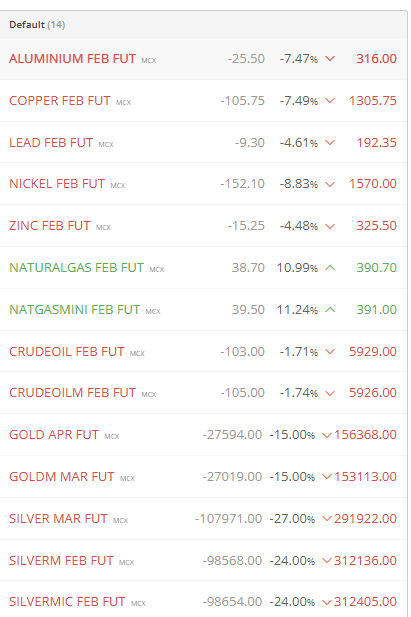
As a broker, there are rare days when risk management simply doesn't work, when markets move so violently that traders lose more than their entire initial margin. When this happens, both the trader and the broker are sitting ducks with no way out.
Yesterday was one of those days in commodity markets. All major metals hit lower circuits—the maximum they can move in a day. Silver crashed 30%, Gold 15%, and others followed. Btw, Natural gas was on an upper circuit.
In our 16 years of operations, we've only seen something like this once before: when Crude oil closed at a negative price during COVID. But that was just one commodity, and commodity trading wasn't nearly as popular as it is today.
What happened in commodities yesterday can happen in equities too; we saw it in 2008.
The lesson is simple but critical: only trade with money you can afford to lose. You can trade successfully for a decade and lose it all in a single day if you're not properly managing risk. There's no margin call, no exit opportunity when markets gap through circuits like this.
@HDFCBank_Cares We submitted the ReKYC documents at the branch on 30th December, 2025, the branch did not move the file for a week, started the process when I visited the branch again to follow up, and the process is still not completed.
I was invited by CFA Society India to present my Global Macro Outlook 2026, where I discussed how markets are entering a Brave New World shaped by rising sovereign debt, monetary realignment, shifting geopolitics, and capital rotation. The session examines the transition away from a US centric hegemonic system toward a multipolar global order, the implications for currencies and reserve assets, the growing role of gold, electrification and commodities, and why real assets are increasingly preferred over financial assets in this cycle.
Watch the full YouTube Video here: https://t.co/yZbX2YiKgT
Access the complete slide deck here: https://t.co/Xn5dZHnpli