👽 The Sapience Forum: Debates About the Modern World
Aliens or Jinn?
Which Better Explains UFOs?
For decades, reports of UFOs, unexplained aerial phenomena, close encounters, abductions, and mysterious entities have captured the public imagination. But what is the best explanation for these phenomena?
Are we witnessing evidence of extraterrestrial intelligence from distant worlds? Or do these experiences align more closely with the Islamic understanding of the unseen realm and the reality of the jinn?
Join us for a fascinating and respectful debate examining one of the most intriguing questions of our age.
🎙️ Yasir Fazaga — Arguing in Favor of the Alien Hypothesis
🎙️ Fahad Tasleem — Arguing in Favor of the Jinn Hypothesis
Topics will include:
• UFO and UAP sightings
• Alien abduction accounts
• Government disclosures and whistleblower claims
• The nature of the unseen world
• Islamic theology and the jinn
• Competing explanations for extraordinary experiences
📅 Friday, June 12
🕰️ Between Maghrib (8:30 PM) and Isha (9:45 PM)
📍 Memphis Islamic Center
Whether you’re a skeptic, a believer, or simply curious, this discussion will challenge assumptions and explore a question that sits at the intersection of religion, science, history, and mystery.
We are pleased to officially announce Sapience Institute’s formal relationship with the International Islamic University Malaysia (IIUM), one of the world’s leading Islamic universities.
As part of this growing collaboration, Dr. Hamza Andreas Tzortzis, CEO of Sapience Institute, will be travelling to Malaysia this June to deliver lectures, seminars and training on Qur’an, science, Islamic thought and contemporary ideas.
See details and itinerary at https://t.co/qiMFG93eaj
We ask Allah to place barakah in this relationship and make it a means of benefit for Islam and the Ummah.
New Episode | Mohammed Hijab’s PhD Series
In this episode, Mohammed Hijab turns to one of the most important figures in Islamic history: Ibn Taymiyyah.
📌 Who was Ibn Taymiyyah?
📌 What was his argument for God’s existence?
📌 Why did he believe the Qur’anic argument was the most powerful way to establish the Creator?
This episode moves from history to theology, from Salafism to causation, from divine speech to the fallacy of composition.
▶️ Watch now:
https://t.co/8huUMwRmAE
Eid Mubarak from all of us at Sapience Institute.
May this Eid renew our commitment to worship, knowledge, daʿwah and standing for truth.
May Allah accept from us and from you.
Tonight: Dhul Hijjah Special Live Q&A
Join us tonight on the final day of Dhul Hijjah for a special Intellectual Frontline live session.
As these blessed days come to an end, we will reflect on faith, sacrifice, purpose, and the intellectual challenges facing the Ummah today.
Bring your questions and be part of the conversation.
📅 Tonight, 26 May
🕖 7PM London
🕐 1PM Houston
📍 Live on YouTube: https://t.co/an35eqsgtZ
Join the Frontline:
https://t.co/AfJ5RB0piF
Shabbir Akhtar lived in a time when secularism had become the dominant lens through which many people viewed truth, morality, and reason itself.
But he refused to accept the idea that Islam had to apologise for itself before the modern world.
Through works like The Quran and the Secular Mind, Akhtar challenged the assumptions of modern secular thought and argued that Islam remained intellectually powerful, coherent, and deeply relevant.
He believed Muslims needed more than slogans and emotional reactions.
They needed intellectual confidence.
They needed to understand their faith deeply and engage the modern world with clarity and courage.
Akhtar reminded Muslims that the Qur’an presents an entire way of understanding reality, one rooted in revelation, reason, morality, accountability, and purpose.
As Allah says in the Qur’an:
“Do they not then reflect upon the Qur’an, or are there locks upon their hearts?”
(Surah Muhammad 47:24)
His work was a call to the Muslim mind: think deeply, know your tradition, and do not retreat from the intellectual challenges of your age.
At Sapience Institute, we aspire to continue this mission by intellectually defending and presenting Islam in a world filled with doubt, confusion, and ideological pressure.
In these blessed days of Dhul Hijjah, we are looking for 400 people to join the intellectual frontline by giving just £50 as a one-off donation.
Your support helps us continue producing courses, videos, publications, and training that strengthen Muslim conviction and confidence.
Stand with us and help build the intellectual future of the Ummah: https://t.co/txnyTwvWxg
In the early 20th century, the Muslim world was facing colonial domination, intellectual stagnation, and a deep loss of confidence.
In that atmosphere, Muhammad Iqbal envisioned a new path forward.
In what could be considered his seminal work, The Reconstruction of Religious Thought in Islam, Iqbal called Muslims to reconnect with the Qur’an intellectually and spiritually.
He argued that Islam was not a religion of passivity or retreat, but a faith that called human beings to reflection, action, creativity, and transformation.
One of Iqbal’s most profound ideas was khudi, the development of the self. He believed the Qur’an sought to cultivate believers who were morally strong, spiritually awakened, and intellectually active.
As Allah says in the Qur’an:
“Indeed, Allah will not change the condition of a people until they change what is within themselves.”
(Surah Ar-Ra’d 13:11)
Iqbal wanted Muslims to rise again with confidence, purpose, and vision.
Today, many Muslims are still searching for that same confidence in an age of confusion and ideological pressure.
At Sapience Institute, we aspire to continue this intellectual legacy by helping Muslims reconnect with Islam through clarity, reflection, and conviction.
In these blessed days of Dhul Hijjah, we are looking for 400 people to join the intellectual frontline by giving just £50 as a one-off donation.
Help us continue producing content, training Muslims, and building the next generation of confident Muslim thinkers.
Join us in carrying this torch forward: https:/sapienceinstitute.org/frontline
There was a time when some philosophers claimed reason alone could explain everything.
In that environment, Imam Al Ghazali stepped forward to defend Islam with depth, intelligence, and precision.
Through works like The Incoherence of the Philosophers, he challenged ideas that undermined core Islamic beliefs and reminded Muslims that intellect, while powerful, has limits when detached from revelation.
Al Ghazali did not reject reason.
He valued it deeply.
But he understood that reason without divine guidance can drift into speculation and uncertainty.
As Allah says in the Qur’an:
“And He found you lost and guided you.”
(Surah Ad-Duha 93:7)
Al Ghazali’s legacy reminds us that revelation is not the enemy of reason. It is the light that guides it.
Today, many Muslims are facing intellectual confusion, ideological pressure, and endless doubts online and in wider society.
At Sapience Institute, we are striving to revive a tradition rooted in both intellect and revelation, helping Muslims navigate modern challenges with clarity and conviction.
In these blessed days of Dhul Hijjah, we are looking for 400 people to stand with this mission by giving just £50 as a one-off donation.
Your support helps us continue producing courses, videos, publications, and training that strengthen the intellectual future of the Ummah.
Be part of this intellectual revival.
Support the frontline today: https://t.co/txnyTwvWxg
Ahmed Deedat became known across the world for his fearless defence of Islam.
At a time when many Muslims felt intellectually intimidated, Deedat stood confidently on public stages, engaging priests, missionaries, and critics of Islam with clarity, knowledge, and conviction.
He reminded Muslims that Islam does not fear questions.
It answers them.
Through his debates, lectures, and books, Ahmed Deedat inspired an entire generation to study their faith deeply and present Islam with confidence rather than hesitation.
As Allah says in the Qur’an:
“Invite to the way of your Lord with wisdom and good instruction, and debate with them in the best manner.”
(Surah An-Nahl 16:125)
Deedat embodied this spirit. He showed Muslims that intellectual dawah requires courage, preparation, and conviction.
Today, many Muslims are facing doubts, aggressive atheism, ideological attacks, and confusion about their faith.
At Sapience Institute, we aspire to continue this legacy by equipping Muslims to intellectually defend and present Islam with wisdom, confidence, and clarity.
In these blessed days of Dhul Hijjah, we are looking for 400 people to join the intellectual frontline by giving just £50 as a one-off donation.
Help us continue producing courses, videos, publications, and training that strengthen Muslim conviction and confidence around the world.
Join the frontline today: https://t.co/fC3p76ovKw
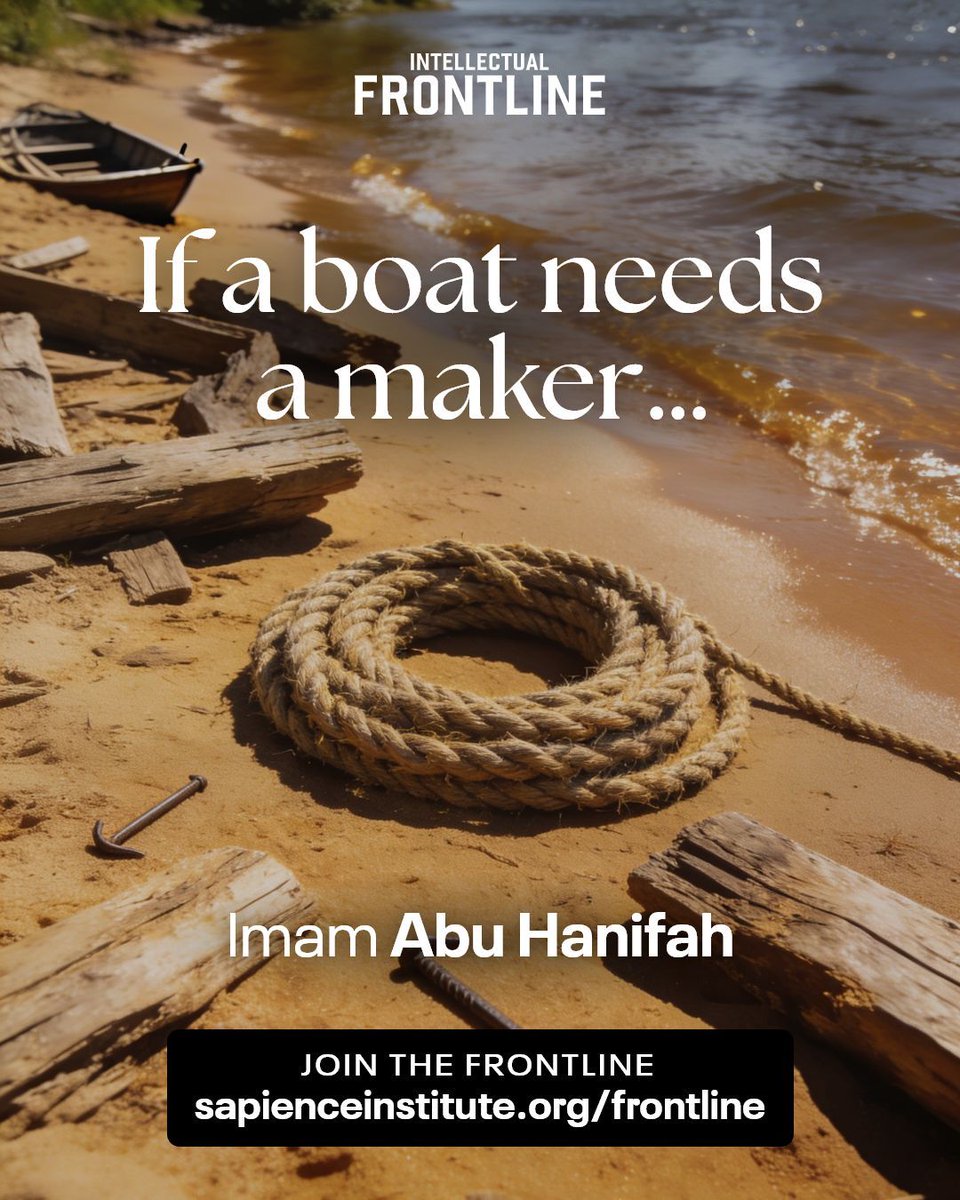
Imam Abu Hanifah once debated a group who denied the existence of a Creator.
When he arrived late to the debate, he explained that he had been waiting for pieces of wood and nails to magically assemble themselves into a boat so he could cross the river.
The skeptics laughed.
“That’s impossible,” they said.
Abu Hanifah replied: if you reject a boat forming by chance, then how can you believe this universe came into existence without a Creator?
With one simple argument, he exposed the contradiction in atheistic thinking.
This reflected the powerful Qur’anic challenge:
“Or were they created by nothing, or are they themselves the creators? Or did they create the heavens and the earth? Rather, they are not certain.”
(Surah At-Tur 52:35–36)
For over a thousand years, Islam has not only been believed, but intellectually defended and articulated with clarity and confidence.
At Sapience Institute, we are striving to continue this legacy in an age of growing doubt and confusion.
In these blessed days of Dhul Hijjah, we are looking for 400 people to join the intellectual frontline by giving just £50 as a one-off donation.
Help us continue producing content, training Muslims, and strengthening conviction for the next generation.
Join the frontline today: https://t.co/txnyTwvWxg
Shah Waliullah Dehlawi lived during a time of decline and fragmentation in the Muslim world.
Political instability, weakening scholarship, and division had left many Muslims disconnected from the depth and guidance of Islam.
In response, Shah Waliullah dedicated his life to reviving the intellectual and spiritual foundations of the Ummah.
He called Muslims back to the Qur’an and Sunnah, emphasising understanding, reflection, sincerity, and renewal.
He believed Islam was not merely inherited rituals, but a complete way of life capable of guiding societies, reforming hearts, and reviving civilizations.
As Allah says in the Qur’an:
“Indeed, this Qur’an guides to that which is most upright.”
(Surah Al-Isra 17:9)
Shah Waliullah worked to reconnect Muslims with that guidance during one of the most difficult periods in Islamic history.
Today, Muslims once again face confusion, division, and intellectual uncertainty.
At Sapience Institute, we aspire to continue this work of revival by helping Muslims reconnect with Islam through clarity, knowledge, and conviction.
In these blessed days of Dhul Hijjah, we are looking for 400 people to join the intellectual frontline by giving just £50 as a one-off donation.
Your support helps us continue building courses, producing content, training Muslims, and strengthening the intellectual future of the Ummah.
Stand with us and be part of this revival: https://t.co/txnyTwvWxg
In a world surrounded by falsehood, Prophet Ibrahim (peace be upon him) stood firm with clarity, courage, and reason.
When his people worshipped idols, Ibrahim shattered them and challenged his people to reflect.
The Qur’an tells us that he looked to the stars, the moon, and the sun, rejecting each one as a lord until he turned completely to the Creator of the heavens and the earth.
Even when debating a tyrannical king, Ibrahim dismantled arrogance through reason and truth.
His story reminds us that Islam has always stood upon intellectual clarity.
Today, Muslims need this same confidence, clarity, and intellectual grounding more than ever before.
In an age of growing doubt, confusion, and ideological pressure, Sapience Institute is committed to intellectually defending and presenting Islam with clarity, confidence, and depth.
In these blessed days of Dhul Hijjah, we are looking for 400 people to join the intellectual frontline by giving just £50 as a one-off donation.
Help us continue this work.
Stand with Sapience Institute and support the future of Islamic intellectual dawah.
Donate Now: https://t.co/txnyTwvWxg
Look at the universe. Its order. Its precision. Its beauty. Its signs.
The Qur’an repeatedly calls us to reflect on creation, not as a random accident, but as a profound sign pointing to the wisdom, power and knowledge of the Creator.
Join us for the second session of the Intellectual Frontline live series as we explore the argument from design and how the created order points beyond itself to Allah.
📅 21 May / 4 Dhul Hijjah
⏰ 7pm UK time
🎥 Watch live: https://t.co/s2PpfpUG0J
🔴 Featuring Live Q&A
Join the Frontline:
https://t.co/txnyTwvWxg
The battle for hearts and minds begins with the greatest truth: Allah exists.
In an age where doubt spreads quickly and secular ideas shape how people think about life, purpose and reality, Muslims need clarity rooted in revelation and reason.
Join us for the first session of the Intellectual Frontline live series as we explore powerful Qur’anic arguments for God’s existence and why the Qur’an speaks so deeply to the human fitrah.
📅 19 May / 2 Dhul Hijjah
⏰ 7pm UK time
🎥 Watch live: https://t.co/WVS5DV0qL7
🔴 Featuring Live Q&A
Join the Frontline:
https://t.co/txnyTwvWxg
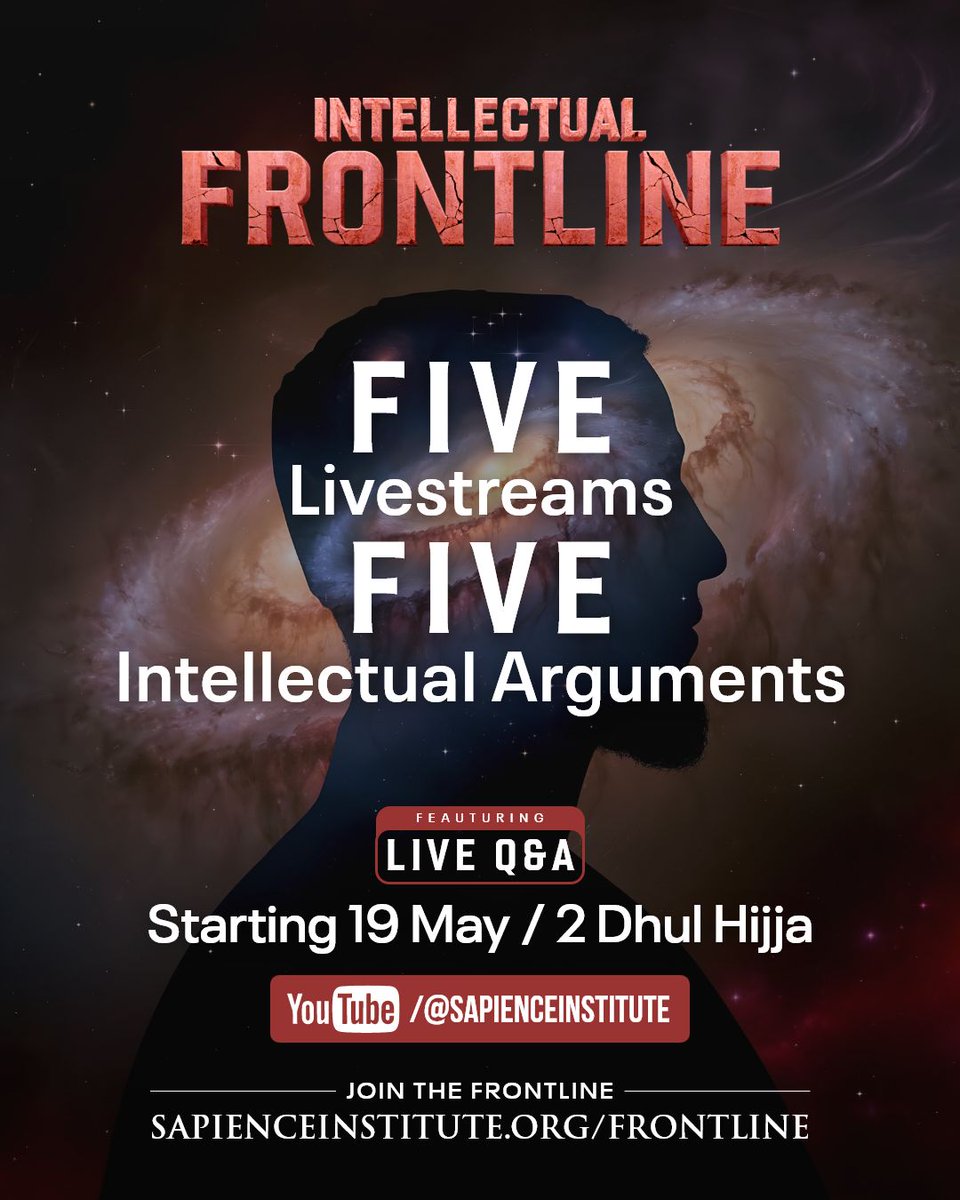
Five livestreams. Five intellectual arguments.
Join us live and ask your questions to explore some of the most powerful foundations for the truth of Islam, from the existence of God and Tawheed to prophethood and the divine authorship of the Qur’an.
📅 Starting 19 May / 2 Dhul Hijjah | 7PM Uk time
🎥 YouTube: https://t.co/yhbJv7i7H2
🔴 Featuring Live Q&A
Join the Frontline:
https://t.co/AfJ5RB0piF
🎓 New Video | PHD Series Ep. 4
In this episode, Mohammed Hijab continues the journey through his PhD thesis by exploring one of the great minds of Islamic intellectual history: Fakhr al-Dīn al-Rāzī.
What is the universe made of?
Can the universe be necessary?
How do matter, form, causation, and contingency help us argue for God’s existence?
And how does the Qur’anic argument for tawḥīd dismantle polytheism and Trinitarian theology?
Watch now: https://t.co/mzx9wKa5In