Joshua 10:13 KJV
1405 BCE
‘And the sun stood still, and the moon stayed, until the people had avenged themselves upon their enemies. Is not this written in the book of Jasher? So the sun stood still in the midst of heaven, and hasted not to go down about a whole day’.
Earth has regular cycles of change.
This occurs like clockwork every 12,000 years.
We are overdue!
‘The Event’ will slip the physical Poles 90 degrees as proven by Chan Thomas’ Adam & Eve Story.
#MicroNova#YoungerDryas
🎥
The Earth Disaster Documentary
https://t.co/iLR2gDTpCI
The Holographic Universe is a living cosmic code, a conscious projection of the Monad via Nada Bindu; an infinite dance of Energy, Frequency, and Vibration, where Mathematics becomes the language of creation and Sacred Geometry reveals the hidden blueprint of the cosmos!
@shellenberger@theblackvault Start by asking about the Lockheed Martin🦨 highly classified, nuclear powered, electrogravitic, superluminal #TR3B aka Manta, flying triangle, etc.
I understand international nuke treaties would need amending; make this beauty PUBLIC, as you did the SR71!
THE TIME IS NOW!
Hidden Beneath the Ice: New Discovery Reveals Rotational Forces That Shaped Antarctica
Deep under the vast East Antarctic Ice Sheet, ice that in places exceeds three kilometers in thickness, lies a colossal geological secret.
An international team of researchers has identified a semi-continental-scale, fan-shaped province of subglacial basins radiating outward from a focal point near the South Pole.
Named the East Antarctic Fan-Shaped Basin Province (EAFBP), this structure offers profound new insights into the tectonic forces that sculpted Antarctica and influenced the final breakup of the ancient supercontinent Gondwana.
The findings, published in Nature Geoscience on June 3, 2026, by lead author Egidio Armadillo and colleagues, integrate high-resolution sub-ice topography from radio-echo sounding data with geophysical observations (gravity, magnetic, and seismic).
This reveals a unified physiographic unit spanning from Prydz Bay (around 70 degrees E) to the Transantarctic Mountains (around 160 degrees E), extending inland to about 85 degrees S.
The Fan’s Geometry: V-Shaped Basins and Circular Shears
At the heart of the discovery are dozens of low-elevation, predominantly V-shaped basins (around 30 identified in detail) aligned radially north-south. These form a “handheld fan” pattern converging near 86.4 degrees S, 129.9 degrees E. A central axis of symmetry, the Belgica Bisector along around 130 degrees E, divides the province into western (sinistral) and eastern (dextral) sectors.
Two massive first-order basins dominate: the Wilkes and Aurora basins, each stretching over 1,500 km southward from the coast. Transverse east-west faults along two circular “transantarctic strike-slip shear belts” (southern and northern TSCBs) dissect these, creating apparent offsets and vertical displacements.
The northern boundary of the province itself traces a striking semi-circular arc along the coastline and continent-ocean margin.
These features were quantified by fitting basin edges to great circles and small circles on the globe, pointing to a common rotational origin centered near the South Pole. The structure divides into three annular sectors (southern, central, and northern transantarctic annuli), reflecting progressive phases of extension.
Formed by Distributed Rotational Extension.
This created the triangular basins as gaps opened between extending blocks.
This process had three major continental-scale consequences:
1Westward Compression and Gamburtsev Uplift: To the west, the extension compressed the crust, contributing to the enigmatic uplift of the Gamburtsev Mountains, an intraplate range with surprisingly youthful Alpine topography.
2Eastward Rotation of the Transantarctic Mountains: The northernmost segment of the Transantarctic Mountains was rotated clockwise by around 20 degrees, overriding hotter lithosphere in the West Antarctic Rift System. This segmented the mountains into three blocks with differential uplift and influenced offshore structures in the Ross Sea.
3Control on Gondwana Breakup: The northern transcurrent edge of the fan created a lithospheric weakness that guided the propagation of separation between Antarctica and Australia, shaping the semi-circular passive margins observed today. Oceanic fracture zones and ridge segments in the Southern Ocean align with onshore features, reinforcing this link.
This discovery exemplifies the power of modern geophysical compilation and first-principles analysis, peering through kilometers of ice to reconstruct ancient plate motions using Euler poles, strike-slip kinematics, and margin geometries. It reframes isolated basins as part of one coherent tectonic story tied to the supercontinent cycle.
Paper https://t.co/IQsRimC321
I would be banned on TikTok (again) for showing this next to the Cuba earthquake.
This is ROTI (Rate Of change of Total Electron Content Index), which measures disturbances in Earth’s ionosphere.
Some researchers have investigated whether ionospheric anomalies can occur around major earthquakes, though the science is still debated and not considered a reliable prediction method.
Nuff said.💥🌎
Here is an animation depicting the seismic waves from today's historic M6.1 in America's Gulf sweeping out across the globe. Though almost an identical reverse thrust like the M7.8 that struck the Philippines a day before, this earthquake was ~355x weaker in total energy release
A significant far-side eruption produced extensive coronal dimming over the southern pole. Launched an impressive full halo and fast CME.
#spaceweather
He describes the Younger Dryas as the last gasp of the ice age, a period that defies simple explanations. After thousands of years of gradual warming, the planet plunged back into full glacial conditions in less than a year. That reversal lasted twelve to thirteen hundred years before the climate lurched out of it just as abruptly, if not faster. The speed and magnitude of these shifts challenge conventional thinking about how climate systems operate. He emphasizes that this wasn't a slow drift but a catastrophic snap, both entering and exiting the cold period. The evidence points to mechanisms far more dramatic than the gradual processes typically invoked in mainstream climate science.
He walks through a key passage describing the Altamont Moraine, a glacial feature that marks where ice once stood. The moraine traces a line deep into the interior of North America, extending into Canada east of Edmonton. What makes this significant is the latitude. This ice front reached roughly 10 degrees farther south than the maximum extent of ice in Europe during the same period. That's an enormous difference when you're talking about continental ice sheets. It raises immediate questions about what was driving glaciation differently across the two continents. Was it simply geography, ocean currents, atmospheric circulation? Or were there other forcing mechanisms at play that allowed ice to push so much deeper into the heart of North America? The evidence is in the ground, and it tells a story that doesn't quite match the European record.
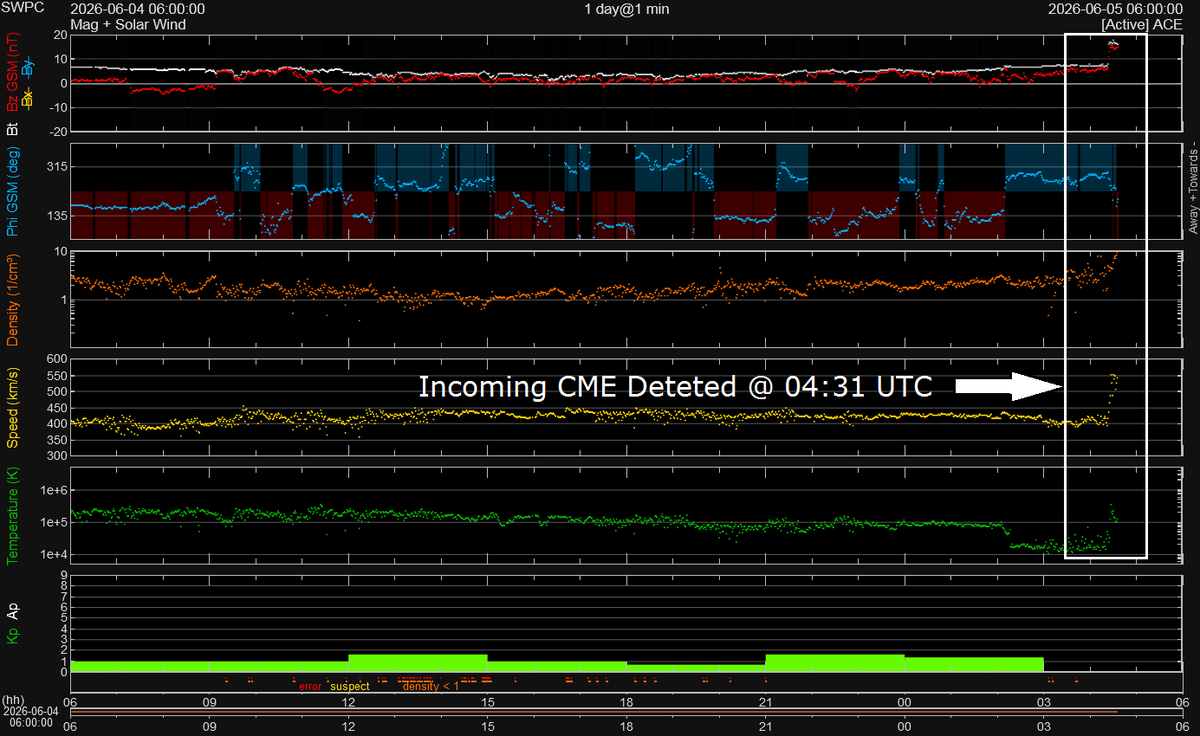
Incoming CME detected at 04:31 UTC (June 5). The solar wind speed increased from 400 km/s to currently just above 550 km/s. A passage past Earth is expected within the next hour. https://t.co/aqK4Q6XdAY
THIS COMET JUST ERUPTED 10,000 TIMES BRIGHTER THAN NORMAL
No one knows why this comet suddenly erupted.
A comet that was barely visible suddenly shocked astronomers after erupting in brightness by an estimated 10,000 times in less than 72 hours.
The comet, known as 220P/McNaught, is now racing toward the Sun at more than 50,000 mph and will make its closest approach in less than 10 days.
The outburst was unexpected.
And with the comet rapidly approaching the Sun, the possibility remains that more changes could still be ahead.
☄️ A mysterious outburst.
☀️ A close encounter with the Sun.
🌎 Another reminder that our solar system is anything but quiet.
👇
Have you ever seen a comet through a telescope?
#MrMBB333 #Comet #Astronomy #SpaceWeather
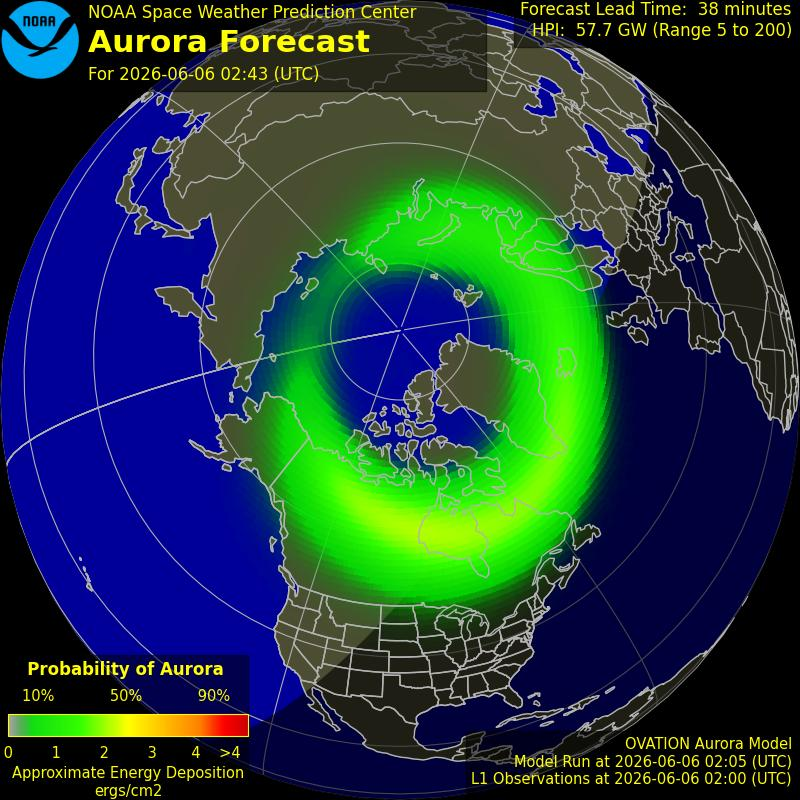
Current OVATION model shows a slightly inflated auroral oval. This is probably true--solar wind speeds are > 550 km/s. We are under the influence of a coronal hole, it seems. Bz is pointing south, and substorms may drive views of the northern lights over the horizon for the northern tier of the U.S.
Firing on all cylinders, we have seen a flurry of CME activity from the Sun in the past few days with at least three CMEs directed towards Earth now. HUXt has a few more in the mix, but all possible impacts overlap at roughly the same time--early UT June 5. This is interesting..