LLB (Hons) finds most things interesting! Proud to be a solicitor (non practicing ) In order to practice you need to be single or have a supportive network..
@KTHopkins@andyburnham@WhiteHouse Wouldn't know how to get through my normal day, without having your hilarious content!
Thank you Katie 😊
(also you were superb at the Circus Tavern)..
Please tour again.
@KTHopkins Katie, my face has only just stopped aching from laughter.
Thanks for coming to Purfleet Circus Tavern. You told me it would be fun (and I've met some new friends too)! Xx
@KTHopkins Remember I told you I booked straight in to the Circus Tavern (originally to bring my hubbie) change of heart from me, I'm bringing a girlie friend who also loves you (can't be arsed trying to convert hubbie!)
So that's me all set up for a good night out!
(His loss)! Xx
The ECHR protects
• the right to a fair trial
• freedom of assembly & expression
• the right to participate in free elections
• freedom of religion
• freedom from discrimination
• the right to privacy
• freedom from torture & degrading treatment
I think viewers should be told that. If you do too RT this widely
One of the late stages of political madness is delusion. You’re not lying. You believe what you’re saying. You’ve persuaded yourself everyone else is wrong. But your beliefs don’t factor in reality.
Trials by jury didn’t become common until the 13th century. Without a formal way of determining someone’s guilt or innocence, the accused were subject to trial by ordeal.
There were three types of ordeals — ordeal by fire, ordeal by water, and ordeal by combat. The goal of these ordeals was to subject the accused to extreme circumstances, and if able to survive, they were seen as innocent in the eyes of God.
Ordeal by fire required the accused to carry a red hot iron 9 feet and then have their hands bandaged. After three days, they were required to show up in court and show their hands.
If the wounds had started to heal, they were considered innocent. If their condition hadn’t improved, they would be found guilty.
There were two different types of ordeal by water. If they were subjected to a cold water ordeal, their hands and feet were tied and thrown into the water. If they began to float, they were considered innocent. But if they sank, they were guilty.
For hot water ordeals, those accused had to retrieve a stone from the bottom of a kettle of boiling water. Similarly to ordeal by fire, if their hands had begun to heal after three days, they were found innocent.
Lastly, ordeal by combat was used to help two parties solve a dispute. This was mostly used when there were no witnesses or confessions to a crime. Two individuals would fight in combat, and the winner would be declared innocent.
While brutal, these ordeals were used to justify God’s will in the criminal justice system. If the accused could survive or be found innocent after their ordeals, it was believed they had been given power from God.
For those who keep asking me why I’m never invited onto @bbcquestiontime just watch todays #PMQs round up
If UK news shows won’t call this absolute boll**** out I will
@DickonFarmar@SkysEdgeMusical I'm going tonight, saw the rave reviews last year so booked up as soon as they announced they were coming to the West End ..looking forward to it.
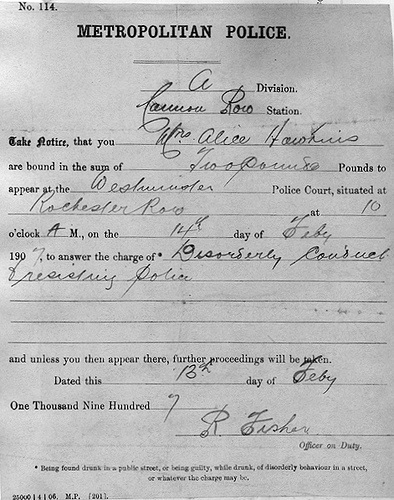
Woman of the Day shoe machinist, trade unionist and suffragette Alice Hawkins (1863-1946) of Stafford, who was arrested OTD in 1907 with 28 other women marching from Hyde Park to the House of Commons to demand votes for women when twenty police on horses mounted a brutal charge into them. Being imprisoned for “disorderly conduct and resisting the police” (how, exactly, could any woman offer any meaningful resistance to a show of force of that nature?) radicalised Alice.
Born into a working class family, Alice left school at 13 to go into the boot and shoe manufacturing industry. Very early on, she realised that women’s pay and working conditions were vastly inferior to those of their male co-workers and she became active in trade unions to try and change this.
In 1896, by now a mother of six, Alice joined a new Women's Co-operative Guild at the factory where she worked. The factory had a library, allowed time for its workers to learn about socialism and actively encouraged them to participate in political organisations. However the main focus was on conditions for men as the breadwinners of the family. She became disillusioned.
Attending her first meeting of the Women’s Social and Political Union in Hyde Park 114 years ago today, followed by that march, was a game changer for Alice. The police charge was vicious. Her lawyer wrote to the local MP that 'in no other civilised country would women be dealt with in this manner'.
Fourteen days in Holloway did nothing to deter her. Quite the opposite. When the 29 women were released, the London Excelsior Band was hired to play stirring tunes that the 29 could hear from their cells and at 9am as they walked out of the prison gate one by one, they were greeted by loud cheers from over 200 of their suffragette sisters standing outside. All of the women marched into central London for a ‘reformed breakfast’ attended by supporters of the cause, including George Bernard Shaw.
Alice returned to Leicester. With the help of Mary Gawthorpe of Leeds and Sylvia Pankhurst, she set up the Leicester branch of the WPSU and signed up the first thirty members for a tireless campaign of speaking at factory gates, markets and village greens in Leicestershire and Northamptonshire, urging women of all classes to support women’s suffrage. Sylvia Pankhurst addressed many of those meetings: “At night, I held meetings for the local WSPU, amongst whom only Mrs Hawkins, as yet, dared mount the platform.”
In June 1908, Alice was a keynote speaker before a mass rally in Hyde Park known as Women’s Sunday and attended by over 250,000 supporters. The event was advertised by a Thames barge moored outside the Houses of Parliament, carrying a banner saying “Cabinet Ministers Specially Invited” (I loved this detail), and the Pankhursts sent a chauffeur-driven car to collect her.
Alice was supported by her husband, Alfred, also arrested a number of times for heckling Winston Churchill whenever his wife was prevented from doing so herself. In 1910, he challenged Churchill during a speech to the Young Liberals in Bradford and was dragged out of the room by stewards who threw him down the stone steps breaking his leg. He spent weeks recuperating at Bradford Hospital but with his friend Victor Duval, founded the Men’s Political Union for Women’s Enfranchisement (MPU), which was so well-organised that they had printed membership cards.
Giving a speech one Sunday evening in Leicester Market, Alice was heckled by a man who shouted “Get back to your family.” Alice retorted: “But here is my family, they are here to support me.” Alfred and their children, all teenagers, were there, standing by her side. Soon after, the suffragettes were asked to cease such open-air meetings in Leicester because of crowd violence. Alice refused and future meetings were given a strong police presence.
In all, Alice was imprisoned five times for crimes ranging from window smashing in 1912 to “obstructing police and damaging police whistles”.
In January 1913, during a Deputation of Working Women meeting she attended with Lloyd George, then chancellor, Alice said, “Women have been trying to get the vote to alter their status in life. I have two sons who have been working for the country, one in the Army and one in the Navy. Those sons, under this new Bill – The Manhood Suffrage Bill – would have votes. I, the mother who brought them into the world, have nothing.”
Alice was too impoverished to vote in 1918 because of the property-owning conditions of the Representation of the People Act 1918. She had to wait until 1928.
Her advice to her granddaughter Vera:
“Vera, you must use your vote, we suffered for it".
Thousands of residents in Thurrock are demanding a public inquiry into the financial collapse of the council, with the issue due to be voted on by councillors at a meeting tonight.
A thread on the fight back against years of secrecy and incompetence